
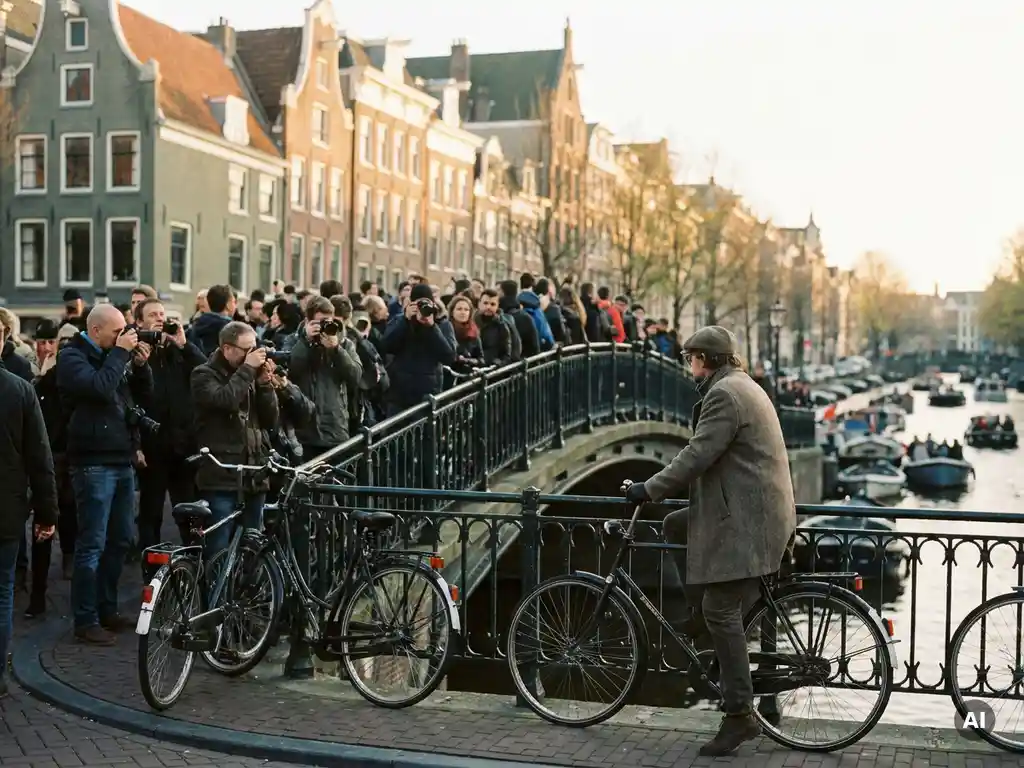
Amsterdam is unlikely to cap tourist numbers in any absolute sense, at least not soon. The city has no legal mechanism to simply close its doors, and European free movement rules make hard limits on visitor numbers almost impossible to enforce. What Amsterdam can do is make mass tourism less profitable, less convenient, and less concentrated in the places that can no longer absorb it.
The tension between welcoming visitors and protecting what makes the city worth visiting is one of Amsterdam’s defining contradictions. Below, we unpack the key questions around overtourism in Amsterdam and what, if anything, the city can realistically do about it.
Has Amsterdam ever tried to limit tourist numbers?
Yes, Amsterdam has made repeated attempts to reduce tourist pressure, though none have amounted to a hard cap on visitor numbers. The city has banned new hotels in the historic centre, restricted short-stay rental platforms like Airbnb, and relocated the cruise terminal further from the old city. These are meaningful steps, but they are more about redirecting tourism than reducing it.
The most visible policy shift has been the city’s decision to stop actively marketing itself as a tourist destination. Amsterdam’s tourism board, ATCB, rebranded its approach around the idea of “donut tourism”, attracting visitors who contribute more and consume less. The city also introduced a higher tourist tax, now among the highest in Europe, partly as a financial deterrent and partly to fund the infrastructure that mass tourism strains.
What has not happened is a formal ceiling on the number of people allowed to visit. That kind of cap would require legal frameworks that simply do not exist at the municipal level in the Netherlands, and possibly not at the national level either.
Why is capping tourists so hard to enforce in Amsterdam?
Capping tourist numbers in Amsterdam is hard to enforce because the city is a public space in a country with open borders and no entry registration system for domestic or EU travellers. You cannot station a bouncer at Amsterdam Centraal and turn people away. Unlike a national park or a ticketed attraction, the city itself has no gate.
European free movement rules add another layer of complexity. Any EU citizen has the right to travel freely within the Schengen Area, which means Amsterdam cannot legally discriminate between a Dutch day-tripper and a visitor from Berlin or Barcelona. A quota system that applied only to non-EU visitors would be both politically toxic and practically ineffective.
There is also the economic argument that complicates political will. Tourism generates billions in revenue for Amsterdam’s hospitality, retail, and cultural sectors. The businesses that benefit from high visitor volumes are well organised and politically active. Reducing those numbers, even if desirable for residents, means real economic consequences that elected officials are cautious about owning.
What tools does Amsterdam actually have to reduce tourist pressure?
Amsterdam has several practical tools to reduce overtourism pressure, even without a hard cap. These fall broadly into three categories: financial disincentives, spatial management, and product steering.
- Tourist tax increases: Amsterdam has raised its tourist tax significantly, making the city a more expensive destination and generating funds to manage the impact of tourism.
- Short-stay rental restrictions: The city has tightened rules on platforms like Airbnb, limiting the number of nights a property can be rented and banning short-stay rentals in certain neighbourhoods entirely.
- Hotel moratoriums: New hotel construction in the historic centre has been effectively blocked, preventing the accommodation supply from growing further in the most pressured areas.
- Cruise ship limits: The number of large cruise ships permitted to dock in the city centre has been reduced, with the long-term plan to relocate the terminal away from the historic core entirely.
- Spreading demand geographically: Campaigns encourage visitors to explore areas outside the canal ring, including neighbourhoods like Noord and Nieuw-West that see far less foot traffic.
- Seasonal and temporal spreading: Some cultural institutions have experimented with timed entry and off-peak pricing to smooth visitor flows across the day and year.
None of these tools reduces the total number of tourists visiting Amsterdam in a dramatic way. But together, they can shift the type of visitor the city attracts and reduce the concentration of pressure in the most fragile parts of the city.
Will Amsterdam cap tourists, or just make them less welcome?
Amsterdam will almost certainly not cap tourists in any formal sense. What it will do is continue making certain kinds of tourism less attractive, less comfortable, and more expensive, which amounts to a soft cap by other means. The city’s strategy is not to close the door but to change who walks through it and what they find when they arrive.
The ban on new cannabis cafes for tourists, the crackdown on bachelor parties in the red light district, and the broader push to reframe Amsterdam as a cultural and creative destination rather than a party city are all part of this approach. The goal is to price out and inconvenience the visitors who cause the most harm while remaining open to those who engage with the city more thoughtfully.
Whether this works depends on factors Amsterdam cannot fully control: global travel patterns, airline routes, the strength of the euro, and the choices of millions of individuals. The city can nudge, it can tax, it can restrict, but it cannot simply decide how many people want to come. That is the fundamental limit of any overtourism strategy that stops short of a hard cap, and it is why the debate in Amsterdam will continue long after any individual policy is introduced.
How Klagen Niet Klagen covers Amsterdam’s tourism debate
If you have made it this far, you already know this is not a simple topic with a clean answer. Amsterdam’s struggle with overtourism is exactly the kind of subject that Klagen Niet Klagen was built for: a real city problem, full of contradictions, that deserves more than a press release or a tourism board talking point.
- Honest, opinionated commentary on Amsterdam city life, written from inside the city, not from a press trip
- Long-form essays that go beyond the headline and actually examine what is happening and why
- A perspective shaped by over three decades of living, working, and building something in Amsterdam
- Coverage that names the tensions other platforms avoid, because there is no advertiser to upset
If you want more of this, the blog archive is the place to start. And if you have a question, a disagreement, or just want to add something to the conversation, the contact page is always open.
One more thing. If you want to experience Amsterdam’s contradictions in a completely different format, live, on stage, with a lot of laughter, Boom Chicago has been doing exactly that since 1993. It is improvisational comedy rooted in the city, performed by people who actually live here. Check the shows and agenda and come see what Amsterdam looks like when it stops being polite and starts being honest.
Frequently Asked Questions
Could Amsterdam follow Venice's model and charge an entry fee to visit the city?
Venice’s day-tripper fee is often cited as a potential model for Amsterdam, but the comparison has significant limits. Venice’s fee applies to a lagoon island with clearly defined entry points, making it physically enforceable in a way that Amsterdam, as an open urban grid connected to the national rail and road network, simply is not. Amsterdam could theoretically introduce a city-access levy for certain zones or attractions, but a blanket entry fee for the entire city would face the same legal and logistical barriers as a hard tourist cap.
What is 'donut tourism' and is it actually working in Amsterdam?
Donut tourism is the strategy promoted by Amsterdam’s tourism board (ATCB) to attract visitors who stay longer, spend more thoughtfully, and engage with the city beyond its most crowded centre — essentially filling the ‘hole’ of undervisited neighbourhoods and off-peak periods. In practice, results are mixed: neighbourhoods like Noord have seen increased visitor interest, but the canal ring and red light district remain overwhelmingly congested during peak season. The strategy is more of a long-term repositioning effort than a quick fix, and its success depends heavily on whether visitor behaviour actually shifts or whether the marketing simply adds a new layer of tourists on top of existing ones.
What are the most common mistakes tourists make that contribute to overtourism pressure in Amsterdam?
The biggest contributors to overtourism pressure are clustering in the same small area — the Jordaan, the Anne Frank House queue, the Rijksmuseum square — at the same times, typically weekend afternoons in summer. Booking through platforms that funnel accommodation back into the historic centre rather than spreading stays across the city also concentrates impact unnecessarily. Visitors who plan even slightly off-peak, choose accommodation in neighbourhoods like De Pijp, Oud-West, or Noord, and avoid the red light district on Friday and Saturday nights will have a meaningfully better experience while placing far less strain on the parts of the city that are already at breaking point.