
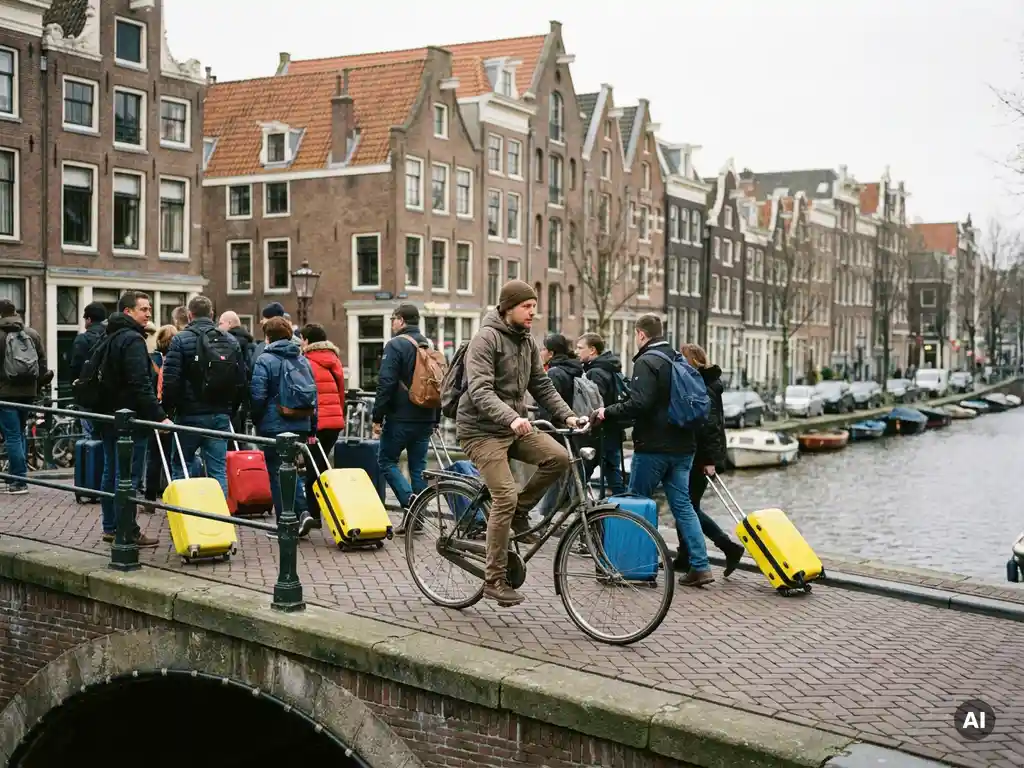
The tension between tourists and residents in Amsterdam comes down to one fundamental imbalance: the city’s infrastructure, housing, and public spaces were built for roughly 900,000 people, but they now absorb tens of millions of visitor arrivals every year. Residents bear the daily costs of that imbalance – the noise, the crowds, the rising rents – while the economic benefits flow elsewhere. The questions below unpack exactly how that tension developed, why it runs so deep, and whether anything can actually fix it.
How has Amsterdam’s tourism growth changed daily life for residents?
Amsterdam’s tourism growth has fundamentally altered everyday life for residents by driving up housing costs, crowding public spaces, and reshaping entire neighbourhoods around visitor needs rather than local ones. Streets that were once functional, lived-in parts of the city have been converted into tourist corridors, where souvenir shops and short-stay rentals have replaced the butchers, pharmacies, and community spaces that residents actually rely on.
The housing market tells the clearest story. Short-term rental platforms turned thousands of Amsterdam apartments into de facto hotel rooms, removing them from the long-term housing stock at a moment when the city was already facing a severe shortage. Residents found themselves priced out of their own neighbourhoods, competing for a shrinking pool of available homes against the financial logic of tourist accommodation.
Beyond housing, the sheer volume of foot traffic has changed the texture of daily life. Cycling through the centre, buying groceries, or simply walking to work now means navigating crowds that treat the city as a backdrop rather than a home. For residents, Amsterdam stopped feeling like theirs – and that loss is not abstract. It is felt every single day.
Why do Amsterdam residents feel so strongly about tourist behaviour?
Amsterdam residents feel strongly about tourist behaviour because the worst of it is not just inconsiderate – it is concentrated in the same streets, canals, and squares where people are trying to live normal lives. Noise late at night, public drinking, littering, and the general treatment of the city as a consequence-free playground are not occasional irritations. For many residents, they are a constant background condition.
There is also a deeper frustration at work. Amsterdam has a specific identity – a city built on tolerance, civic culture, and a certain quiet pride in doing things properly. The version of Amsterdam that attracts the loudest and least considerate visitors is often a caricature of that identity: the red-light district, the coffee shops, the canal boat parties. Residents watch their city’s reputation get flattened into a party destination and feel powerless to correct the narrative.
It is worth being honest here: not all tourists behave badly, and most residents understand that. The frustration is not really about individuals – it is about scale. When millions of people pass through a city of under a million residents, even a small percentage of disruptive behaviour adds up to something that genuinely degrades quality of life.
What has the Amsterdam city council done to reduce tourism tension?
The Amsterdam city council has introduced a range of measures designed to reduce the tension between tourists and residents, including stricter short-term rental rules, a ban on new tourist shops in certain areas, limits on cruise ship arrivals, and a significant increase in the tourist tax. The city has also run campaigns explicitly telling certain types of visitors – particularly those coming for stag parties or drug tourism – that they are not welcome.
The short-term rental restrictions have been among the most consequential. The city capped the number of nights a property can be rented to tourists per year and tightened enforcement considerably. This returned some apartments to the long-term housing market, though the effect has been modest relative to the scale of the problem.
The tourist tax increase was another significant lever. Amsterdam now charges one of the highest tourist taxes in Europe, with the explicit goal of both generating revenue and making the city slightly less attractive to budget visitors who contribute little and cause disproportionate disruption. Whether pricing out lower-budget tourists is the right approach is a genuine ethical debate – but the direction of policy is clear.
What the city has not done is fundamentally restructure the economic incentives that make mass tourism so profitable for some and so costly for others. That would require a more radical political conversation than Amsterdam has been willing to have.
Will the tension between tourists and Amsterdam residents ever be resolved?
The tension between tourists and Amsterdam residents is unlikely to be fully resolved, but it can be meaningfully managed. The honest answer is that Amsterdam is one of the most visited cities in the world relative to its size, and that fundamental fact creates structural pressures that no policy can entirely eliminate. What cities can do is shift the balance – making tourism less extractive, more regulated, and more accountable to the people who actually live there.
Progress is possible, and Amsterdam has made some. The measures introduced over recent years have slowed the growth of short-term rentals, reduced some of the most disruptive visitor flows, and signalled that the city takes resident quality of life seriously. That matters, even if the results are incremental.
The deeper question is whether Amsterdam wants to remain a city where people build lives, or whether it gradually becomes a theme park that happens to have residents in it. That is not a dramatic exaggeration – it is a trajectory that several European cities have already followed further than Amsterdam has. The tension will ease when the city’s economic model stops treating tourism as an unconditional good and starts measuring it against what it actually costs the people who live there.
How Klagen Niet Klagen helps you make sense of Amsterdam
The tourist-resident tension is one of the defining stories of modern Amsterdam – and it is one that mainstream tourism content almost never tells honestly. Klagen Niet Klagen exists precisely to fill that gap: sharp, independent, English-language commentary on Amsterdam from someone who has lived and built here for over three decades.
- Honest takes on city life that go well beyond what any tourism board would publish
- Long-form essays and opinion pieces written from genuine insider experience
- Coverage of the contradictions, frustrations, and pleasures of Amsterdam that residents actually recognise
- A consistent editorial voice – not anonymous, not advertorial, not afraid to say the uncomfortable thing
If you want Amsterdam commentary that treats you as an intelligent adult, find out more about the blog and what drives it – or get in touch directly via the contact page.
And if you want to experience Amsterdam’s creative side in person, Boom Chicago has been doing exactly that since 1993 – sharp, funny, and rooted in the city in a way that no tourist trap can replicate. It is the kind of evening that reminds you why Amsterdam is worth caring about in the first place.
Frequently Asked Questions
Is it still worth visiting Amsterdam as a tourist, given the tension with residents?
Yes — but the kind of visit matters enormously. Tourists who engage with Amsterdam as a living city rather than a party destination are part of the solution, not the problem. That means staying in hotels rather than short-term rentals, spending money in locally-owned businesses, visiting neighbourhoods beyond the historic centre, and treating public spaces with the same consideration you would expect at home. The tension is not between Amsterdam and tourists broadly — it is between the city and a specific extractive model of mass tourism.
What are the most common mistakes tourists make that frustrate Amsterdam residents?
The most friction-generating behaviours tend to cluster around a few specific patterns: late-night noise in residential streets, treating canals and public spaces as party venues, renting canal houses or apartments on short-term platforms rather than hotels, and navigating the city in large slow-moving groups that block cycle lanes and pavements. None of these require dramatic effort to avoid — they mostly come down to being aware that you are moving through someone else’s everyday environment, not a set designed for your entertainment.
How can I find out which Amsterdam neighbourhoods are least affected by overtourism?
The most tourist-saturated areas are concentrated in and around the historic centre — the Jordaan, the Red Light District, the canal belt, and Leidseplein. Neighbourhoods like De Pijp, Oud-West, Noord, and Oost have far more of a genuine local character, better everyday amenities, and a visitor-to-resident ratio that does not make you feel like you are attending an event rather than visiting a city. Spending time — and money — in these areas is one of the most practical ways to distribute the economic benefits of tourism more fairly.