
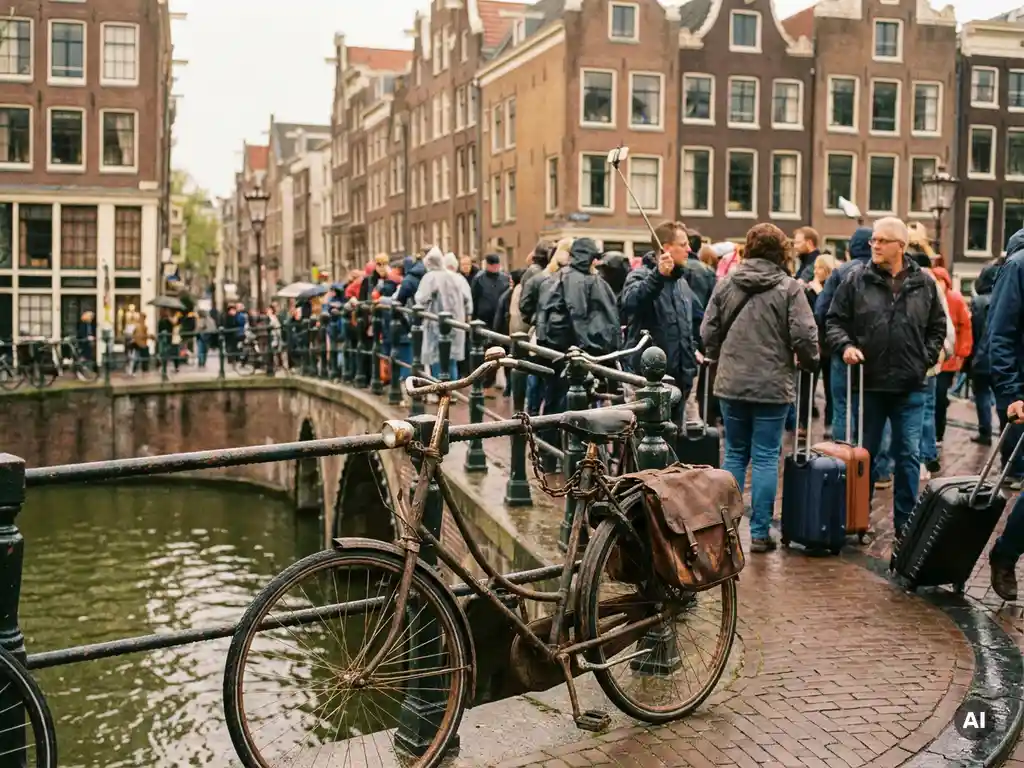
Housing pressure and tourism are deeply intertwined in Amsterdam. Short-term rentals remove homes from the long-term housing market, landlords chase tourist income over resident tenants, and entire neighbourhoods shift their character as locals get priced out. The result is a city where the balance between tourism and living has become one of the most urgent debates of the decade. The questions below unpack exactly how this works, and what it means for Amsterdam’s future.
How do short-term rentals shrink Amsterdam’s housing stock?
Short-term rentals shrink Amsterdam’s housing stock by converting apartments that would otherwise house permanent residents into tourist accommodation. Every home listed full-time on a platform like Airbnb is one fewer home available to someone who actually wants to live in the city. In a market already suffering from severe undersupply, even a modest number of conversions has an outsized effect on availability and price.
The mechanism is straightforward. A landlord who rents to a tourist can charge significantly more per night than a long-term tenant would pay per month. In a city where housing demand already far exceeds supply, this financial incentive is powerful enough to pull apartments out of the residential market entirely. Amsterdam has introduced strict limits on short-term rental days per year precisely because the city recognized how quickly this dynamic can hollow out a neighbourhood’s residential population.
What makes the problem particularly stubborn is that the lost homes tend to be in the most desirable and central areas, exactly where young professionals, families, and long-term expats most want to live. The housing stock that disappears into the tourist economy is not evenly distributed across the city; it concentrates in the places where living is already hardest.
Why are Amsterdam rents so high compared to other Dutch cities?
Amsterdam rents are significantly higher than in other Dutch cities because of a combination of chronic housing undersupply, strong international demand, and the tourism economy competing directly with residential use. The city has one of the tightest housing markets in Europe, and the pressure from short-term rentals and investor purchases compounds a structural shortage that has been building for decades.
Rotterdam, Utrecht, and The Hague all face housing pressure, but Amsterdam occupies a different category. Its international reputation, its concentration of multinational employers, and its cultural magnetism attract a continuous stream of people who want to live there, far more than the city can currently accommodate. When you layer tourism economics on top of that baseline demand, rents climb in ways that other Dutch cities simply do not experience to the same degree.
There is also a psychological dimension. Amsterdam’s global brand makes it a target for property investment in a way that purely residential Dutch cities are not. Investors buy apartments not just to rent them out locally but to participate in what they see as a premium market. That investment pressure feeds directly into the rent levels that ordinary tenants face, and it sits uncomfortably alongside the city’s longstanding identity as a place built for people, not capital.
What happens to Amsterdam neighbourhoods when tourism takes over?
When tourism takes over an Amsterdam neighbourhood, the local infrastructure gradually realigns around visitors rather than residents. Shops that served daily life, the hardware store, the family butcher, the neighbourhood pharmacy, are replaced by souvenir sellers, overpriced restaurants, and short-stay accommodation. The neighbourhood stops functioning as a place to live and becomes a backdrop for other people’s holidays.
The De Wallen area is the most visible example, but the pressure has spread well beyond the historic centre. Neighbourhoods like the Jordaan and parts of the Oud-West have seen their residential character eroded over years of rising tourist footfall and the commercial activity that follows it. Long-term residents find that the amenities they relied on have disappeared, and the social fabric, the neighbours you know, the local institutions you trust, frays as turnover accelerates.
There is also a noise and safety dimension that rarely features in policy discussions but matters enormously to the people who actually live there. Tourism concentrated in residential streets means late nights, unfamiliar faces, and a general sense that the space no longer belongs to the people who call it home. That erosion of belonging is not just sentimental; it drives residents out, which in turn accelerates the very process they were hoping to resist.
Should Amsterdam prioritise housing or tourism revenue?
Amsterdam should prioritise housing. Tourism revenue is real and economically significant, but it is not a substitute for a functioning city, and a city that cannot house its own residents, workers, and creative community will eventually lose the very qualities that make it worth visiting. The balance between tourism and living is not a genuine trade-off between equals; housing is the foundation on which everything else depends.
This is not an argument against tourism. Amsterdam’s openness, its international character, and its cultural richness are genuine assets, and visitors contribute meaningfully to the city’s economy. The question is one of sequencing and priority. When housing and tourism compete for the same physical space, the same apartment, the same street, the same neighbourhood, the city has to decide which use it values more. Consistently choosing tourism revenue in those moments has cumulative consequences that are difficult to reverse.
The deeper issue is that Amsterdam’s identity has always rested on being a place where unconventional people could afford to build unconventional lives. The artists, the entrepreneurs, the thinkers and experimenters who gave the city its reputation did not arrive because Amsterdam was a great tourist destination. They arrived because Amsterdam was liveable, affordable, and genuinely open. Protecting that liveability is not nostalgia; it is the only strategy that keeps Amsterdam interesting in the long run.
How Klagen Niet Klagen helps you think through Amsterdam’s housing debate
The tension between tourism and housing is exactly the kind of Amsterdam contradiction that Klagen Niet Klagen was built to examine. This blog exists to cut through the PR-friendly framing and say what is actually happening in the city, honestly, with humour, and from the inside. Here is what you get when you follow along:
- Long-form essays on Amsterdam city life written by someone who has lived and built here for over three decades
- Independent commentary free from tourism board influence or advertorial pressure
- A clear editorial framework, Klagen and Niet Klagen, that names both the frustrations and the genuine reasons to love this city
- An English-language perspective that reflects the reality of actually living in Amsterdam, not just visiting it
- Honest takes on policy, culture, and urban change that mainstream Amsterdam media rarely provides in English
If you want commentary that treats you as someone who actually thinks about this city, find out more about the blog and explore the archive. Amsterdam deserves better than polished talking points, and so do you.
Speaking of things Amsterdam does brilliantly: if you have never been to Boom Chicago, the comedy theatre that has been shaking up this city since 1993, you are missing one of the genuinely great Amsterdam experiences. Improvisation, sharp political satire, and the kind of laughter that makes you think: it is the perfect antidote to a city that sometimes takes itself a little too seriously. Check the shows and agenda and come and see what all the fuss is about.
Frequently Asked Questions
What practical steps can Amsterdam residents take to push back against housing pressure from tourism?
Residents can engage directly with local politics by attending district council meetings, joining neighbourhood associations, and responding to public consultations on housing and tourism policy. Reporting illegal short-term rentals to the municipality is also genuinely effective — Amsterdam’s enforcement teams act on tip-offs, and removing unlicensed listings from platforms like Airbnb does return homes to the residential market. Collective action matters too: neighbourhood groups that document and publicise the local impact of over-tourism have historically influenced city policy far more than individual complaints.
Are Amsterdam's short-term rental restrictions actually working, or are landlords finding workarounds?
The restrictions have had a measurable effect — the cap on rental nights and the outright ban on short-term rentals in the most pressured areas have reduced listings and returned some homes to the long-term market. However, enforcement remains inconsistent, and workarounds do exist, including informal arrangements that bypass official platforms and properties registered under business structures to avoid residential rules. The honest answer is that regulation is necessary but not sufficient: without sustained enforcement and political will to close loopholes, determined landlords will continue to find ways around the rules.
If Amsterdam's housing crisis keeps worsening, which types of residents are most at risk of being pushed out first?
Young people, lower-income workers, and mid-career creatives are the most vulnerable, precisely the groups that have historically defined Amsterdam’s cultural character. Social housing waitlists now stretch to over a decade in many cases, and the private rental market has effectively priced out anyone without a high or dual income. Expats on fixed-term contracts and international students are also increasingly squeezed, as landlords favour short-term tourist income over the administrative complexity of tenant contracts with legal protections.