
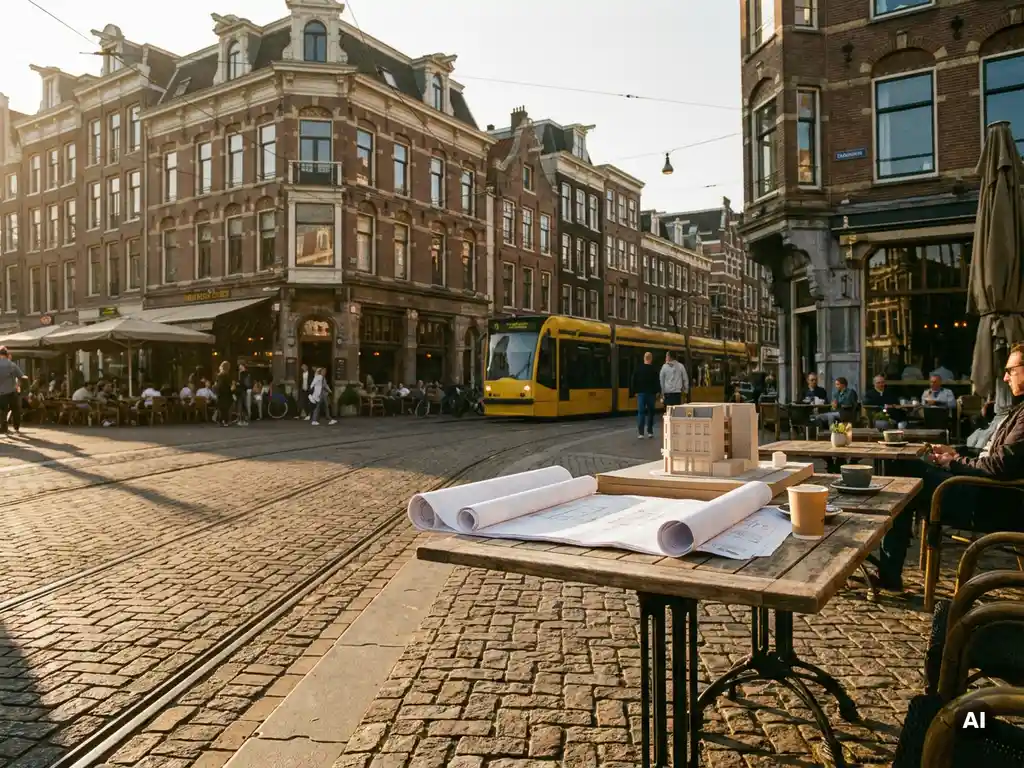
Amsterdam’s Leidseplein square is set for a significant redesign, with plans focused on reducing car and scooter traffic, expanding pedestrian space, improving cycling infrastructure, and creating a more liveable public square. The redevelopment is part of the city’s broader push to reclaim urban space from motor vehicles and invest in sustainable, people-first public areas. Below, we unpack the key questions surrounding the Leidseplein Amsterdam changes.
What changes are actually proposed for Leidseplein?
The proposed changes for Leidseplein centre on transforming it from a chaotic traffic junction into a calmer, greener, more pedestrian-friendly square. The plans include removing through-traffic, expanding pavement and terrace space, improving tram connections, and adding greenery to soften the hard urban environment that currently dominates the area.
The current Leidseplein is a genuinely strange place when you think about it. One of Amsterdam’s most famous entertainment squares, packed with theatres, bars, and restaurants, yet a significant portion of it is dedicated to moving and parking vehicles. The redevelopment aims to fix that imbalance by prioritising the people who actually want to be there rather than those passing through.
Key elements of the proposed redesign include:
- Restricting or eliminating motor vehicle access through the square
- Widening pedestrian zones and outdoor terrace areas for cafes and restaurants
- Improving tram stop layout and passenger flow
- Introducing more greenery, seating, and public space features
- Better cycling routes through and around the square
The result, if the plans are executed well, should be a square that finally matches the energy and importance it already has in Amsterdam’s cultural life.
Why is Amsterdam redeveloping Leidseplein now?
Amsterdam is redeveloping Leidseplein now because the square’s current layout is outdated, unsafe, and increasingly at odds with the city’s long-term ambitions around mobility, liveability, and public space. Leidseplein has long been a pinch point where pedestrians, cyclists, trams, and cars compete for the same limited space, a situation that has become harder to justify as the city grows busier.
The broader context is Amsterdam’s sustained effort to reduce private car use across the city centre. Leidseplein sits at the edge of the canal ring and handles enormous foot traffic from residents, visitors, and nightlife crowds. Redesigning it fits neatly into the city’s wider strategy of converting traffic-heavy squares into genuinely usable public spaces, a pattern already seen with the partial pedestrianisation of other central areas.
There is also a practical maintenance argument. Infrastructure around the square, including tram tracks and underground utilities, is ageing and requires significant work regardless. Combining that necessary maintenance with a broader redesign makes both financial and logistical sense.
How will the Leidseplein redevelopment affect local businesses and nightlife?
The Leidseplein redevelopment is likely to have a mixed short-term impact on local businesses, with construction disruption affecting footfall during the works, but a potentially positive long-term effect as expanded terrace space and a more pleasant environment attract more visitors. The nightlife scene, which is central to Leidseplein’s identity, should ultimately benefit from a calmer, more pedestrian-friendly square.
During construction, businesses around the square will face the familiar Amsterdam challenge of operating through roadworks, noise, and reduced accessibility. This is never easy, particularly for venues that depend on spontaneous evening crowds. Theatres, including Boom Chicago, bars, and restaurants in the area will need to navigate that period carefully.
Longer term, the logic is sound. More outdoor terrace space means more capacity for cafes and restaurants. Fewer cars and scooters means a more pleasant atmosphere for people choosing where to spend an evening. And a square that genuinely invites people to linger rather than just pass through is good news for every business that depends on that lingering.
The risk, as always with Amsterdam redevelopment projects, is that the execution does not match the ambition. Poorly designed pedestrianisation can kill the energy of a square just as effectively as too much traffic.
When will Leidseplein redevelopment be completed?
A firm completion date for the Leidseplein redevelopment has not been publicly confirmed, and Amsterdam city projects of this scale typically unfold over several years from planning to delivery. As of 2026, the project is in early planning and consultation phases, meaning construction is unlikely to begin immediately and a finished square is likely still several years away.
This is, frankly, very Amsterdam. The city has a well-documented tendency to move slowly on major public space projects, with planning rounds, public consultations, political debates, and budget negotiations all adding time before a single paving stone is lifted. Anyone who has watched the multi-year saga of other Amsterdam square redesigns will recognise the pattern.
The most realistic expectation is that significant visible work on Leidseplein will begin sometime in the late 2020s, with completion potentially stretching into the early 2030s depending on scope, funding, and the inevitable complications that surface once construction actually starts. Keeping an eye on Amsterdam municipality communications is the best way to track concrete timelines as they are confirmed.
How Klagen Niet Klagen keeps you informed about Amsterdam change
Amsterdam is constantly evolving, and keeping up with what is actually happening, beyond the press releases and tourist-friendly spin, takes a certain kind of platform. That is exactly what Klagen Niet Klagen is built for. Written by Andrew Moskos, co-founder of Boom Chicago and someone with over three decades of lived Amsterdam experience, the blog offers honest, independent commentary on the city’s changes, contradictions, and ongoing reinventions.
- Honest takes on Amsterdam urban development without tourism-board polish
- Long-form essays that go beyond the headline and into the actual implications
- An insider perspective grounded in real experience of building something lasting in this city
- Commentary written for people who actually live here or genuinely want to understand it
If you want to stay across what Amsterdam is becoming, not just what it claims to be, explore the blog archive for more essays and opinion pieces. And if you have thoughts, questions, or a topic you think deserves the Klagen Niet Klagen treatment, get in touch.
And speaking of things worth experiencing in Amsterdam before, during, or after any Leidseplein construction chaos: Boom Chicago has been making people laugh in this city since 1993. Sharp, improvised, and genuinely funny comedy is a reliable antidote to whatever the municipality is currently digging up outside. Check the shows and agenda and come see what all the fuss is about.
Frequently Asked Questions
Will the Leidseplein redesign affect tram services during construction?
Tram disruption during the Leidseplein redevelopment is highly likely, given that improving the tram stop layout is one of the core goals of the project. Amsterdam’s GVB typically implements temporary reroutes or replacement bus services during major track and infrastructure works, though these arrangements are rarely as convenient as the original routes. Checking GVB’s service updates and the municipality’s project communications as construction approaches will give you the most accurate picture of which lines are affected and for how long.
What can Amsterdam residents or locals do if they want to have a say in the Leidseplein redesign plans?
Amsterdam municipality runs formal public participation rounds (inspraakprocedures) for projects of this scale, during which residents, businesses, and stakeholders can submit responses, attend information evenings, or engage with the plans online. The best way to get involved is to monitor the gemeente Amsterdam website and sign up for project-specific updates, as consultation windows tend to be time-limited and easy to miss. Local neighbourhood organisations and business associations around Leidseplein are also worth connecting with, as they often coordinate collective responses that carry more weight than individual submissions.
Are there other Amsterdam squares that have already gone through similar pedestrianisation projects that give a sense of what Leidseplein might look like?
Yes — Amstelveenseweg, parts of the Nieuwmarkt, and the ongoing transformation of areas around Centraal Station offer useful reference points for what pedestrianisation can achieve in Amsterdam’s urban context. The partial redesign of Rembrandtplein is perhaps the closest comparison in terms of scale and nightlife-heavy character, where expanded terrace space and reduced through-traffic gradually shifted the square’s atmosphere. The results are rarely perfect immediately after completion, but most of Amsterdam’s pedestrianised squares have improved meaningfully in liveability and commercial vibrancy over time.