
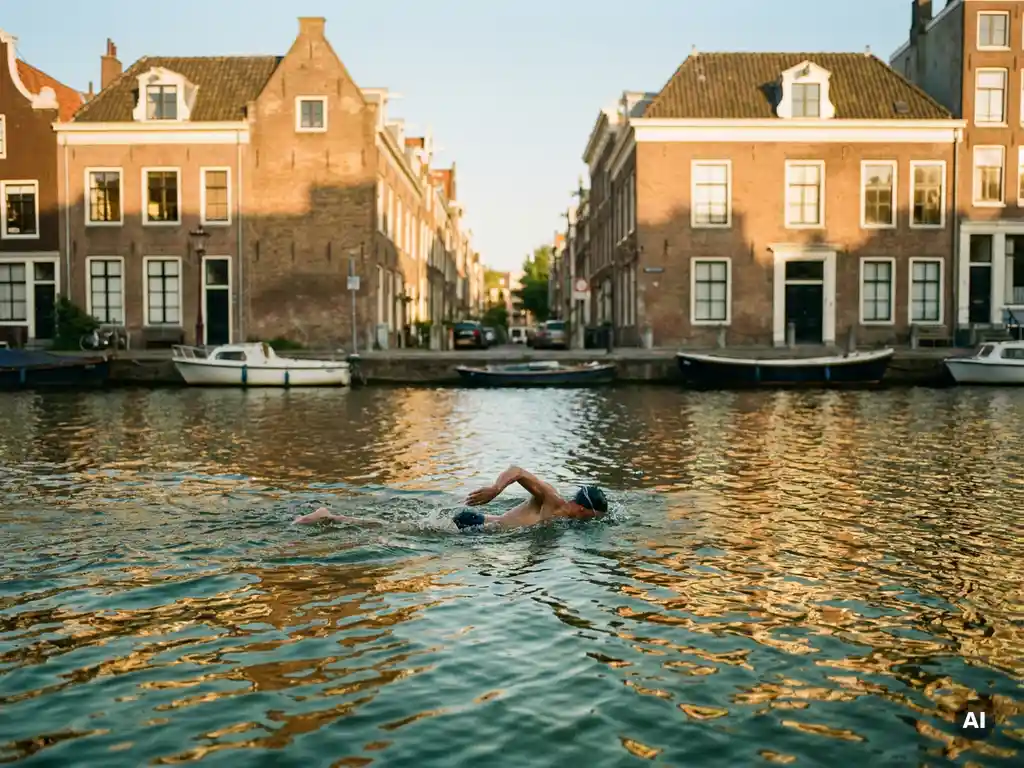
Swimming in the canals of Amsterdam is mostly illegal and actively discouraged by the city. The canals are classified as public waterways, which means swimming in them is officially prohibited under Amsterdam municipal rules. There are, however, a handful of designated spots where you can legally take a dip in open water in the city.
The reasons behind the ban are practical rather than bureaucratic: boat traffic, water quality, and safety all play a role. Below, this article unpacks where you can legally swim, why the canals are off-limits, what happens if you ignore the rules, and whether things might ever change.
Where in Amsterdam are you actually allowed to swim?
Amsterdam does have designated swimming spots, but none of them are in the historic canal ring. The city officially permits swimming at a number of outdoor locations, primarily around the Sloterplas, the Gaasperplas, the Nieuwe Meer, and the Amstel River at certain points. These are monitored for water quality, have clear entry and exit points, and are generally safe for recreational swimming.
The Sloterplas, located in the Nieuw-West district, is probably the most popular. It is a large recreational lake with a proper beach area and lifeguard supervision during summer months. The Gaasperplas in Amsterdam-Zuidoost is similarly set up for swimmers and is a little less crowded. Both are well worth the journey if you want to cool off during a hot Amsterdam summer.
The Amstel River is a slightly different case. Parts of it are technically swimmable, but conditions vary, and boat traffic means you need to be careful and well informed about exactly where you are entering the water. Always check the city’s official water quality monitoring before swimming anywhere in Amsterdam’s open water.
Why are the Amsterdam canals off-limits for swimming?
The Amsterdam canals are off-limits for swimming primarily because of boat traffic, water quality, and structural safety hazards. The canal ring is a working waterway system, not a recreational one. Houseboats, tourist boats, cargo vessels, and water taxis share the same narrow channels, making swimming genuinely dangerous.
Water quality is the second major factor. Despite significant improvement over the decades, the canal water still receives runoff from the city’s drainage system, particularly after heavy rainfall when the sewer system can overflow into the canals. Bacteria levels can spike unpredictably, making swimming a genuine health risk rather than just a bureaucratic concern.
There is also the issue of the canal walls themselves. The historic grachtengordel was not built with swimmers in mind. The walls are slippery, steep, and largely without handholds or ladders. Getting out of a canal if you fall in is far harder than getting in, which turns what might seem like a refreshing swim into a potential emergency.
What happens if you swim in the Amsterdam canals anyway?
If you swim in the Amsterdam canals, you can be fined by the city. Amsterdam’s municipal enforcement officers (known as handhaving) do patrol the canals, particularly in summer when the temptation rises with the temperature. The fine is not trivial, though the exact amount can vary depending on the specific location and circumstances.
Beyond the fine, the practical risks are real. People do fall into the Amsterdam canals every year, and not always by choice. The combination of slippery walls, cold water, and boat traffic means that what starts as a casual swim can quickly become dangerous. Emergency services are called to canal incidents regularly, particularly during summer evenings when alcohol is involved.
The city does not treat this as a victimless rule. The enforcement is real, the fines are real, and the physical risks are real. Jumping into the canals for a photo or a dare is the kind of thing that looks fun in the moment and considerably less fun in the aftermath.
Are the Amsterdam canals getting cleaner, and could swimming ever be allowed?
Yes, the Amsterdam canals are genuinely cleaner than they were a few decades ago. The city has invested heavily in water quality over the years, and the improvement is measurable. Fish have returned to canals where they were previously absent, and the water clarity has increased noticeably. By most accounts, the canal water today is cleaner than it has been at any point in the modern era.
Whether that translates into legal swimming is a different question. The city of Amsterdam has explored the idea of designated canal swimming spots in recent years, and there is genuine public appetite for it. The Prinsengracht and other central canals have been discussed as potential locations, but the logistical challenges are significant. Boat traffic would need to be rerouted or restricted, access infrastructure would need to be built, and water quality would need to be consistently monitored to a standard that protects public health.
As of 2026, no central canal swimming has been formally approved, but the direction of travel is encouraging. The conversation is happening at city level, and Amsterdam has a history of eventually delivering on ambitious urban water projects. It may not be this summer, but the idea of a legal swim in the Prinsengracht is no longer pure fantasy.
How Klagen Niet Klagen helps you understand Amsterdam
Questions like this one sit right at the intersection of what Klagen Niet Klagen is built for: practical Amsterdam knowledge delivered with honesty and a little humour, without the tourist-board gloss. Whether you are an expat trying to make sense of the city’s rules, a visitor who wants to go beyond the surface, or a curious Amsterdammer who never quite got around to asking, this blog exists to give you straight answers.
- Honest, insider commentary on Amsterdam city life written from over three decades of experience
- No tourist-board spin, no advertorial pressure, just genuine perspective
- Long-form essays and practical guides that treat you as an intelligent adult
- Written in English for a globally minded audience that mainstream Dutch media ignores
If you enjoyed this, there is plenty more where it came from. Head to the blog archive for more Amsterdam insight, and feel free to read about the person behind it if you want to know who you are actually listening to.
And speaking of Amsterdam experiences worth having: if you have never been to Boom Chicago, the comedy theatre that has been making Amsterdam laugh since 1993, now is a good time to fix that. It is the kind of evening that gives you a real feel for the city’s irreverent, creative soul, and frankly, it is a lot drier than swimming in the canals.
Frequently Asked Questions
Is it safe to swim at the Sloterplas and Gaasperplas, and do I need to bring anything specific?
Both the Sloterplas and Gaasperplas are monitored for water quality by the city and are generally safe for recreational swimming during summer months. The Sloterplas has lifeguard supervision in peak season, so it is the safer bet if you are swimming with children or are not a confident swimmer. It is worth checking Amsterdam’s official water quality dashboard (waterkwaliteit.amsterdam.nl) before you go, as heavy rainfall can temporarily affect readings even at designated spots.
What should I do if I accidentally fall into an Amsterdam canal?
Stay calm and do not panic — your first priority is to get to the nearest canal wall or object you can hold onto while you assess your options. Shout for help immediately, as bystanders and emergency services respond quickly to canal incidents in Amsterdam. Be aware that the walls are steep and slippery, so look for a ladder, a moored boat, or a low-access point rather than trying to haul yourself straight up the brickwork — and call 112 as soon as you are able if you need emergency assistance.
Are there any organised open-water swimming events or clubs in Amsterdam where I can swim legally?
Yes — Amsterdam has a small but active open-water swimming community, and some organised events take place at the designated locations like the Sloterplas and Nieuwe Meer under controlled conditions. Groups like the Amsterdam City Swim, which raises money for ALS research, occasionally use parts of the canal network under special municipal permits, which is one of the very few legal exceptions to the canal swimming ban. Joining a local open-water swimming club is a great way to find safe, legal, and social swimming opportunities in and around the city.