
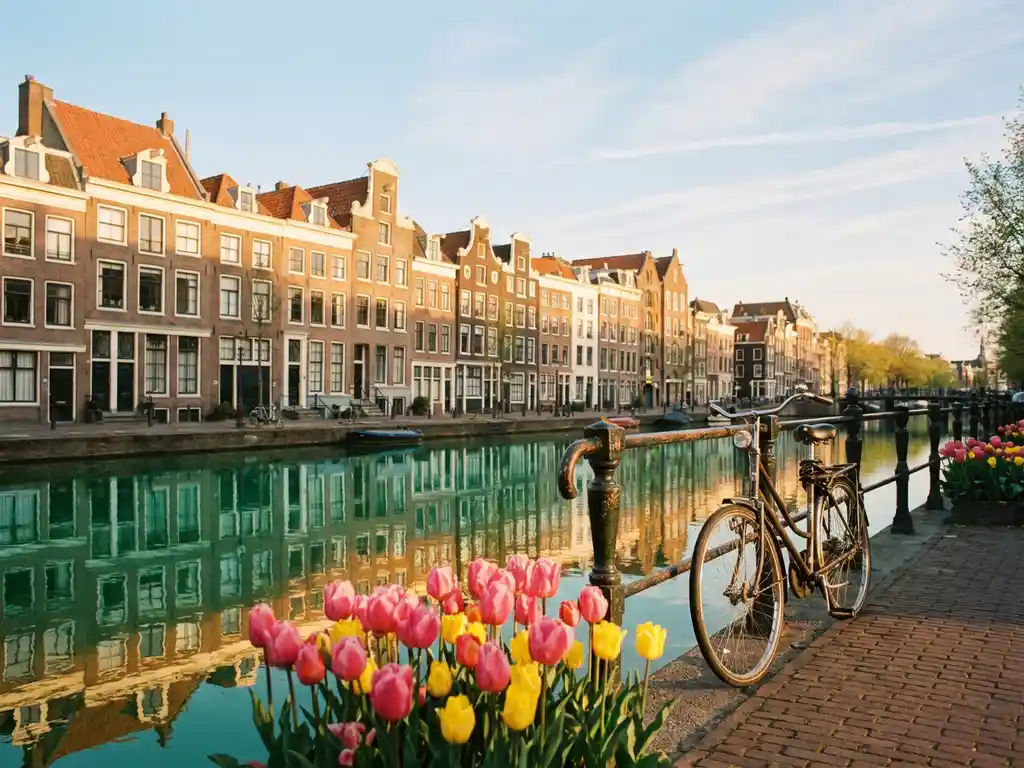
The best time to visit Amsterdam is late April through May. The tulip fields are in full bloom, the weather is genuinely pleasant without being hot, the days are long, and the city has not yet been swallowed by peak summer crowds. For most visitors, this window offers the ideal balance of good conditions and manageable tourism pressure.
That said, “best” depends on what you are actually looking for. A winter visit has its own quiet magic, summer has energy and festivals, and autumn offers something in between. The rest of this article breaks down each season honestly, so you can match Amsterdam to your actual travel style rather than just following the tourist calendar.
Which month is the absolute best to visit Amsterdam?
May is the single best month to visit Amsterdam. Temperatures hover between 12 and 18 degrees Celsius, the city is green and blooming, daylight stretches well into the evening, and the summer crush has not fully arrived yet. You can cycle along the canals, sit on a terrace, and actually enjoy the city without fighting through tour groups at every corner.
April runs a close second, particularly for anyone making the trip specifically to see the tulip fields. The Keukenhof gardens are open from late March through mid-May, and peak bloom typically falls somewhere in mid-April. The trade-off is that April weather is unpredictable — you might get a brilliant warm week or a run of grey, drizzly days. Pack layers regardless.
June is still excellent before the school holidays kick in. Once July arrives, the dynamic shifts noticeably. The city fills up fast, prices climb, and the famous Amsterdam canal tour queues grow long enough to test anyone’s patience. If you are flexible, avoid July and August, and you will have a meaningfully better experience.
What is Amsterdam like in summer — and is it worth it?
Amsterdam in summer is lively, warm, and extremely crowded. July and August bring the highest visitor numbers of the year, longer queues, higher hotel prices, and a city centre that can feel more like a theme park than a real place. The weather is genuinely warm — typically 20 to 25 degrees — and the outdoor culture is at its best, but you pay for it in every sense.
That said, summer has real appeal if you go in with the right expectations. The canal-side terraces are buzzing, the parks fill with locals and visitors alike, and the city’s cultural programme is in full swing. Amsterdam’s outdoor festivals, open-air cinema events, and neighbourhood street parties all happen in this window. If you are coming for the energy and the social atmosphere, summer delivers.
The honest advice is this: if you must visit in summer, come in June rather than July or August. You get most of the warmth and outdoor atmosphere without the absolute peak of the crowds. And if you are staying for more than a few days, push beyond the tourist centre. The best Amsterdam experiences in summer are found in the neighbourhoods where actual Amsterdammers spend their time — De Pijp, Noord, the Jordaan on a weekday morning — not on Damrak or near the Anne Frank House queue.
When is Amsterdam least crowded?
Amsterdam is least crowded from November through February. These months see the fewest tourists, the lowest hotel prices, and a version of the city that most visitors never encounter. The streets are quieter, the museums are accessible without advance booking weeks ahead, and you can walk through the canal district in genuine peace.
Winter Amsterdam has a distinct atmosphere that is worth experiencing on its own terms. The canal houses look striking under grey skies, the city’s brown cafes and indoor food markets come into their own, and there is something genuinely charming about cycling past lit-up canal houses on a cold, clear evening. It is not a postcard version of the city, but it is an honest one.
The main drawbacks are obvious: it is cold, it is often wet, and daylight is short. By mid-December, the sun sets around four in the afternoon, which limits outdoor time considerably. That said, the Christmas markets and the Amsterdam Light Festival — which runs through the canal district each winter — give the city a festive quality that partially compensates. If you are after cheap hotels in Amsterdam and are comfortable with a coat and umbrella, January and February are genuinely hard to beat on value.
What Amsterdam events should influence your travel dates?
Several Amsterdam events are worth planning around — or deliberately avoiding. King’s Day on April 27th transforms the entire city into an outdoor street party and is one of the most extraordinary urban events in Europe. The Amsterdam Dance Event in October draws the global electronic music world. And the Keukenhof tulip season runs roughly from late March to mid-May. These events add real colour to a visit, but they also spike crowds and prices significantly.
Events worth planning your trip around:
- King’s Day (April 27) — The city turns orange, the canals fill with boats, and everyone is in a good mood. One of the best days to be in Amsterdam, full stop.
- Keukenhof tulip gardens (late March to mid-May) — Worth the trip from the city if you are visiting in spring. Book entry in advance.
- Amsterdam Dance Event (October) — Five days of electronic music across hundreds of venues. The city fills with a specific, energetic crowd.
- Amsterdam Light Festival (December to January) — Light installations along the canals. Genuinely beautiful and a good reason to visit in winter.
- Amsterdam Open Air and other summer festivals (June to August) — Multiple outdoor music and cultural events throughout the warmer months.
Events worth being aware of to avoid overcrowding: King’s Day, while brilliant, does mean the city is absolutely packed. If you are not there for the party specifically, it is one of the most chaotic days of the year. Similarly, the summer school holiday period in July and August brings family tourism to its annual peak. Plan accordingly.
How does Amsterdam weather actually affect a visit?
Amsterdam’s weather is genuinely unpredictable year-round, and it affects a visit more than most people anticipate. The city sits in a maritime climate, which means mild temperatures but frequent rain, wind, and rapidly changing skies at any time of year. A sunny April morning can turn grey and wet by afternoon. Summer is warm but not reliably so. The best Amsterdam weather guide is simple: always bring a waterproof layer, regardless of the forecast.
In practical terms, the weather shapes how much of Amsterdam you can actually enjoy. The city is at its best outdoors — cycling, canal tours, terrace culture, the parks, the markets. When the weather cooperates, Amsterdam is genuinely one of the most enjoyable cities in Europe to move around in. When it does not, you retreat indoors, which means museums, cafes, and covered markets.
The good news is that Amsterdam has excellent indoor options. The Rijksmuseum, the Van Gogh Museum, the Eye Film Institute in Noord, the indoor food halls, and the city’s dense concentration of brown cafes all make rainy days entirely manageable. The Amsterdam weather guide that actually serves visitors well is not about finding a guaranteed sunny window — it is about accepting the variability and building a trip that works in any conditions.
Should you avoid Amsterdam during peak tourist season?
If you have flexibility, yes — avoiding the peak of July and August will give you a significantly better experience. Amsterdam has been grappling with overtourism for years, and the city centre in high summer can feel overwhelmed. Prices are at their highest, queues are longest, and the neighbourhoods most worth seeing are hardest to enjoy. The city is not at its best when it is at its busiest.
That said, “avoid peak season” is easier advice to give than to follow. Many people can only travel in summer due to work schedules, school calendars, or the simple fact that summer is when they want to be somewhere warm and outdoors. If that is your situation, the answer is not to skip Amsterdam — it is to be strategic about how you experience it.
A few honest strategies for visiting in peak season:
- Book accommodation well in advance and consider staying outside the immediate centre — the best Amsterdam neighborhoods for a more local experience include De Pijp, Oud-West, and Amsterdam Noord.
- Visit the major museums first thing in the morning or late in the afternoon, and book timed entry tickets online before you arrive.
- Avoid the most congested streets — Damrak, Leidseplein, and the immediate area around the Anne Frank House — during midday hours.
- Use a bike. The Amsterdam bike routes that run through quieter residential areas are far more enjoyable than walking through the tourist centre.
- Eat where locals eat. The best cheap restaurants in Amsterdam are rarely in the tourist centre — they are in the side streets and neighbourhood blocks that most visitors never reach.
The deeper truth about peak season is this: Amsterdam the tourist destination and Amsterdam the actual city coexist in the same geography but barely overlap. The version of the city worth experiencing — the Amsterdam locals guide version — is always accessible, even in August. You just have to know where to look.
How Klagen Niet Klagen helps you plan your Amsterdam visit
Knowing the best month to visit is one thing. Knowing what to actually do when you get there — beyond the obvious, beyond the tourist trail — is where most travel content falls short. That is exactly the gap that Klagen Niet Klagen exists to fill.
- Honest, insider commentary on Amsterdam life written by someone who has lived and worked here for over three decades
- No tourism board influence, no advertorial pressure, no sanitised version of the city
- Practical cultural context that helps you understand Amsterdam rather than just tick it off
- Regular essays on Amsterdam neighbourhoods, events, food, culture, and the contradictions that make the city genuinely interesting
- A perspective grounded in the real Amsterdam — the one locals actually inhabit
Whether you are planning your first trip or your fifteenth, the blog archive is worth a read before you book anything. The best Amsterdam experiences are rarely the ones on the tourist map.
And while you are planning your visit, consider adding one genuinely unmissable evening to the itinerary: a show at Boom Chicago. The comedy institution that helped put Amsterdam’s English-language cultural scene on the map has been running since 1993, and a live show there is one of those experiences that stays with you long after the canal tour fades from memory. It is sharp, funny, and deeply Amsterdam — exactly the kind of thing you came here for. If you want to know more or have questions before you visit, the Boom Chicago team is easy to reach.
Frequently Asked Questions
How far in advance should I book hotels and museum tickets for Amsterdam?
For peak season visits (June through August), booking accommodation at least two to three months in advance is strongly recommended — popular hotels in central areas sell out fast and prices spike closer to your travel date. For major museums like the Rijksmuseum and Van Gogh Museum, timed-entry tickets should be booked online as soon as your dates are confirmed, ideally weeks ahead. Even outside peak season, booking museum tickets in advance saves you from long queues and occasional sold-out slots. The earlier you lock in the logistics, the more flexibility you have to focus on the parts of Amsterdam that actually make the trip memorable.
Is Amsterdam worth visiting for just a weekend, or do you need more time?
A long weekend — three to four days — is genuinely enough to get a meaningful feel for Amsterdam, provided you are selective about what you try to fit in. Rather than chasing every major sight, pick two or three museum visits, build in time to cycle or walk through a neighbourhood like De Pijp or the Jordaan, and leave room for the unplanned moments that define the city. Where visitors go wrong with short trips is over-scheduling: Amsterdam rewards slow exploration far more than box-ticking. If you only have two days, skip the tourist-centre scramble entirely and focus on depth over breadth.
What are the most common mistakes first-time visitors make when planning an Amsterdam trip?
The most common mistake is concentrating the entire trip within the tourist centre — Damrak, the Red Light District, and the Anne Frank House queue — and missing the neighbourhoods where Amsterdam actually lives. A close second is underestimating how much the weather can shift and not packing a waterproof layer, which turns an unexpected rainy afternoon into a miserable one. First-timers also frequently overlook the value of a bike: renting one for even a single day changes how the city opens up to you entirely. Finally, many visitors book nothing in advance and then lose hours of their trip standing in queues that a five-minute online booking would have eliminated.