
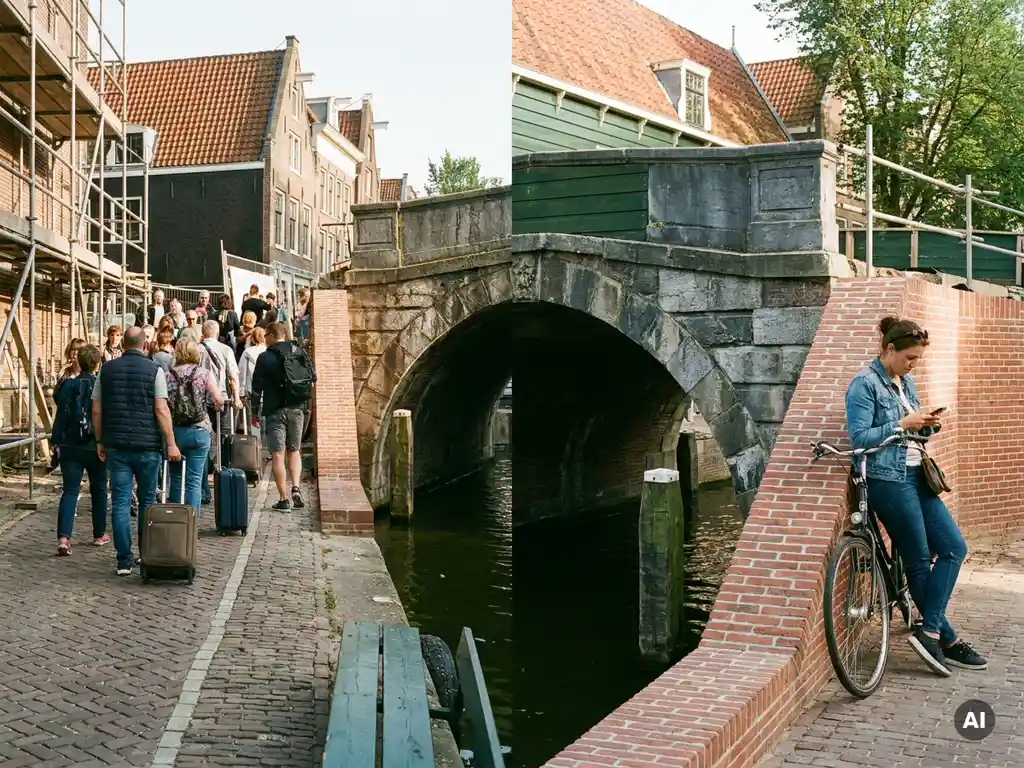
Public space redesigns in Amsterdam rarely balance tourists and locals equally. In practice, the outcome depends heavily on who commissioned the redesign, what the stated goals were, and whether local residents had a meaningful seat at the planning table. Most redesigns aim for balance in theory but deliver something messier in practice.
The tension is real and structural. Amsterdam attracts tens of millions of visitors a year while housing roughly 900,000 permanent residents who use the same streets, squares, and waterways every single day. When those spaces get redesigned, the competing needs of these two groups rarely align neatly. The questions below unpack how this actually plays out.
Who actually gets priority when shared spaces are redesigned?
In formal planning documents, neither tourists nor locals are explicitly prioritised. But in practice, the group whose behaviour is hardest to manage tends to shape the design most. That usually means tourists. High foot traffic, safety concerns, and revenue pressure push planners toward solutions that accommodate visitor volume rather than protect the daily rhythms of people who live nearby.
This is not always a cynical choice. Designers and city officials often genuinely believe that making a space more legible, safer, and better signposted serves everyone. And sometimes it does. But “serving everyone” in a high-tourism zone almost always means designing for the lowest common denominator: the visitor who has never been there before and may never return. That logic quietly sidelines the experienced local who just wants to cycle through without being cut off by a tour group.
Local residents do have formal input through neighbourhood councils and public consultation processes in Amsterdam. But consultation is not the same as decision-making power. When economic or political pressure is strong, local objections tend to get noted and then politely ignored.
What design features help separate tourist flow from daily local life?
Effective public space redesigns use physical and spatial cues to distinguish through-routes from destination zones. The most practical features include dedicated cycling infrastructure that bypasses tourist hotspots, clearly separated pedestrian flows, and distinct surface materials that signal different functions to different users without requiring signage.
Some specific approaches that work in dense urban environments:
- Protected cycling lanes that run parallel to, rather than through, high-footfall tourist areas
- Widened pavements with designated slow zones near attractions, keeping faster commuter movement on separate paths
- Resident-priority access to certain streets during peak hours, enforced through retractable bollards or permit systems
- Pocket spaces set slightly back from main tourist corridors, designed for sitting and daily use rather than spectacle
- Clear wayfinding that actively directs tourists toward alternative routes, reducing the concentration of visitor traffic on single streets
The honest caveat: these features work best when they are designed with local input from the start, not bolted on afterward as a concession. A cycling lane that cuts through a tourist zone is only useful if cyclists actually feel safe using it when surrounded by distracted visitors.
Why do so many shared-space redesigns end up favouring tourists anyway?
Because money talks, and tourist spending is visible in ways that local quality of life is not. A redesigned square that attracts more visitors generates measurable revenue for nearby businesses and tax income for the city. The benefit to a local resident of being able to cross that square quickly on a Tuesday morning is real but impossible to quantify in the same way.
There is also a political dimension. Elected officials and city planners are accountable to broad constituencies and often face pressure from hospitality and retail sectors whose interests align with tourist-friendly design. Residents, particularly in central neighbourhoods, are a smaller and less economically powerful lobby.
Design culture plays a role too. Prestigious redesign commissions tend to attract architects and urban designers whose portfolios are built on landmark public spaces. Landmark public spaces attract tourists almost by definition. The incentive to create something photogenic and internationally recognised pulls in a different direction from the incentive to make a space genuinely liveable for the people who use it every day.
Finally, there is the problem of timescale. Tourists experience a space in hours. Residents experience it across years and decades. Design briefs are usually evaluated against short-term outcomes, which systematically underweights the long-term impact on local life.
What does a successful balance between tourists and locals actually look like?
A genuinely balanced public space redesign is one where a local resident can go about their daily routine without meaningfully altering their behaviour to accommodate tourists, while visitors still feel welcomed and oriented. It is less about equal allocation of space and more about protecting the functional layer of the city beneath the tourism layer.
In practical terms, success tends to look like this:
- Locals report no meaningful increase in journey times or frustration after the redesign
- Tourist concentration is distributed rather than intensified at single points
- The space continues to serve neighbourhood functions: market stalls, school routes, daily errands
- Resident satisfaction in the surrounding streets holds steady or improves
- The design ages well without requiring constant intervention to manage conflict between user groups
Amsterdam has examples of this working and examples of it failing badly. The Nieuwmarkt area has maintained more neighbourhood character than the immediate surroundings of the Anne Frank House, partly because its design never fully surrendered to a single dominant use. The lesson is not that tourist-heavy areas cannot be redesigned well, but that success requires explicitly naming local daily life as a design priority from day one, not as an afterthought once the visitor infrastructure is already in place.
The deeper issue is one of honesty. Cities that pretend public space redesign can serve all users equally tend to produce spaces that serve none of them particularly well. The ones that acknowledge the tension openly and make deliberate choices about trade-offs tend to do better. Amsterdam is still working this out, which is precisely what makes it worth watching.
How Klagen Niet Klagen helps you think about Amsterdam’s public spaces
If you have ever felt that the Amsterdam you love is slowly being reshaped around someone else’s priorities, you are not imagining it. Klagen Niet Klagen exists precisely to name these tensions honestly, without the diplomatic softening of a tourism board or the detachment of a journalist parachuting in for a week.
- Long-form essays on how Amsterdam’s built environment is changing and who it is changing for
- Opinion pieces written from over three decades of lived experience in the city
- Commentary that takes both the klagen and the niet klagen seriously, because Amsterdam deserves more than cheerleading or complaint
- A consistent, independent editorial voice free from advertorial pressure or tourism industry influence
If this kind of honest, insider perspective on Amsterdam is what you have been looking for, explore the blog archive for more essays on city life, culture, and the contradictions that make Amsterdam endlessly interesting. And if you want to get in touch directly, the contact page is always open.
Speaking of shared spaces that actually work for everyone: Boom Chicago has been bringing locals, expats, and international visitors together in the same room since 1993, and making all of them laugh at the same things. If you want to experience Amsterdam at its sharpest and most alive, check out what is on stage. It is one shared space that has never had a problem balancing its audience.
Frequently Asked Questions
What can local residents actually do if a planned public space redesign in Amsterdam seems to ignore their needs?
Start by engaging early through your neighbourhood council (wijkraad) and formally submitting responses during the public consultation period — these are logged and can carry legal weight if a decision is later challenged. If you feel your input is being noted but not acted on, coalition-building with other residents and local organisations amplifies your voice considerably more than individual objections. Documenting the specific functional impacts on daily life — journey times, school routes, market access — in concrete terms tends to be more effective than general complaints about tourism pressure.
Are there any Amsterdam neighbourhoods that have genuinely managed to protect local character through smart redesign?
The Nieuwmarkt area is probably the clearest example discussed in urban planning circles, where a combination of mixed-use design and the retention of neighbourhood-serving functions like the market has kept it from becoming purely tourist-facing. The Jordaan is a more complicated case — it has maintained visual character but at the cost of affordability and genuine local use, which shows that aesthetic preservation and functional preservation are not the same thing. The lesson from both is that protecting local character requires explicit decisions made at the brief stage, not design gestures applied after the core priorities have already been set.
How do I tell the difference between a redesign that genuinely balances both groups and one that just looks like it does?
The most reliable test is to visit the space on an ordinary weekday morning and observe whether it is actually functioning as part of neighbourhood daily life — people cycling through purposefully, locals running errands, the rhythms of a working city rather than a stage set. A redesign that only comes alive when tourists are present, or that requires locals to meaningfully adapt their routes and routines, has not achieved balance regardless of how the planning documents describe it. Ask residents in the surrounding streets whether the redesign changed how they use the area; their answers will tell you more than any official evaluation.