
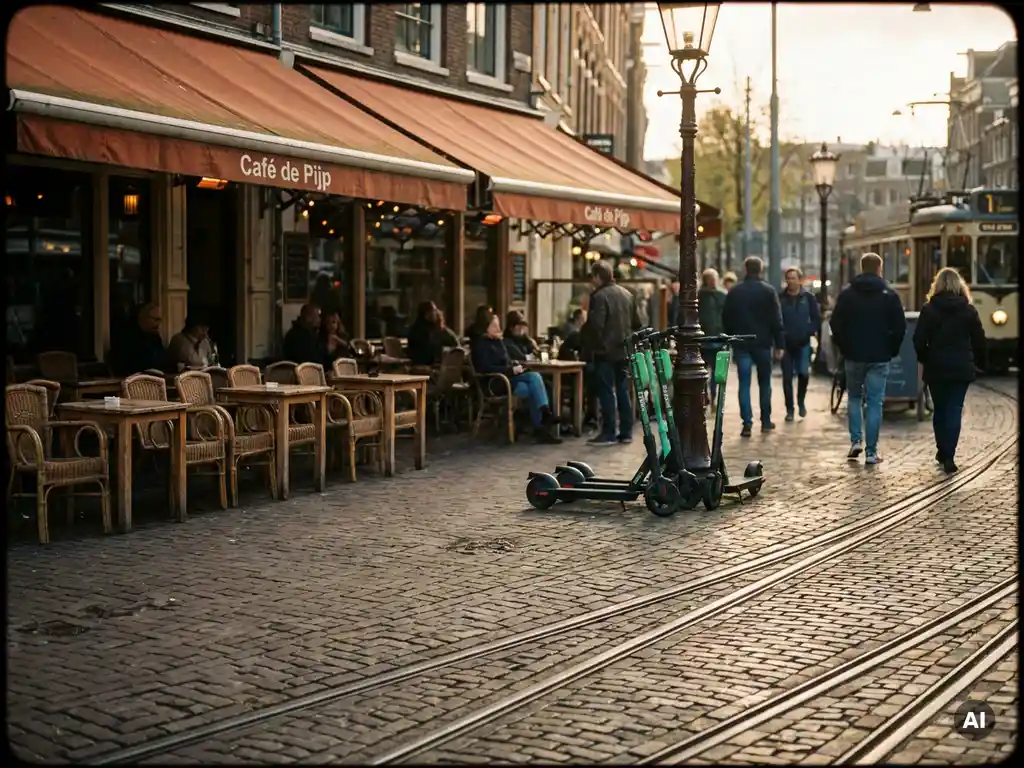
Leidseplein has changed significantly over the past decade or so, shifting from a lively local hub to a square that feels increasingly shaped by mass tourism rather than Amsterdam itself. The crowds are bigger, the venues more generic, and the energy more transactional. That said, the square has not entirely lost its character – it still holds a few things worth your time, if you know where to look.
What does Leidseplein look and feel like today?
Today, Leidseplein looks polished but feels hollow in places. The square itself is well-maintained, the trams still rattle through, and the terraces fill up on sunny afternoons. But walk around the edges and you will notice that a lot of the venues catering to visitors have pushed out the kind of places that gave the square its original texture. Chain cocktail bars, tourist-menu restaurants, and souvenir-adjacent shops now occupy prime spots that were once home to more idiosyncratic Amsterdam businesses.
The physical bones of the square are still there. The Stadsschouwburg (now known as ITA, Internationaal Theater Amsterdam) anchors one side with genuine cultural weight. The American Hotel remains one of the most beautiful buildings in the city. But between these landmarks, the ground-level experience has become noticeably more homogenised. If you arrived in Amsterdam blindfolded and someone dropped you on Leidseplein, you might be forgiven for thinking you were in any other major European tourist city.
How has the nightlife on Leidseplein changed?
The nightlife on Leidseplein has shifted from a mixed local-and-visitor scene to something that caters almost entirely to tourists. Through the 1990s and into the 2000s, the square was a genuine meeting point for Amsterdammers going out – you would find locals at the bars alongside visitors, and that mix created real energy. That dynamic has largely evaporated.
Several factors drove this change. Rising rents pushed out the kinds of independent bars and clubs that locals actually wanted to go to. The city’s broader approach to nightlife regulation also played a role, with noise restrictions and licensing pressures making it harder for venues to operate in ways that attract a local crowd. Meanwhile, Amsterdam’s actual nightlife scene migrated east and north – to neighbourhoods like Oost and Noord, where rents are lower and the atmosphere more experimental.
What remains on Leidseplein after dark is loud, often crowded, and perfectly functional if you want a night out without much thought. But it is not where most Amsterdammers choose to spend their evenings anymore.
Why do locals feel differently about Leidseplein now?
Locals feel differently about Leidseplein because they have largely stopped going there. For many long-term Amsterdam residents, the square has crossed a threshold where the tourist density makes it feel like a different city – one that exists alongside Amsterdam rather than as part of it. The experience of sitting on a terrace surrounded almost entirely by people on short city breaks is not necessarily unpleasant, but it is not what most locals are looking for on a night out.
There is also a sense of loss attached to the square. People who remember Leidseplein from the 1990s or early 2000s remember a place with more personality and more friction – in the best sense of that word. It was noisier, messier, and more genuinely Amsterdam. The current version feels managed and optimised for visitor throughput in a way that strips out some of what made it interesting.
That said, Amsterdammers are not entirely absent. You will still find locals at the ITA, at a handful of bars that have maintained their character, and on the terraces during major football matches or public events. The square has not been completely abandoned by the city – it has just been deprioritised.
Is Leidseplein still worth visiting in Amsterdam?
Yes, Leidseplein is still worth visiting, but your expectations should be calibrated. If you arrive hoping to find the beating heart of Amsterdam’s social life, you will probably be disappointed. If you arrive as part of a broader exploration of the city – curious about how a historically important square has evolved under the pressure of mass tourism – it is actually quite interesting.
A few things genuinely make it worth the trip:
- The ITA theatre hosts some of the most ambitious theatrical productions in the Netherlands – if there is a show on, that alone justifies the visit.
- The American Hotel’s Art Nouveau interior is stunning and often overlooked by people who only see it from the outside.
- The square is a useful transport node, and using it as a starting point to walk toward the Jordaan or the Vondelpark takes you quickly into parts of the city that feel much more like Amsterdam.
- On a warm afternoon, the terraces are genuinely pleasant – just do not expect a local crowd.
Leidseplein is best understood now as a threshold rather than a destination: a place you pass through on the way to somewhere more interesting, with a few worthwhile stops along the route.
How Klagen Niet Klagen helps you understand Amsterdam’s changing neighbourhoods
If Leidseplein has left you wondering what else has shifted in Amsterdam – and why – Klagen Niet Klagen is the place to dig deeper. This is not a tourism blog with sanitised recommendations. It is honest, long-form commentary on Amsterdam city life, written by someone who has been here since 1993 and has watched the city change up close.
- Candid takes on how Amsterdam’s neighbourhoods, squares, and cultural institutions have evolved over decades
- An insider perspective that goes well beyond what any travel guide or tourism board will tell you
- Content written for expats, curious visitors, and internationally minded locals who want more than a top-ten list
- A consistent editorial voice grounded in real Amsterdam experience – not sponsored content or PR copy
Want more of this kind of commentary? Find out more about the blog and start reading. Amsterdam is a complicated city, and it deserves complicated writing about it.
And while you are thinking about Amsterdam’s cultural scene – the theatres, the comedy, the energy that the city still generates when it is at its best – it is worth knowing that Boom Chicago has been part of that scene since 1993. Started on Leidseplein itself, Boom Chicago has grown into one of Amsterdam’s most beloved and internationally recognised comedy institutions. If you want a night out that actually feels like Amsterdam rather than a facsimile of it, check what is on and come and see for yourself.
Frequently Asked Questions
What are the best alternatives to Leidseplein if I want a more authentic Amsterdam night out?
If you want to experience Amsterdam’s nightlife the way locals actually do, head east or north. Neighbourhoods like Oost and Noord have become the city’s real nightlife hubs, with independent bars, experimental clubs, and a crowd that is predominantly local. The Jordaan, just a short walk from Leidseplein, also offers a more genuinely Amsterdam atmosphere with neighbourhood cafés and brown bars that have maintained their character over decades.
Is the American Hotel on Leidseplein open to the public, or do you need to be a guest to see the interior?
The American Hotel’s Art Nouveau interior is accessible to the public through its café, Café Americain, which is open daily. You do not need to be a hotel guest to walk in and look around. It is one of the most beautifully preserved interiors in Amsterdam and well worth stepping inside, even if you only stay for a coffee.
What is the best time of day to visit Leidseplein to avoid the worst of the tourist crowds?
Early morning is by far the quietest time on Leidseplein — the square has a completely different feel before 10am, when the terraces are empty and the trams run through without the surrounding noise. Weekday afternoons are more manageable than weekends. If you want to visit in the evening, going early in the week rather than Friday or Saturday will make a noticeable difference to how crowded it feels.