
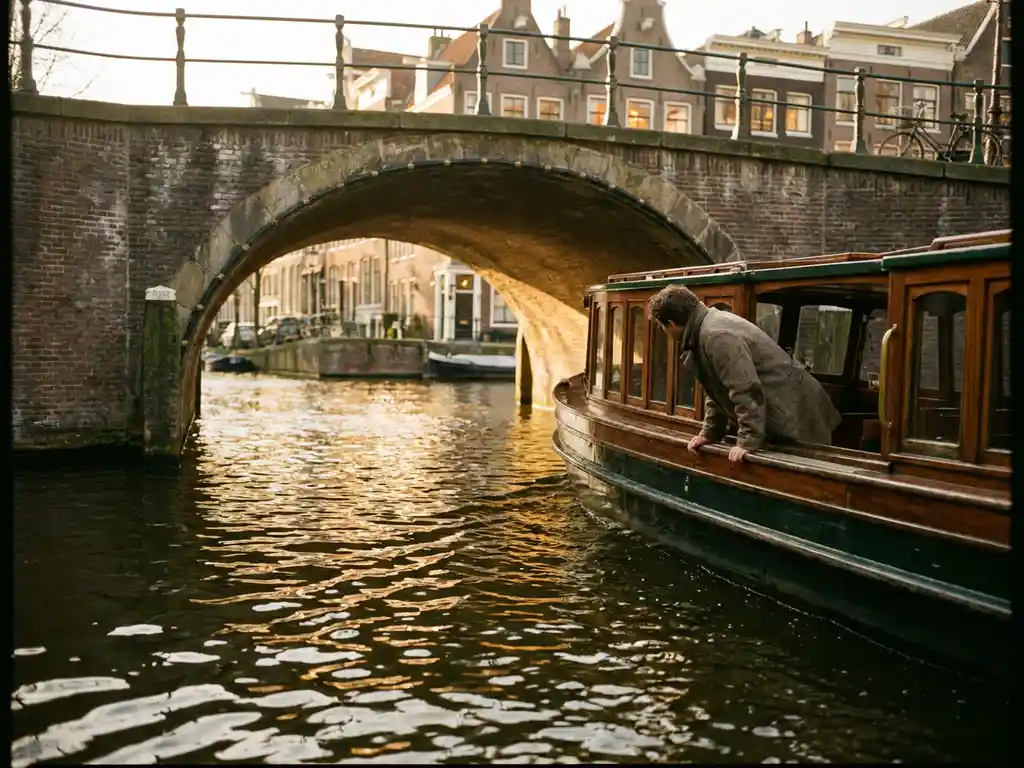
The best canal tour in Amsterdam worth taking is on a small, open boat on the narrower canals of the Jordaan and the canal ring — not the giant glass-topped cruise vessels that dominate the main waterways. The difference is not just aesthetic: smaller boats reach places the big operators cannot, and the experience feels like Amsterdam rather than a floating airport lounge. Below, every question worth asking before you book gets a straight answer.
Which type of canal tour actually shows you Amsterdam?
The canal tours that actually show you Amsterdam are on small open boats navigating the historic canal ring and the Jordaan’s side canals, ideally with a local guide or skipper who knows the city rather than pre-recorded audio commentary. These tours put you at water level, close to the canal houses, and away from the cruise-ship traffic on the Amstel and the IJ waterfront.
Amsterdam has roughly 165 canals and more than 1,500 bridges. The majority of large tour operators stick to the same predictable loop: Central Station, the Rijksmuseum, the Heineken brewery, back again. It is perfectly fine for orientation, but it shows you the postcard version of Amsterdam rather than the lived city.
What separates a memorable canal experience from a forgettable one comes down to three things:
- Boat size: Smaller vessels access the narrower canals in the Jordaan, the Nine Streets area, and the Eastern Islands neighbourhood — the parts of Amsterdam where people actually live
- Commentary quality: A knowledgeable guide who improvises and responds to what you see beats a looping audio track in any language
- Route originality: The best operators avoid the main tourist corridor and take you through residential waterways where you see laundry, houseboats, cyclists, and real Amsterdam life
If you want to understand Amsterdam rather than simply photograph it, a small-group boat with a human guide is the only option worth your time.
What’s the difference between a hop-on hop-off and a fixed-route canal tour?
A hop-on hop-off canal tour lets you board and exit at multiple stops around the city throughout the day on a single ticket, while a fixed-route tour takes you on one continuous journey with a set departure time, a defined route, and a return to the starting point. The key distinction is flexibility versus depth: hop-on hop-off prioritises movement around the city, and fixed-route tours prioritise the canal experience itself.
Hop-on hop-off boats are useful if you want to combine a canal journey with reaching specific landmarks without walking or cycling. They run on a schedule similar to a bus network, and the boats are almost always large, enclosed vessels. The commentary is generic and the experience is transactional. You are using the canal as transport, which is a perfectly legitimate choice in Amsterdam.
Fixed-route tours, especially smaller private or semi-private ones, are a different product entirely. You commit to a route and a duration, and in return you get a coherent, curated experience. A good fixed-route tour tells a story about the city as it unfolds around you, rather than dropping you at a series of stops and leaving you to piece it together yourself.
For first-time visitors who want to cover ground, hop-on hop-off is practical. For anyone who wants Amsterdam’s canal ring to actually mean something, a fixed-route small boat tour is the better investment.
How long should a canal tour in Amsterdam be?
The ideal canal tour in Amsterdam lasts between 60 and 90 minutes. That is long enough to cover the main historic canal ring and the Jordaan waterways without the experience becoming repetitive or exhausting. Tours shorter than 45 minutes tend to feel rushed and rarely leave the main tourist corridor; tours longer than two hours often pad their routes with stretches that add little.
There are exceptions. Evening dinner cruises and private boat rentals operate on different logic, where the boat itself is the venue and duration is part of the appeal. If you are renting a small open boat with friends and a cooler, three hours on the canals on a warm afternoon is one of the best things to do in Amsterdam, full stop.
For a standard guided tour, the 75-minute format has become the industry standard for good reason. It fits within most visitors’ attention spans, covers enough of the canal ring to feel complete, and leaves time for the rest of the day. Anything marketed as a “quick 30-minute highlights tour” is almost always a waste of money.
When is the best time to take a canal tour in Amsterdam?
The best time to take a canal tour in Amsterdam is late afternoon on a weekday between April and October. The light is warm and low, the main morning rush of tourist boats has thinned out, and the canals feel closer to the way locals experience them. Avoid Saturday and Sunday mornings in summer, when the main waterways become genuinely congested.
Amsterdam’s weather makes timing more complicated than in most cities. The canal ring is beautiful in every season, but an open boat in February requires real commitment. Most operators run open boats from April through October, and the experience is genuinely different once the city warms up and the trees along the Herengracht and Keizersgracht are in full leaf.
A few practical considerations:
- Golden hour (late afternoon): The light on the canal houses is at its best in the two hours before sunset, making this the most photogenic window
- Weekday mornings: Quieter on the water and often cheaper, though the light is less dramatic
- Evening tours: The illuminated canal ring after dark is genuinely beautiful and a completely different atmosphere from a daytime tour
- Spring tulip season (April to early May): Peak tourist season, so book in advance, but the city is at its most visually striking
If Amsterdam’s weather is doing what Amsterdam weather typically does, which is to say something unpredictable, a covered boat is the sensible fallback. But an open boat on a clear afternoon remains the definitive canal experience.
Are Amsterdam canal tours worth the money?
Yes, a well-chosen Amsterdam canal tour is worth the money. The canal ring is a UNESCO World Heritage Site and genuinely one of the most beautiful urban waterscapes in the world. Seeing it from the water rather than from a bridge changes how you understand the city’s architecture, scale, and history. The question is not whether to do it, but which version to pay for.
The large operators running glass-topped boats from the main tourist piers are not bad value for what they are, but what they are is a tourist product rather than a genuine Amsterdam experience. If that is the budget and the context, they are perfectly adequate. But for anyone who has come to Amsterdam with real curiosity, the extra cost of a smaller, better-guided tour pays for itself in the quality of what you actually learn and see.
Private boat rental is worth flagging separately. Renting a small open motorboat and navigating the canals yourself is legal, does not require a licence for boats under a certain size, and costs roughly the same per person as a premium guided tour when shared between a group. It is one of the genuinely great Amsterdam experiences and one that most visitors do not know is available to them.
What should you watch out for when booking a canal tour?
When booking a canal tour in Amsterdam, watch out for misleading descriptions, hidden fees, and operators who sell “small group” experiences that turn out to seat 50 people on an enclosed barge. The canal tour market in Amsterdam is large and competitive, and quality varies considerably between operators at similar price points.
Specific things to check before booking:
- Actual boat capacity: A “small group tour” should mean fewer than 20 people. Anything larger and the intimacy disappears
- Live versus recorded commentary: Always confirm whether there is a live guide on board. Pre-recorded audio in six languages is not the same thing
- Route specifics: Ask which canals the tour covers. If the operator cannot name specific waterways beyond “the historic centre,” the route is almost certainly the standard tourist loop
- Departure point: Tours departing from near Central Station tend to be the most commercial. Operators based in the Jordaan or the canal ring itself are often more interesting
- Cancellation policy: Amsterdam weather changes fast. A flexible cancellation policy matters more here than in most cities
The booking platforms that aggregate canal tours apply the same logic as hotel aggregators: they surface what converts, not necessarily what is best. Reading recent reviews on independent platforms and looking specifically for comments about guide quality and route variety will tell you more than the operator’s own marketing copy.
How Klagen Niet Klagen helps you find the best Amsterdam experiences
Finding the canal tour that actually shows you Amsterdam rather than a sanitised version of it is exactly the kind of question that mainstream tourism content fails to answer honestly. Klagen Niet Klagen exists to fill that gap, with independent, opinion-driven commentary on Amsterdam city life written by someone who has lived and worked here for over three decades.
- Honest assessments of what is genuinely worth your time and money in Amsterdam, with no advertorial pressure or tourism-board influence
- Insider perspective on the city’s neighbourhoods, culture, and contradictions that no travel guide provides
- Long-form essays and guides on Amsterdam experiences written for curious visitors and long-term residents alike
- A clear editorial voice grounded in real Amsterdam life, not curated for a tourist audience
If you want to understand Amsterdam rather than simply visit it, start here and keep reading.
And if you are in Amsterdam and want an evening that captures the city’s sharpest, most irreverent side, Boom Chicago has been doing exactly that since 1993. Improvised comedy, sharp writing, and a room full of people who get the joke: it is one of the best English-language shows in Amsterdam and one of the few things in the city that locals and visitors genuinely enjoy together. Check the current shows and agenda and see what is on while you are here.
Frequently Asked Questions
Can I rent a boat and navigate Amsterdam's canals myself, and do I need a licence?
Yes, self-skippered boat rental is legal in Amsterdam and no licence is required for small open motorboats under a certain engine size — typically 15 horsepower or less. Most rental companies provide a brief orientation before you head out, and the canals, while busy in summer, are navigable without prior experience if you take it slowly. Shared between four to six people, the per-person cost is comparable to a premium guided tour, and the freedom to linger wherever you like makes it one of the most rewarding ways to spend an afternoon in the city.
What should I wear or bring on an open boat canal tour in Amsterdam?
Even in summer, Amsterdam’s canal-level air is noticeably cooler than street level, so bring an extra layer regardless of how warm the day feels on land. A light waterproof jacket is worth packing from April through October given how quickly the weather can shift. Sunscreen and sunglasses matter more than most visitors expect on a clear afternoon, since the water reflects a significant amount of light — and if you are on an open boat, there is nowhere to hide from it.
Are Amsterdam canal tours suitable for young children, and what should parents know before booking?
Most canal tours are suitable for children, but the experience varies considerably by boat type and tour length. A 75-minute guided tour on a small open boat works well for children old enough to sit still and stay interested; anything longer risks losing younger kids entirely. Check with the operator whether life jackets are provided for small children, confirm that the boat has low or open sides rather than enclosed glass walls (children tend to disengage quickly on enclosed vessels), and look for operators who offer a more informal, interactive style of commentary rather than a scripted audio loop.