
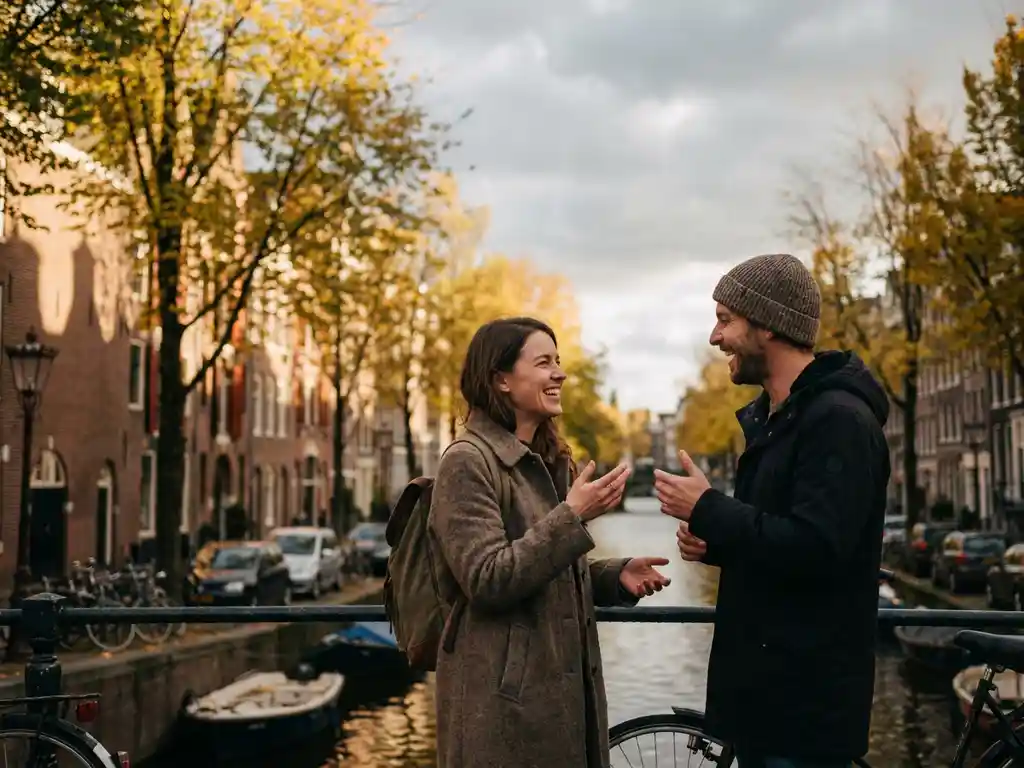
English is spoken very well in Amsterdam. The city consistently ranks among the most English-proficient non-native speaking cities in the world, and in most everyday situations — shopping, dining, asking for directions, navigating public transport — you will have absolutely no trouble communicating in English. Amsterdam is, in practical terms, a bilingual city.
This is not an accident. Decades of international education, a deeply export-oriented economy, and a cultural openness to foreign media have made English fluency the norm rather than the exception. Whether you are visiting for a weekend or building a life here, the language barrier that slows people down in Paris or Berlin simply does not exist in Amsterdam in the same way.
That said, there are nuances worth knowing — situations where English gets you less far than you might expect, and honest questions about whether you should bother learning Dutch at all if you live here.
How fluent are Amsterdam locals in English?
Amsterdam locals are genuinely fluent in English, not just conversationally functional. Most people under 60 can hold a full, nuanced conversation in English without difficulty. Younger Amsterdammers often speak with near-native fluency, switching between Dutch and English mid-sentence without breaking stride. This is not tourist-industry English — it is the real thing.
The Netherlands as a whole performs exceptionally well on international English proficiency indices, and Amsterdam, as the country’s most internationally connected city, sits at the top of that already impressive national average. You will meet people who are more comfortable discussing certain topics in English than in Dutch, simply because so much of their professional and cultural life happens in English.
There is also a generational element worth noting. People in their 20s, 30s, and 40s grew up watching English-language television and films without dubbing — a small but surprisingly powerful factor in building natural fluency. Older Amsterdammers are generally still quite capable, though you may notice a slight drop in comfort level and confidence among people over 65 or 70.
Where in Amsterdam will you always be understood in English?
In the city centre, the Jordaan, De Pijp, Oud-West, and most tourist-facing areas, English is effectively the default language. Restaurants, cafes, museums, hotels, shops, transport hubs, and most government-facing services all operate comfortably in English. You will rarely need to try Dutch first — staff often switch to English the moment they hear an accent.
Beyond the obvious tourist zones, English works reliably across most of Amsterdam’s professional and creative environments. Startups, tech companies, international NGOs, creative agencies, and the broader expat-heavy neighbourhoods like the Zuidas corridor operate largely in English. Many Amsterdam offices have adopted English as their working language entirely, even when every employee in the room is Dutch.
Cultural venues are also a safe bet. Most major museums offer English signage, audio guides, and staff who can assist fluently. Comedy shows, theatre productions, and live events in English are a genuine part of Amsterdam’s cultural scene — not a niche offering for tourists, but a well-established part of how the city entertains itself. If you are looking for the best English shows Amsterdam has to offer, the options are plentiful and the quality is high.
Are there situations where English won’t get you far?
Yes, and it is worth being honest about this. English has real limits in Amsterdam, particularly in local government bureaucracy, healthcare settings, and working-class or outer-district neighbourhoods that are less exposed to international life. A GP appointment, a visit to the gemeente (municipality), or a conversation with a housing association can quickly reveal the edges of Amsterdam’s English-friendliness.
Dutch bureaucracy runs on Dutch. Official letters, forms, legal documents, tax correspondence, and most formal communications from the government arrive in Dutch and are not routinely translated. You can often get verbal help in English, but the paperwork expects you to manage in Dutch. This is one of the more frustrating realities of expat life in Amsterdam that no one warns you about adequately.
There are also social situations where defaulting to English creates subtle friction. Some Dutch people, particularly outside the city centre, find it slightly odd — or occasionally mildly irritating — to be addressed in English when they are clearly local. It is not hostility, but there is a quiet expectation in certain contexts that you have made some effort. A single sentence of Dutch, even imperfect, goes a long way socially.
Why do the Dutch speak such good English?
The Dutch speak such good English because of a combination of structural, educational, and cultural factors that reinforce each other over generations. Unlike Germany, France, or Spain, the Netherlands never adopted widespread dubbing of foreign television and film — English content has always been subtitled, which means Dutch children grow up listening to native English for thousands of hours before they ever sit in a classroom language lesson.
The Dutch education system also introduces English at an early age and treats it seriously throughout secondary school. English is not a peripheral subject — it is considered a core competency, and students are expected to reach a high functional level before they leave school.
Beyond education, there is an economic and cultural logic to English fluency in the Netherlands. The country is small, trade-dependent, and historically outward-looking. Dutch is spoken by roughly 24 million people worldwide — a pragmatic person quickly realises that English opens far more doors. This is not resignation; it is a characteristically Dutch calculation about what is useful.
There is also a cultural comfort with directness that translates well into English communication. The Dutch are not known for softening their opinions or hiding behind pleasantries, and English, for them, is simply another vehicle for saying what they mean.
Should you bother learning Dutch if you live in Amsterdam?
Yes, you should bother — though the honest answer is more complicated than a simple yes. You can absolutely live a full, functional, professionally successful life in Amsterdam without speaking Dutch. Many people do, for years, sometimes indefinitely. But there is a ceiling to how deeply you can connect with the city, its people, and its culture if Dutch remains permanently closed to you.
The practical case for learning Dutch is strongest around bureaucracy, healthcare, and neighbourhood life. The social and cultural case is equally strong, if less urgent. Dutch unlocks a different register of Amsterdam — local news, neighbourhood politics, casual conversations at the market, the dry humour of Dutch friends speaking freely. Without it, you are always slightly on the outside of something.
There is also the matter of respect. The Dutch are famously tolerant of English speakers and will almost always accommodate you, but they notice and appreciate when someone has made the effort. Learning Dutch in Amsterdam is genuinely difficult — everyone switches to English the moment they hear you struggle, which is helpful and maddening in equal measure. But persisting anyway signals something about your commitment to actually being here, not just passing through.
The realistic goal for most expats is not fluency but functional literacy: enough Dutch to read official correspondence, follow a conversation, and handle situations where English is not available. That is achievable for most people within a year of consistent effort, and it changes the texture of daily life in Amsterdam in ways that are hard to quantify but easy to feel.
How Klagen Niet Klagen helps you understand Amsterdam life in English
Navigating Amsterdam as an English speaker goes beyond knowing that locals speak your language. It means understanding the cultural codes, the unspoken rules, and the honest realities of city life that no guidebook or tourism website will tell you. That is exactly what this blog exists to do.
- Long-form essays and opinion pieces on Amsterdam life, written in English for people who live here or want to understand the city beyond the surface
- Honest commentary on expat realities, Dutch culture, and the contradictions of Amsterdam that polished media tends to avoid
- A perspective grounded in over three decades of actually building something in this city, not just observing it from the outside
- Content organised around the Klagen / Niet Klagen framework, which means you get both the frustrations and the genuine appreciation, in the same place
If you want more of this kind of commentary, the full blog archive is the place to start. And if you want to understand what the Klagen Niet Klagen project is really about, the homepage gives you the full picture.
And if you want to experience Amsterdam’s English-language cultural scene at its best, Boom Chicago has been doing exactly that since 1993. Comedy, improvisation, and sharp social commentary performed entirely in English, in the heart of Amsterdam. It is the kind of show that makes even the Dutch laugh, which is genuinely not easy. Take a look at the upcoming shows and agenda and come see what three decades of Amsterdam English looks like on stage.
Frequently Asked Questions
If I only visit Amsterdam for a few days, is there any Dutch phrase worth learning before I arrive?
Even a single phrase goes a long way: ‘Dank je wel’ (thank you) is universally appreciated and signals that you have made at least some effort. You do not need more than a handful of basics for a short visit, but using them — even imperfectly — tends to warm interactions noticeably. Most Amsterdammers will immediately respond in English, but the gesture registers positively every time.
What is the best way to start learning Dutch when everyone in Amsterdam keeps switching to English?
The most effective approach is to remove yourself from situations where English is the easy default — language classes, Dutch-speaking social groups, or apps like Duolingo and Babbel for building vocabulary at home before you practice in person. Some expats find it helpful to explicitly ask Dutch friends or colleagues to stick to Dutch, even when it is uncomfortable. The ‘switch to English’ reflex is a kindness, but you have to actively resist it if you want to make real progress.
Are there specific Amsterdam neighbourhoods where knowing some Dutch is more important than others?
Yes — areas like Noord, Nieuw-West, Oost, and Zuidoost are less internationally oriented than the city centre, and while English will still get you through most situations, you will encounter more moments where Dutch is simply the expected language. Local shops, community centres, neighbourhood services, and conversations with long-term residents in these areas tend to operate more fully in Dutch. If you are settling in one of these neighbourhoods rather than just visiting, even basic Dutch will meaningfully improve your day-to-day experience.