
Which Amsterdam neighborhood is older, the Jordaan or De Pijp?
The Jordaan is significantly older than De Pijp. The Jordaan was built in the early 17th century as part of Amsterdam’s famous canal ring expansion, making it around 400 years old. De Pijp, by contrast, was developed in the late 19th century as a working-class district to house the city’s rapidly growing population during the industrial era.
The Jordaan was originally home to artisans, craftsmen, and immigrants — a gritty, working-class neighborhood that sat just outside the wealthy canal ring. Over the centuries, it transformed from a rough-around-the-edges district into one of the most desirable addresses in the city. Its narrow streets, hidden courtyards called hofjes, and centuries-old canal houses give it an architectural depth that takes generations to build.
De Pijp came along roughly 250 years later. Built quickly and cheaply to house workers flooding into Amsterdam during the late 1800s, it earned the nickname “the Latin Quarter of Amsterdam” for the bohemian, artistic community that moved in once the original working-class residents could afford to leave. The neighborhood’s grid layout and densely packed apartment buildings reflect its utilitarian origins — but its character has always been shaped by the people who chose to live there rather than by the architecture they inherited.
What does each neighborhood actually look like?
The Jordaan is defined by its narrow, winding streets, historic canal houses, and intimate scale. De Pijp has a denser, more urban feel with wide boulevards, apartment blocks, and a grid street plan. The two neighborhoods look and feel architecturally distinct the moment you step into either one.
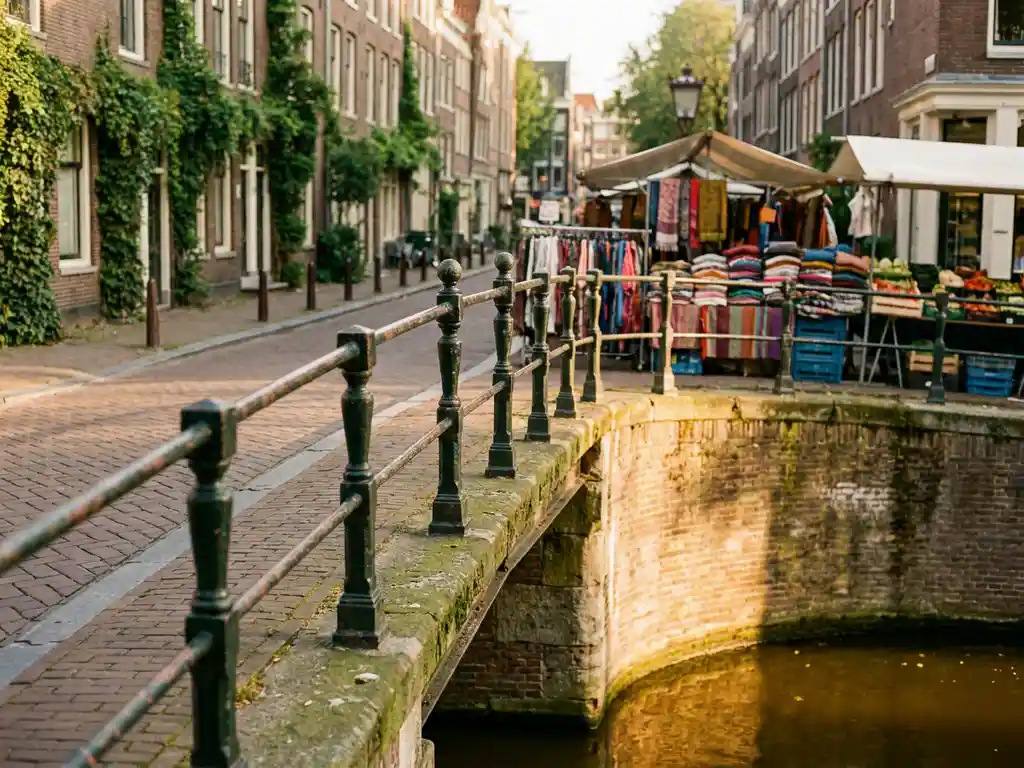
Walking through the Jordaan, you are surrounded by 17th-century canal houses with their distinctive stepped and bell-shaped gables. The streets are tight and often pedestrian-friendly. Small bridges cross narrow canals. Hidden courtyards appear behind unassuming doorways. The whole area feels like it was designed at a human scale, which of course it was — before cars, before mass transit, before anyone imagined the city would grow as large as it has.
De Pijp feels more open and urban. The main artery, Ferdinand Bolstraat, is a proper commercial street lined with shops, cafes, and restaurants. The Albert Cuyp Market, one of the longest outdoor markets in Europe, runs through the heart of the neighborhood and gives it a daily rhythm that is hard to replicate anywhere else in Amsterdam. The apartment buildings are taller and more uniform than the Jordaan’s canal houses, but the street life more than compensates.
How do the vibes of the Jordaan and De Pijp differ?
The Jordaan feels calm, romantic, and slightly nostalgic — a neighborhood that wears its history comfortably. De Pijp feels dynamic, multicultural, and energetic — a neighborhood that is always in the process of becoming something new. Both are genuinely loved by the people who live there, but they attract different types of people for different reasons.
The Jordaan has a quiet confidence about it. It knows it is beautiful and does not need to try too hard. Weekend mornings bring locals to the small street markets on Noordermarkt and Lindengracht. The cafes fill up with people who look like they have been regulars for decades. There is an intimacy to the neighborhood that feels earned rather than manufactured.
De Pijp is louder, more diverse, and more openly ambitious. It has been a magnet for young professionals, international residents, and creative types for years. The neighborhood has gentrified considerably, but it retains a multicultural energy that the Jordaan — which is now quite homogeneously affluent — has largely lost. If you want to feel the full, complicated, modern reality of Amsterdam, De Pijp gives you more of it.
Which neighborhood has better food, bars, and nightlife?
De Pijp has the edge on food diversity and nightlife energy, while the Jordaan wins on cozy, traditional Amsterdam brown cafes and a more relaxed drinking culture. Both neighborhoods offer excellent options, but they cater to different moods and tastes.
De Pijp is one of the best areas in Amsterdam for eating out. The concentration of restaurants along Gerard Doustraat and Van Woustraat covers an impressive range of cuisines, price points, and styles. The Albert Cuyp Market is a daytime food destination in its own right, with street food, fresh produce, and snacks that reflect the neighborhood’s multicultural makeup. If you are looking for cheap restaurants in Amsterdam that do not sacrifice quality, De Pijp is consistently one of the best places to look.
The Jordaan excels at the kind of Amsterdam bar experience that has become genuinely rare: the bruine kroeg, or brown cafe. These dark, wood-panelled pubs with their worn furniture and long histories are the soul of Dutch drinking culture, and the Jordaan has some of the finest examples in the city. The nightlife is quieter and more low-key than De Pijp, which suits the neighborhood perfectly.
Is the Jordaan or De Pijp better to live in?
For most people actually living in Amsterdam, De Pijp offers better day-to-day practicality and a stronger sense of neighborhood community, while the Jordaan offers unmatched beauty and tranquility at a premium price. The right answer depends heavily on your lifestyle, budget, and what you want from city living.
The Jordaan is one of the most expensive neighborhoods in Amsterdam. The combination of architectural beauty, central location, and low supply of available housing pushes prices to levels that put it out of reach for many. Those who do live there tend to be established, often older, and value the quiet and the prestige. It is a wonderful place to live if you can afford it and prefer calm over buzz.
De Pijp is also not cheap by any standard, but it offers more variety in housing stock and a livelier street-level experience. The neighborhood has excellent transport connections, a strong local market culture, and a mix of residents that makes it feel like a real, functioning urban community rather than an open-air museum. For expats and younger residents in particular, De Pijp consistently ranks among the best Amsterdam neighborhoods to actually put down roots.
Should tourists stay in the Jordaan or De Pijp?
Tourists who want a romantic, quintessentially Amsterdam experience should stay in the Jordaan. Those who want to be closer to local life, diverse food, and a livelier social scene will enjoy De Pijp more. Neither choice is wrong — it depends on what kind of Amsterdam you are looking for.
Staying in the Jordaan puts you in the middle of postcard Amsterdam: canal views, historic architecture, and easy walking distance to the Anne Frank House, the Westerkerk, and the main canal ring. It is genuinely one of the most beautiful urban neighborhoods in Europe, and waking up there never gets old. For first-time visitors who want to feel like they are living inside the Amsterdam they imagined, the Jordaan delivers.
De Pijp is a better base for visitors who want to move beyond the tourist circuit. The Heineken Experience is nearby, the Rijksmuseum and Van Gogh Museum are walkable, and the neighborhood itself gives you a more honest picture of how Amsterdam actually functions day to day. The Albert Cuyp Market alone is worth the choice. If you are the kind of traveler who uses a city blog rather than a guidebook, De Pijp is probably your neighborhood.
How Klagen Niet Klagen helps you understand Amsterdam’s neighborhoods
Choosing between the Jordaan and De Pijp is really a question about what kind of Amsterdam experience you are after — and that is exactly the kind of question that Klagen Niet Klagen exists to answer. Written from over three decades of lived experience in the city, the blog gives you the honest, insider perspective that no tourism board or travel aggregator will ever provide. Here is what you get:
- Opinionated, long-form takes on Amsterdam’s neighborhoods, culture, and contradictions
- Practical guidance on where to eat, drink, and explore — written by someone who actually lives it
- A frank look at what makes Amsterdam genuinely special and where it falls short
- Content written for expats, curious visitors, and internationally minded locals — not for tourists with a checklist
- Regular essays covering the full range of Amsterdam city life, from neighborhood dynamics to cultural quirks
If you want to understand Amsterdam the way a local does, start reading and keep coming back.
And if you really want to experience Amsterdam’s creative energy firsthand, there is no better place than Boom Chicago. The comedy theater that Andrew Moskos co-founded in 1993 has been making audiences laugh — and think — for over three decades. Whether you are a first-time visitor trying to crack the Dutch sense of humor or a long-time Amsterdam local who just wants a great night out, a Boom Chicago show is one of those experiences that makes the city feel fully alive. Get in touch or check the current shows and find out why it has become one of the most enduring institutions in Amsterdam’s cultural life.
Frequently Asked Questions
Is it easy to get between the Jordaan and De Pijp, and how long does it take?
Yes, the two neighborhoods are very easy to get between — a leisurely walk from the heart of the Jordaan to De Pijp takes around 20 to 30 minutes, passing through the canal ring and the Museum Quarter along the way. Cycling, which is of course the default Amsterdam mode of transport, cuts that to around 10 minutes. There is no real reason to choose one over the other for access to the city — both are well-connected and centrally located.
Which neighborhood is more beginner-friendly for first-time expats moving to Amsterdam?
De Pijp tends to be the more practical landing spot for first-time expats. The neighborhood has a well-established international community, a strong network of local services, and a social scene that makes it easier to meet people and find your footing quickly. The Jordaan is beautiful, but its higher price point and quieter social dynamic can make it a harder place to build a new social life from scratch — it rewards people who already have roots in the city.
Are there any common mistakes tourists make when visiting these neighborhoods?
One of the most common mistakes is trying to do both neighborhoods thoroughly in a single day — they each deserve unhurried time, and rushing through them means missing the small details that make them special. Another frequent misstep in the Jordaan specifically is sticking only to the main streets; the real magic is in the side streets, the hofjes, and the quieter canals that most visitors never find. In De Pijp, arriving at the Albert Cuyp Market late in the afternoon is a missed opportunity — go in the morning when it is at its most alive.