
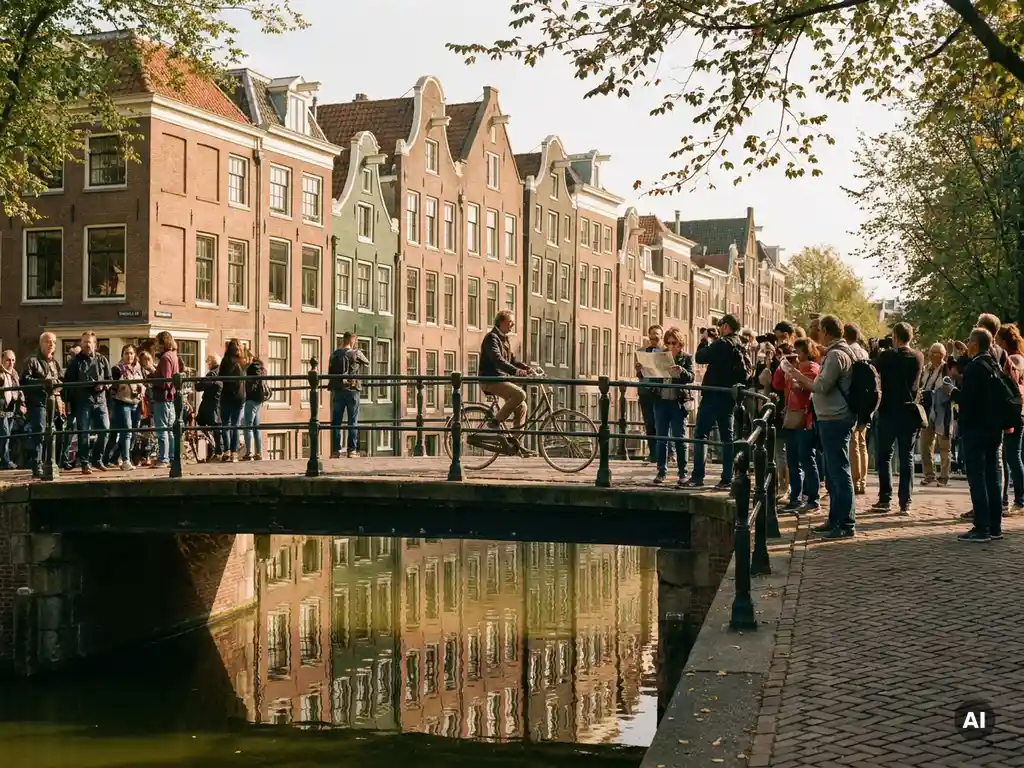
Amsterdam has made real progress balancing tourism with quality of life, but the balance remains imperfect and contested. The city has introduced meaningful restrictions – on short-term rentals, cruise ships, and hotel expansion – but the core tension between a globally desirable destination and a livable city for residents has not been resolved. The questions below dig into what has actually changed, who benefits, and what Amsterdam risks losing.
What has Amsterdam actually done to limit tourism?
Amsterdam has introduced some of the most aggressive anti-tourism measures of any major European city. The most significant steps include banning new hotels in the city centre, phasing out cruise ship terminals near the historic core, restricting short-term rentals to 30 nights per year, and outright banning cannabis sales to non-residents in certain areas. These are not symbolic gestures – they represent a genuine shift in municipal policy.
The city has also invested in redirecting visitors away from the most overcrowded neighbourhoods. Marketing campaigns have actively promoted lesser-known areas of the broader Amsterdam metropolitan region, and the municipality has published blunt messaging – including ads telling certain types of tourists they are not welcome – that would have been unthinkable from a tourism board even a decade ago.
What is striking is how far the conversation has moved. For years, Amsterdam’s economy leaned heavily into its popularity. The pivot toward managing and reducing visitor numbers reflects a recognition that growth in tourism had started to actively damage the city’s social fabric, housing market, and public spaces.
Does reducing tourism actually improve life for Amsterdam residents?
Reducing tourism improves some aspects of resident life, but the relationship between visitor numbers and quality of life is more complicated than it first appears. Fewer tourists in the Jordaan or De Wallen do make those streets more livable for the people who actually live there. Noise, litter, and anti-social behaviour drop when short-term rental properties convert back to long-term housing. These are real, measurable improvements.
But the gains are uneven. Many of the city’s cultural institutions – museums, theatres, music venues – depend on tourist spending to stay financially viable. When visitor numbers drop sharply, these institutions feel it first. The same applies to the hospitality sector, which employs a significant share of Amsterdam’s working population.
There is also a housing dimension that tourism policy alone cannot fix. The Amsterdam housing crisis has structural causes – land scarcity, planning constraints, population growth – that reducing Airbnb listings helps at the margins but does not solve at the root. Residents who struggle to find affordable housing are not primarily suffering because of tourism; they are suffering because of a housing market that has been broken for a long time.
Who benefits most from Amsterdam’s tourism economy?
The benefits of Amsterdam’s tourism economy are distributed unevenly, and that unevenness is at the heart of the debate about the balance between tourism and living. Large hospitality businesses, hotel chains, and commercial landlords capture a disproportionate share of tourism revenue. Meanwhile, the costs – noise, crowding, rising rents, degraded public space – fall most heavily on ordinary residents, particularly those in the city centre.
Small, independent businesses occupy a complicated middle ground. A local café or bookshop on a tourist-heavy street benefits from foot traffic but also faces rents inflated by the same tourism economy that drives customers through the door. Many have been priced out entirely, replaced by souvenir shops and chain restaurants that serve visitors rather than residents.
Workers in the tourism and hospitality sector benefit in terms of employment, but often in low-wage, precarious roles that do not offset the higher cost of living that tourism contributes to. The net effect for this group is frequently negative when housing and living costs are factored in.
Can Amsterdam stay a world-class city without mass tourism?
Yes – and the more interesting question is whether Amsterdam can stay a world-class city with mass tourism at its current scale. The cities that consistently rank as the most livable, creative, and culturally vital in the world are not necessarily the ones with the highest visitor numbers. They are the ones that have maintained the conditions that attract talented, curious, engaged people to actually live there long-term.
Amsterdam’s global reputation was built on genuine qualities: its architecture, its liberal culture, its history of trade and openness, its creative industries, and its human scale. None of those qualities require ten million tourists a year to sustain them. In fact, several of them are actively undermined by that volume of visitors.
What Amsterdam risks losing is not its international appeal – that is deeply embedded and will not disappear. What it risks losing is the social texture and economic diversity that made it interesting in the first place. A city centre full of short-term rental apartments and tourist restaurants is not a world-class city; it is a theme park with a very good canal system. The balance between tourism and living is ultimately a question about what kind of city Amsterdam wants to be – and who it wants to be that city for.
How Klagen Niet Klagen looks at Amsterdam’s tourism debate
This is exactly the kind of question that mainstream Amsterdam media tends to flatten into either cheerful tourism promotion or breathless crisis coverage. Klagen Niet Klagen exists to do something different: to sit with the genuine complexity, name the contradictions honestly, and write about them with the perspective that only comes from three decades of actually living and building something here.
- Long-form essays on Amsterdam city life written from genuine insider experience, not a press release
- Honest takes on the tensions between what makes Amsterdam great and what is slowly eroding it
- Commentary that serves residents, expats, and internationally minded visitors who want more than a top-ten list
- A consistent editorial voice free from tourism board influence or advertorial pressure
If you want more of this kind of writing, the blog archive is the place to start. Pull up a chair, pour something Dutch, and dig in.
And if you want to experience Amsterdam’s creative energy in person rather than just read about it, Boom Chicago has been doing exactly that since 1993. Sharp, funny, Amsterdam-rooted comedy that has nothing to do with tourist traps and everything to do with the city at its best. Check the shows and agenda – there is almost certainly something on that is worth your evening.
Frequently Asked Questions
How can Amsterdam residents get involved in shaping local tourism policy?
Amsterdam residents can engage through district council meetings (deelraadscommissies), public consultations on urban planning proposals, and civic organisations that lobby on housing and liveability issues. The municipality periodically opens formal feedback periods on major policy changes — such as short-term rental rules or zoning decisions — where individual input is recorded and considered. Staying informed through local outlets like Klagen Niet Klagen, rather than tourism-facing media, is a practical first step toward understanding which battles are actually worth fighting.
What are the most common misconceptions about Amsterdam's overtourism problem?
The biggest misconception is that overtourism is simply a numbers problem — that if visitor counts drop, everything improves. In reality, the damage is highly concentrated: a relatively small number of neighbourhoods, streets, and property types absorb the vast majority of negative effects, while other parts of the city see little tourist pressure at all. A second misconception is that tourism and a livable city are inherently incompatible; the real issue is the type of tourism, its spatial distribution, and who captures the economic benefits — not the existence of visitors per se.
Are other European cities handling the tourism-versus-liveability tension better than Amsterdam?
Barcelona and Lisbon face structurally similar problems and have implemented comparable tools — short-term rental caps, tourist taxes, cruise restrictions — with mixed results, suggesting there is no proven playbook that fully resolves the tension. Vienna is frequently cited as a counterexample: a city with enormous cultural draw and high visitor numbers that has maintained strong liveability scores, largely because of robust social housing policy and tight land-use controls that exist independently of tourism management. The lesson Amsterdam might draw is that tourism policy works best as a complement to strong housing and urban planning policy, not as a substitute for it.