
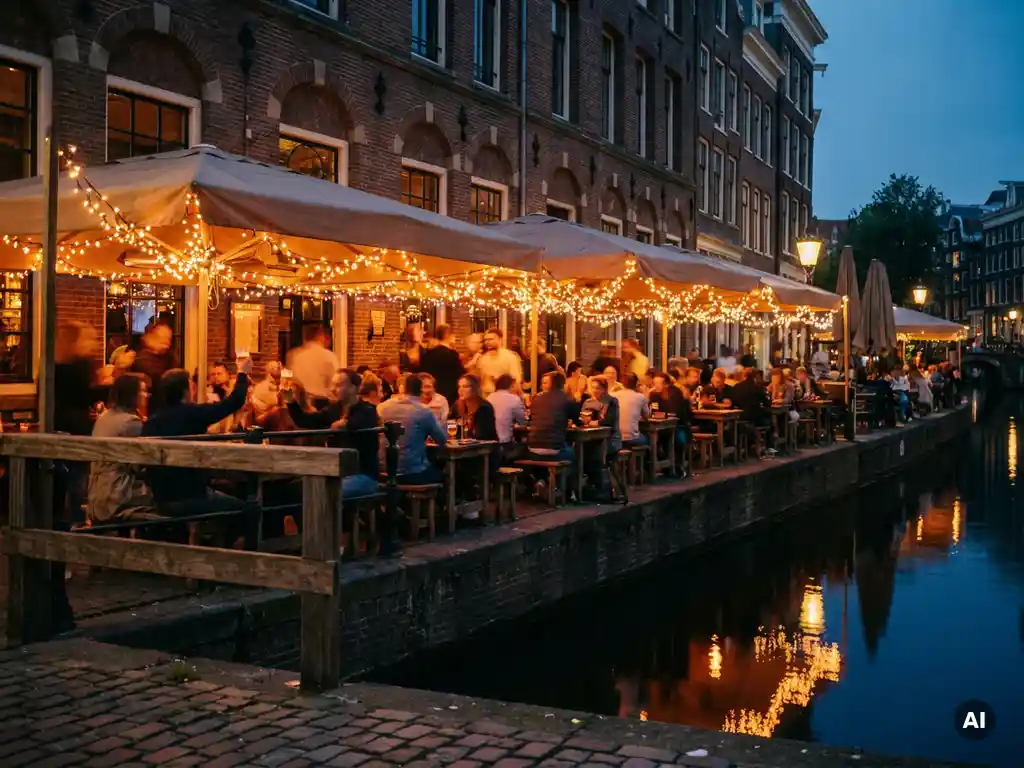
Amsterdam’s nightlife after covid has genuinely shifted, and in ways that go beyond simply replacing what was lost. The scene that emerged from the pandemic is more diverse, more neighbourhood-driven, and arguably more interesting than what existed before 2020. Some of the old club culture is gone for good, but what replaced it tells you a lot about how Amsterdam has changed as a city.
Which Amsterdam neighbourhoods have the best nightlife now?
The best nightlife in Amsterdam after covid is concentrated in Noord, De Pijp, and the emerging creative pockets of Oost. The old centre and Leidseplein still exist, but serious night owls have largely moved on. The energy and authenticity now live across the IJ and in the neighbourhoods where locals actually live.
Noord deserves the most attention. What was once an industrial backwater has become the city’s most exciting cultural district, with venues like NDSM Wharf continuing to host club nights, art events, and pop-up experiences in spaces that feel genuinely raw. The free ferry from Centraal Station makes it accessible without making it overrun.
De Pijp has matured from a bar-hopping neighbourhood into something with more texture. Natural wine bars, late-night cocktail spots, and intimate live music venues have replaced the rowdier student bars that defined it a decade ago. The crowd is older, the drinks are better, and the conversations are more interesting.
Oost, particularly around Javaplein and Dappermarkt, is where a lot of Amsterdam’s more adventurous nightlife energy has settled. It is less polished than De Pijp and more genuinely mixed in terms of who shows up. That mix is exactly what makes it worth your time.
What types of venues replaced the clubs that closed during covid?
The venues that replaced closed Amsterdam clubs after covid fall into three broad categories: smaller music-focused bars, cultural hybrid spaces, and outdoor or temporary event formats. The era of the large, anonymous techno club has given way to venues with a clearer identity and a more intentional atmosphere.
Smaller music bars have proliferated across the city. These are places with a proper sound system and a real programming philosophy, but a capacity of two or three hundred rather than a thousand. They feel more like venues where the music matters than warehouses where the experience is about volume and numbers.
Cultural hybrids are perhaps the most interesting development. Spaces that function as a gallery, a cinema, or a community centre by day shift into nightlife venues by evening. This dual-use model made financial sense during a period of uncertainty, and it turned out to create genuinely better atmospheres. People who are there for the culture tend to be more engaged than people who are simply there to queue.
Outdoor and temporary formats also exploded in popularity. Canal-side events, rooftop parties, and pop-up nights in unexpected locations became a fixture of Amsterdam summers during and after the pandemic. Some of these have now become semi-permanent fixtures on the city’s cultural calendar.
Why did some Amsterdam clubs never reopen after covid?
Many Amsterdam clubs never reopened after covid because the financial model was already fragile before the pandemic hit. Two years of zero revenue exposed structural weaknesses that had been masked by good years. When venues calculated the cost of reopening against the realistic revenue they could generate, many owners made the rational decision to walk away.
Amsterdam’s property market played a significant role. Landlords who had been patient during the lockdowns saw an opportunity to convert club spaces into residential or office use when leases came up for renewal. The city’s chronic housing shortage made this an economically obvious move, and planning regulations did not always stand in the way.
Staffing was another genuine barrier. The hospitality industry lost a generation of experienced workers during covid, many of whom found other careers and did not return. Reopening a club requires a reliable team of bartenders, security staff, and sound technicians, and that labour market had fundamentally changed.
Finally, some venues simply read the cultural moment correctly and concluded that their time had passed. The appetite for a certain kind of anonymous, high-capacity club experience had genuinely declined. Owners who were honest with themselves about this made a clean exit rather than trying to revive something the city had moved on from.
How has the Amsterdam nightlife crowd changed since covid?
The Amsterdam nightlife crowd after covid is older, more selective, and more willing to pay for quality over quantity. The shift is not dramatic, but it is consistent across venues and neighbourhoods. People go out less frequently but with more intention, and they tend to stay loyal to places that reward that intention with a genuinely good experience.
The international character of the crowd has also shifted. Amsterdam’s expat population has grown significantly since 2020, and that is reflected in who shows up at bars and venues across the city. English is now the default language in a wider range of nightlife settings than it was before the pandemic, which changes the social texture of an evening out in ways that are hard to quantify but easy to feel.
There is also a noticeable appetite for experiences that combine nightlife with something else. People want to see a live set, attend a talk, or visit an exhibition before the dancing starts. The crowd that emerged from covid is not content with a venue that offers only a dancefloor and a bar. They want a reason to be there beyond the obvious ones.
How Klagen Niet Klagen helps you navigate Amsterdam nightlife
Klagen Niet Klagen is an Amsterdam city blog written by someone who has been part of this city’s creative and nightlife scene for over thirty years. That perspective matters when the landscape keeps shifting. Here is what the blog offers:
- Honest, insider commentary on Amsterdam neighbourhoods and how they are actually changing, not how the tourism board wants you to see them
- Long-form essays that go beyond the obvious and explore the cultural and social forces shaping the city’s nightlife
- A consistent editorial voice free from advertorial pressure or venue sponsorship
- Nuanced takes on what has genuinely improved in Amsterdam and what has been lost, written from a position of real skin in the game
- Content aimed at expats, culturally curious visitors, and internationally minded Amsterdammers who want more than a top-ten list
If you want to understand Amsterdam nightlife rather than just consume it, read more about the blog and explore the archive for essays that put the current moment in proper context.
And if you want to experience Amsterdam’s creative energy live and in person, Boom Chicago has been doing exactly that since 1993. The comedy institution that helped shape the city’s English-language cultural scene runs shows year-round, and an evening there gives you a feel for Amsterdam’s wit and irreverence that no nightlife guide can replicate. It is the kind of night out that actually gives you something to talk about the next morning.
Frequently Asked Questions
What's the best way to find out about one-off events and pop-up nights in Amsterdam without relying on mainstream listings?
The most reliable approach is to follow the social media accounts of venues you already trust, since Amsterdam’s pop-up and temporary event scene is largely announced through Instagram and word of mouth rather than centralised listings platforms. Neighbourhood-specific Telegram groups and local city blogs like Klagen Niet Klagen are also worth bookmarking, as they tend to surface events that never make it onto the tourist-facing apps. Getting plugged into a few regular mailing lists from Noord or Oost venues will do more for your nightlife calendar than any generic city guide.
Is Amsterdam nightlife still worth exploring as a visitor, or has it become too expat-dominated and lost its local character?
Amsterdam nightlife is absolutely still worth exploring as a visitor, but the experience you get depends almost entirely on where you go. Sticking to Leidseplein or the centre will give you a heavily tourist-facing version of the city that locals have largely abandoned. Crossing the IJ to Noord, or spending an evening working through the bars around Javaplein in Oost, puts you in spaces where the crowd is genuinely mixed and the atmosphere is shaped by people who actually live there. The local character has not disappeared — it has just moved, and finding it requires a bit more deliberate navigation than it did before.
What are the most common mistakes people make when planning a night out in Amsterdam for the first time?
The biggest mistake is concentrating everything around the centre and assuming that proximity to the main tourist landmarks equals quality nightlife — it almost never does in Amsterdam. A close second is underestimating how neighbourhood-specific the city’s nightlife has become; what works in De Pijp is a completely different experience from what you will find in Noord, and treating them as interchangeable wastes an evening. Finally, many first-time visitors overlook earlier programming like live sets, talks, or gallery openings that happen before midnight, which are often the most interesting part of a night at Amsterdam’s better cultural hybrid venues.