
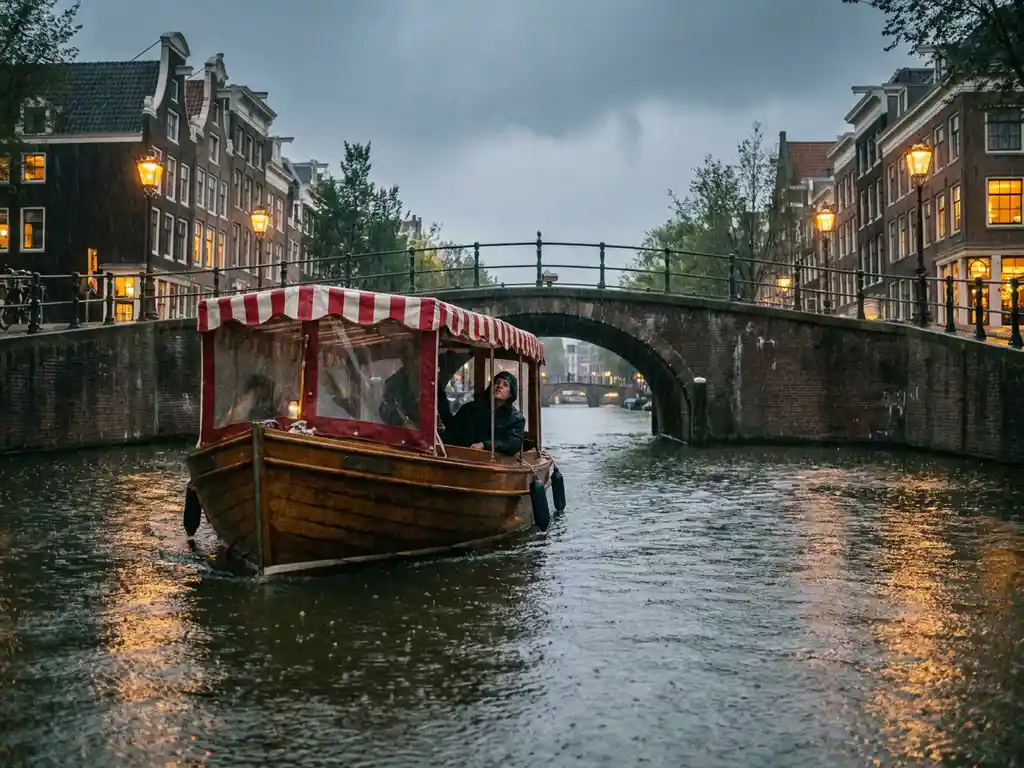
The best canal tour in Amsterdam for a rainy day is one with a fully enclosed or covered boat — and there are plenty of good options. Most of the larger commercial canal tour operators run glass-topped or fully enclosed vessels, which means the rain becomes scenery rather than a problem. Below are the key questions answered so you can pick the right tour, show up prepared, and actually enjoy it.
Which canal tours have covered or enclosed boats?
Most of the major Amsterdam canal tour operators run fully enclosed glass-topped boats, making them genuinely suitable for rainy weather. Companies like Blue Boat, Lovers Canal Cruises, and Amsterdam Canal Cruises all operate enclosed vessels with panoramic windows and climate control. The glass-roof design lets you see the canal houses and bridges without getting soaked.
If you want a more intimate experience, smaller private boat operators sometimes offer covered wooden salon boats — often called salonboten — which have a cabin section that keeps passengers dry. These tend to feel more authentic and less like a floating bus, though they come at a higher price point. For a rainy day specifically, the fully enclosed glass boats are the most practical choice: you stay completely dry, the windows are large enough to actually see the city, and the heating makes the whole experience comfortable even in February.
One thing worth knowing: open-top boats do exist, and some operators run a mix of vessel types. When booking, always confirm the boat type explicitly rather than assuming. “Canal tour” does not automatically mean “covered boat.”
What’s the difference between a private and a group canal tour in Amsterdam?
A group canal tour follows a fixed route with recorded or live commentary, typically lasting 60 to 75 minutes, and you share the boat with strangers. A private canal tour means you rent the entire boat — often with a captain and sometimes a host — and can customise the route, timing, and atmosphere to suit your group.
Group tours are significantly cheaper, usually ranging from around 15 to 25 euros per person. They are efficient and informative, but the experience is standardised. You stop where everyone stops, hear the same commentary as everyone else, and cannot linger at a particular spot that catches your eye.
Private tours cost considerably more — often starting at 150 to 200 euros for a small group — but they offer a fundamentally different experience. You can bring your own food and drinks, set your own pace, and actually have a conversation rather than listening to a headset. On a rainy day, a private salon boat with a small group of friends or family feels genuinely special rather than just functional. If budget allows, it is the better choice for a memorable Amsterdam experience rather than a box-ticking exercise.
How long does a typical Amsterdam canal tour last?
A standard Amsterdam canal tour lasts approximately 60 to 75 minutes. This is enough time to cover the main canal ring, pass the Anne Frank House, see the Westerkerk, and get a sense of the city’s historic waterfront without feeling rushed or exhausted.
Longer tours of 90 minutes to two hours also exist and typically extend into the eastern harbour area or the Jordaan neighbourhood. These are worth considering if you have a genuine interest in Amsterdam’s architectural history, but for most visitors, the standard 60-minute tour covers the essential highlights comfortably.
On a rainy day, the duration question matters more than it might seem. An hour on a warm, enclosed boat watching the rain fall on the canals is pleasant. Two hours starts to test even the most enthusiastic tourist’s patience, especially if you have children with you. For most people, the 60-minute option is the sweet spot.
Where do Amsterdam canal tours depart from?
Most Amsterdam canal tours depart from one of three main areas: the Damrak (near Centraal Station), the Rokin, or the Leidseplein area. The Damrak and Rokin departure points are the most convenient if you are arriving by train, as they are within walking distance of Centraal Station.
The Leidseplein departure points tend to be slightly less crowded and drop you into the canal ring more quickly, which means more time actually seeing the city and less time navigating out of the busy tourist corridor around the station. If you have a choice, Leidseplein is generally the more pleasant starting point.
Some private operators depart from quieter locations along the Prinsengracht or Keizersgracht, which immediately puts you in the heart of the canal ring rather than the commercial centre. These are worth seeking out if you want the experience to feel less like a theme park queue and more like a genuine Amsterdam afternoon.
Should you book a canal tour in advance or just show up?
For group tours, booking in advance is strongly recommended during spring and summer, and on weekends year-round. In peak season, popular departure times sell out. In autumn and winter — including most rainy days — walk-up availability is usually fine, though booking online often gets you a small discount and saves you from standing in a queue.
For private tours, always book in advance. Good operators fill up quickly, and the better salon boats are often reserved days or even weeks ahead. Last-minute private bookings are possible but limit your options significantly.
The honest answer is that booking ahead costs you nothing and saves you the frustration of arriving at the canal with a group of wet, impatient people only to find the next available slot is in two hours. Five minutes online the night before is worth it.
What should you bring on an Amsterdam canal tour in the rain?
On an enclosed canal tour in the rain, you need less than you might think. The boats are heated and fully covered, so heavy rain gear is unnecessary inside. That said, you will be walking to and from the departure point, so a compact umbrella or a waterproof jacket is practical.
A few things worth bringing regardless of weather:
- A charged phone or camera — the canal houses look spectacular in moody, overcast light, and the reflections on wet cobblestones are genuinely beautiful
- A light layer — the boats are heated but the temperature can vary, and stepping off into the cold after an hour in a warm cabin is a sharp contrast
- Cash or a card — some smaller operators do not accept all payment methods, and buying a warm drink at the dock is always a good idea
- Comfortable shoes — canal tour docks are often on slippery stone steps, and heels or slick-soled shoes are a bad idea in wet weather
One underrated tip: a rainy afternoon is actually one of the better times to take a canal tour. The crowds thin out, the light on the water is dramatic, and the city looks the way it does in all those classic Dutch paintings — grey, atmospheric, and genuinely beautiful. Do not let a bit of rain talk you out of it.
How Klagen Niet Klagen helps you navigate Amsterdam like a local
Canal tours are just one slice of what Amsterdam has to offer — and finding the honest, unvarnished version of the city takes more than a booking platform and a tourist map. That is exactly what Klagen Niet Klagen is here for: independent, opinionated commentary on Amsterdam life, written by someone who has lived it for over three decades.
- Honest takes on Amsterdam experiences — what is genuinely worth your time and what is overpriced and overrated
- Practical guides on things to do in Amsterdam across every season and every kind of weather
- Long-form essays on the city’s culture, contradictions, and hidden character — the stuff no tourism board will ever tell you
- A consistent, trustworthy editorial voice rather than anonymous listicles or sponsored content
If you want to go deeper than the canal tour, explore the full blog archive for more Amsterdam perspectives written from the inside.
And if you are already in Amsterdam and looking for something to do after the boat docks, consider spending an evening at Boom Chicago — the comedy theatre that has been making Amsterdam laugh since 1993. Live improvisation, sharp political humour, and a warm room full of people who came for a good time: on a rainy Amsterdam evening, there are worse places to end up. Take a look at the shows and agenda and see what is on.
Frequently Asked Questions
Are Amsterdam canal tours worth it in winter, or is the experience too limited by the weather?
Winter is actually one of the more underrated times to take a canal tour in Amsterdam. The crowds are significantly smaller, the atmosphere on the water is moody and cinematic, and the enclosed boats are fully heated — so the cold outside becomes part of the charm rather than a deterrent. If you visit in late November or December, you may also catch the Amsterdam Light Festival, which transforms the canals into an open-air art exhibition best viewed from the water.
Can I take a canal tour with young children, and are there any practical things to know?
Yes, canal tours are generally very child-friendly — the enclosed boats are stable, warm, and require no physical exertion, which makes them a good option even with toddlers. Most major operators offer free or reduced fares for young children, so check the age thresholds when booking. For restless kids, the 60-minute tour is the right call; anything longer tends to push the limits of their patience, especially on a grey day when there is less visual variety to keep them engaged.
Is there a best time of day to take a canal tour in Amsterdam for photography?
The golden hour before sunset — roughly 4 to 6 PM depending on the season — gives the canal houses a warm, flattering light that makes for the most striking photographs. On overcast or rainy days, the soft diffused light actually works in your favour: it eliminates harsh shadows and brings out the texture of the brick facades and the reflections on the water. Morning departures are also worth considering if you want fewer boats in your shots and a quieter experience overall.
Related Articles
- What streets are affected by the new traffic policy?
- What is the difference between the Jordaan and De Pijp neighborhoods?
- How do you find the best canal tour in Amsterdam for your budget?
- What day trips from Amsterdam can you do without a car?
- What is the best neighborhood in Amsterdam to walk around freely?