
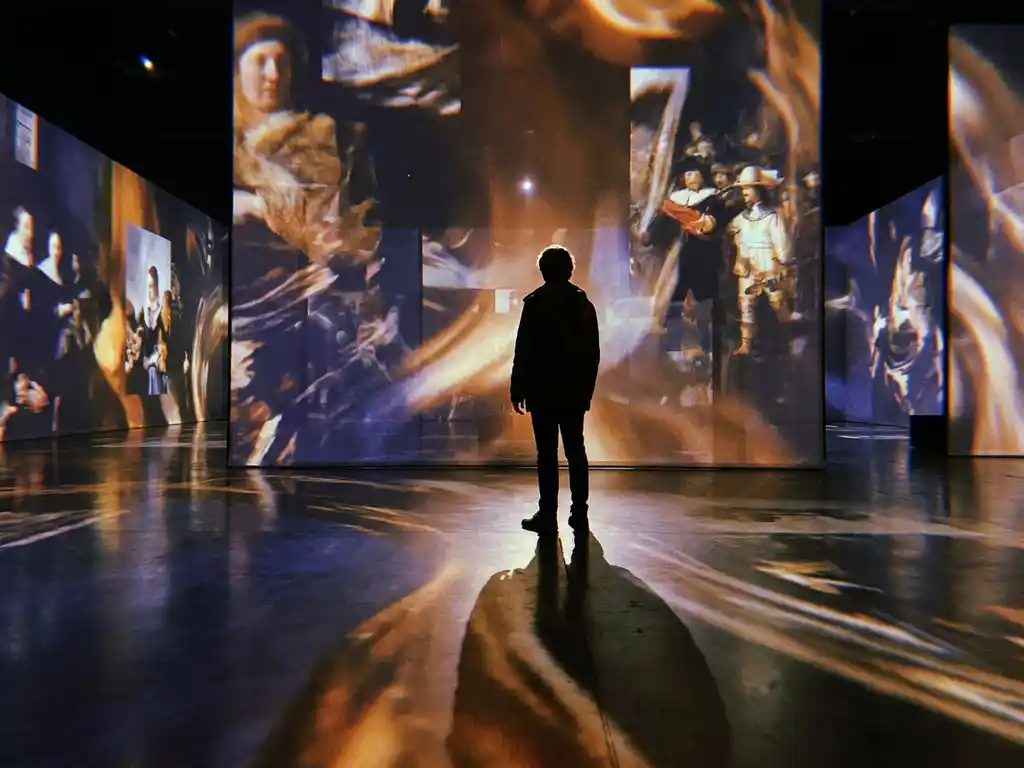
Amsterdam’s best immersive art experiences in 2026 include WONDR Experience, Moco Museum’s digital exhibitions, and a growing number of projection-based and sensory shows that have made the city one of Europe’s most interesting destinations for this format. The quality varies considerably, and not every experience justifies the ticket price — but the standouts are genuinely impressive. Below, the most useful questions are answered honestly, from a local who has seen more than a few of them.
Which immersive art venues in Amsterdam are worth visiting in 2026?
The venues most consistently worth your time in Amsterdam right now are WONDR Experience in Amsterdam-Noord, the Moco Museum on Museumplein, and whatever rotating large-scale projection show is currently running at one of the city’s repurposed industrial spaces. These three represent different ends of the spectrum — playful and Instagram-friendly, commercially polished, and genuinely ambitious — and between them they cover most of what the format can do.
WONDR is probably the most talked-about. It occupies a sprawling space in Noord and delivers room after room of interactive, sensory environments. It leans heavily into the shareable aesthetic — bright colours, fog machines, mirrors — but it does it well enough that even the cynical visitor tends to enjoy it. The Moco Museum has built a strong reputation for its Banksy collection, but its digital and immersive wing, featuring work from artists like Refik Anadol, pushes it into more intellectually serious territory.
Beyond the permanent or semi-permanent venues, Amsterdam regularly hosts travelling large-format shows. Productions built around Van Gogh, Klimt, and other canonical artists have cycled through the city in recent years, typically taking over a warehouse or event space for a season. These vary enormously in quality. Some are genuinely moving. Others feel like a screensaver projected on a very large wall. Check what is currently running before you book.
What’s the difference between immersive art and interactive art?
Immersive art surrounds you with an environment — light, sound, projection, scent — designed to absorb your attention and alter your sense of being in a space. Interactive art goes a step further by responding to your presence or actions. The key distinction is agency: immersive art envelops you, interactive art changes because of you.
In practice, Amsterdam’s most popular experiences blend both. WONDR, for instance, includes rooms where your movement triggers visual or audio responses alongside rooms where you simply stand inside a carefully constructed environment. The Moco’s digital installations tend toward the immersive end — you watch and absorb rather than participate.
The distinction matters when you are deciding what to book. If you are visiting with children or a group that wants to feel actively involved, prioritise venues with strong interactive elements. If you are looking for something more contemplative — closer to a conventional art experience but with a heightened sensory dimension — a purely immersive show may suit you better.
How much do immersive art experiences in Amsterdam cost?
Most immersive art experiences in Amsterdam cost between €15 and €30 per adult, with children’s tickets typically available at a reduced rate. Premium or limited-run shows can push above €30. WONDR Experience sits in the €20 to €25 range depending on the session and any add-ons. The Moco Museum is similarly priced, though it covers considerably more than just the digital wing.
It is worth booking in advance for most of these venues. Popular time slots sell out, particularly on weekends and during school holidays. Booking online also tends to be slightly cheaper than buying at the door, and some venues offer early-bird or off-peak pricing if you are flexible on timing.
If you are watching your budget, keep an eye on Amsterdam’s cultural discount schemes. The Museumkaart, which gives unlimited access to hundreds of Dutch museums for an annual fee, covers some immersive venues but not all — check before assuming it applies. For visitors rather than residents, the I Amsterdam City Card bundles museum access with public transport and may include relevant venues depending on the current partnership agreements.
Are Amsterdam’s immersive art experiences actually worth it?
Honestly, it depends on what you are after. The best immersive experiences in Amsterdam are genuinely worth it — they are well-produced, often surprising, and offer something you cannot get from a conventional gallery visit. The weaker ones feel like expensive novelties that exhaust their concept within the first ten minutes. The honest answer is that the format has a ceiling, and not every show reaches it.
The experiences that tend to hold up are those with a strong artistic concept behind the spectacle. Refik Anadol’s data-driven installations at Moco, for instance, give you something to think about beyond the visual effect. WONDR works because it commits fully to the playful, physical experience it promises rather than pretending to be something more profound than it is. The ones that disappoint are usually the ones that use a famous artist’s name as a branding exercise and then deliver a glorified slideshow.
A useful test: if the venue’s marketing leads with the number of square metres or the number of projectors, be sceptical. If it leads with the artist or the concept, it is more likely to deliver something with actual substance.
Where are Amsterdam’s immersive exhibitions located?
Amsterdam’s immersive art experiences are spread across several distinct parts of the city. Museumplein, in the south, is home to the Moco Museum and sits within easy walking distance of the Rijksmuseum and Van Gogh Museum. Amsterdam-Noord, accessible via a free ferry from Centraal Station, has become the city’s main hub for larger, more experimental venues — WONDR is based there, and the area’s former industrial buildings make it a natural fit for large-format shows.
The city centre occasionally hosts pop-up or temporary immersive exhibitions in repurposed spaces, though these come and go quickly. The Eastern Docklands and the area around Westerpark have also hosted significant productions in recent years. If you are planning a visit specifically around an immersive experience, it is worth mapping the location in advance — Amsterdam’s neighbourhoods are distinct enough that combining a show in Noord with dinner in De Pijp requires a bit of planning.
When is the best time to visit immersive art shows in Amsterdam?
Weekday mornings are the best time to visit immersive art shows in Amsterdam. Crowds are thinner, the experience is less rushed, and you are more likely to have key rooms or installations to yourself for at least a few minutes — which matters enormously for the quality of the experience. Weekend afternoons, particularly in summer, can feel more like queuing than exploring.
Seasonally, the quieter months for tourism in Amsterdam — roughly November through February, excluding the holiday period — mean shorter queues and a more relaxed atmosphere across the board. That said, some shows are specifically designed for the darker months, with light and projection-based work often hitting differently when the city outside is grey and cold. There is something to be said for stepping into a room full of colour and warmth when it is raining sideways on the Prinsengracht.
If you are visiting during peak season and weekday mornings are not possible, booking the first slot of the day remains the next best option. Venues are freshest, staff are most energetic, and the cumulative effect of hundreds of visitors has not yet taken its toll on the experience.
How Klagen Niet Klagen helps you navigate Amsterdam’s art scene
Finding the genuinely good experiences in Amsterdam — the ones worth your time and money — is harder than it should be. Most online content about Amsterdam is either written for first-time tourists or produced by venues promoting themselves. Klagen Niet Klagen exists to fill that gap: honest, experienced, opinionated commentary on what Amsterdam actually has to offer, written by someone who has lived and worked here for over thirty years.
- Honest assessments of Amsterdam experiences — no advertorial pressure, no tourism board spin
- Long-form cultural commentary that goes beyond the surface of what the city offers
- Written from genuine insider knowledge, not a journalist’s weekend visit
- Covers the full range of Amsterdam life — art, comedy, neighbourhoods, food, and the city’s contradictions
- Relevant for expats, international visitors, and curious locals alike
If you want more of this kind of honest, locally grounded perspective on Amsterdam, the full blog archive has you covered across a wide range of topics.
And if immersive experiences are your thing, it is worth knowing that live performance — done well — is the original immersive art form. Boom Chicago has been putting audiences inside sharp, surprising, and genuinely funny shows in Amsterdam since 1993. Improvisation theatre responds to the room in real time in a way no projection wall ever can. Check the current shows and agenda — there is a good chance something is on that will stay with you longer than any Instagram-friendly fog room.
Frequently Asked Questions
Can I visit multiple immersive art venues in Amsterdam in a single day?
It is possible but not always advisable. Most immersive experiences are designed to be absorbed slowly, and back-to-back visits can lead to sensory fatigue that dulls the impact of each show. A more practical approach is to pair one immersive venue with a conventional gallery or neighbourhood walk — for example, WONDR in the morning followed by a wander through Amsterdam-Noord’s creative district in the afternoon. If you are set on two in a day, prioritise the more contemplative experience first and the more playful, high-stimulation one second.
What should I bring or wear to get the most out of an immersive art experience?
Comfortable, flat shoes are genuinely important — most venues involve a lot of standing, walking, and occasionally sitting on the floor. Avoid bulky bags where possible, as some installations are physically tight and large bags become a nuisance for both you and other visitors. If you plan to take photos, a phone with a decent low-light camera will serve you better than a DSLR in most environments. One underrated tip: arrive without a rigid schedule for how long you will spend, since the best experiences tend to reward those who linger rather than move through at a fixed pace.
Are Amsterdam's immersive art experiences suitable for young children?
Many are, but with caveats worth knowing in advance. WONDR Experience is generally well-suited to children — it is physical, colourful, and designed to engage visitors of all ages. However, some installations use loud sound design, strobing light effects, or very dark environments that can be distressing for younger or more sensitive children. Check the venue’s website for any age guidance or sensory warnings before booking, and if you are visiting with a child under five, weekday morning slots will give you a much calmer experience than peak weekend sessions.