
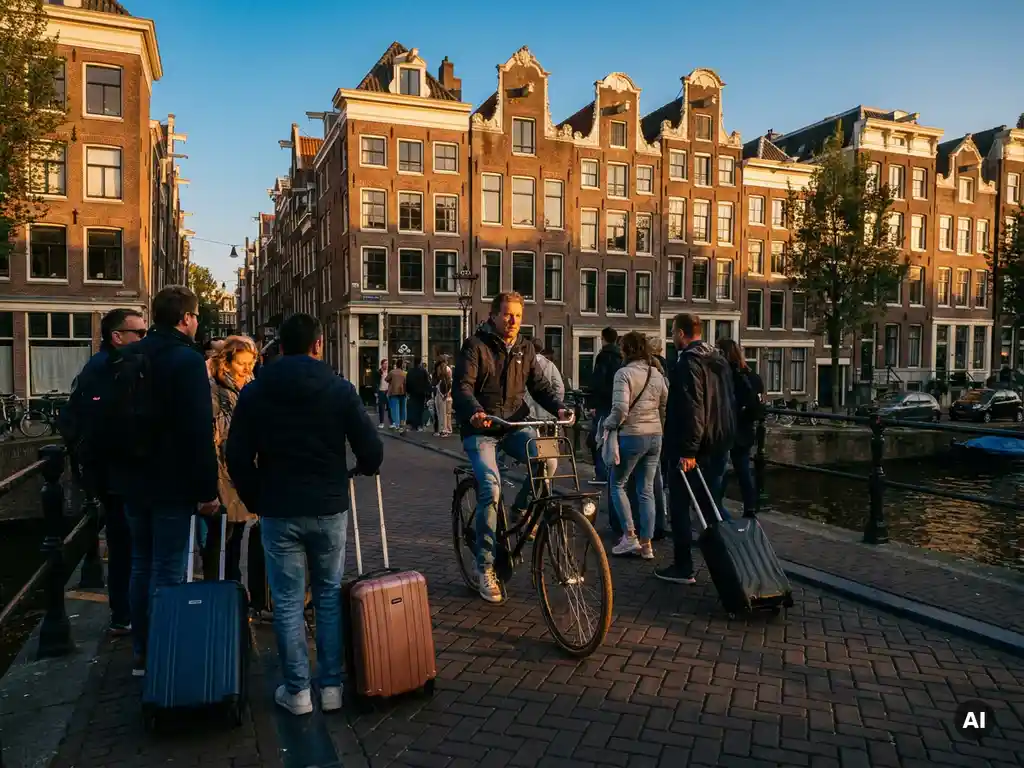
Amsterdam has introduced a range of policies to balance tourism and residential life, including Europe’s highest hotel tourist tax, cruise ship restrictions, short-stay rental limits, and targeted crowd management in sensitive neighbourhoods. These measures have had real but uneven results. The balance between tourism and living in Amsterdam remains one of the city’s most contested ongoing debates, and the sections below unpack exactly why.
Which Amsterdam policies have actually reduced tourist pressure?
Several Amsterdam policies have measurably reduced tourist pressure in specific areas. The ban on new hotels in the city centre, limits on Airbnb rentals to 30 nights per year, the closure of the cruise terminal at Passenger Terminal Amsterdam, and the redirection of large ships to IJmuiden have all contributed to reducing visitor volume in the most congested parts of the city.
The short-stay rental cap deserves particular attention. By limiting residents to renting out their homes for a maximum of 30 nights per year, the city clawed back thousands of properties that had effectively been converted into permanent tourist accommodation. In neighbourhoods like the Jordaan and De Pijp, this made a tangible difference to housing availability, even if it did not solve the broader housing crisis.
The city has also experimented with redirecting tourist flows through campaigns that actively discourage certain visitor profiles. One campaign, aimed at young British men planning alcohol-fuelled weekends, told them bluntly: Amsterdam does not want you here. Whether that kind of messaging changes behaviour at scale is debatable, but it signals a political willingness to prioritise residents over revenue that was largely absent a decade ago.
How does Amsterdam’s tourist tax compare to other European cities?
Amsterdam charges one of the highest tourist taxes in Europe. As of 2026, visitors pay 12.5% of the accommodation price per night, making it significantly more expensive than cities like Paris, Barcelona, or Rome, which typically charge flat fees of a few euros per night. Amsterdam also applies a separate tax on cruise passengers and day-trippers arriving by sea.
The logic behind a percentage-based tax rather than a flat fee is that it scales with the cost of accommodation, meaning luxury travellers pay substantially more than budget visitors. In theory, this discourages the lowest-spending, highest-impact visitor while generating revenue that can be reinvested in the city’s infrastructure and livability.
In practice, the tax has generated significant income for the municipality, but critics argue it has done little to reduce visitor numbers. A traveller willing to spend hundreds of euros on a hotel room is unlikely to be deterred by an additional 12.5%. The tax functions better as a revenue tool than as a crowd management mechanism.
Why is it so hard to protect Amsterdam residents from overtourism?
Protecting Amsterdam residents from overtourism is genuinely difficult because the city’s economy, its physical layout, and its global brand all pull in the opposite direction. Tourism generates billions in annual revenue, employs a significant portion of the workforce, and funds cultural institutions that residents themselves value. Reducing it meaningfully requires accepting real economic trade-offs that elected officials are reluctant to make.
The city’s geography compounds the problem. Amsterdam’s historic centre is small, dense, and irreplaceable. Unlike a larger city that can absorb tourist pressure across many districts, Amsterdam funnels millions of visitors into a handful of canals and streets that also happen to be where people live. There is no obvious overflow valve.
Enforcement is another persistent challenge. Short-stay rental rules, noise regulations, and zoning restrictions are only as effective as the capacity to monitor and enforce them. The city has invested in enforcement teams, but the scale of the problem consistently outpaces the resources available to address it. Platforms that facilitate short-term rentals have also historically been slow to share data with municipalities, making oversight harder than it should be.
What do Amsterdam residents actually want from city policy?
Amsterdam residents consistently want city policy to prioritise housing availability, neighbourhood livability, and genuine enforcement over tourism revenue. Surveys and public debates repeatedly surface the same demands: fewer short-stay rentals converting residential properties into hotels, stricter limits on noise and nuisance in residential streets, and a clearer signal from the municipality that residents come first.
Beyond the practical complaints, there is a deeper frustration about identity. Many long-term residents, both Dutch and international, feel that the city they chose to live in is being slowly replaced by a theme-park version of itself. The coffee shops, the red-light district, and the canal boat selfies are not wrong in themselves, but when they dominate the public space entirely, the city loses the texture and authenticity that made it worth living in.
What residents rarely ask for is a complete end to tourism. Amsterdam is a cosmopolitan, outward-facing city, and most people who live here genuinely enjoy that. What they want is proportionality: a city where the needs of the people who actually live, work, and raise children here are weighted at least as heavily as the preferences of visitors who will leave on Sunday.
How Klagen Niet Klagen looks at Amsterdam’s tourism debate
Klagen Niet Klagen exists precisely for questions like this one. The balance between tourism and living is not a problem you can solve with a listicle or a tourism board press release. It needs honest, experienced, opinionated commentary from someone who has actually built a life and a business in Amsterdam across more than three decades. That is what this blog offers.
- Long-form essays on Amsterdam city policy written from a resident’s perspective, not a visitor’s
- Commentary that names the real tensions without diplomatic softening
- A consistent editorial voice grounded in lived experience, not journalistic distance
- An English-language platform for a conversation that is too often conducted only in Dutch
If you want more of this kind of thinking, the about page explains the perspective behind it, and the blog archive has plenty more where this came from. Amsterdam deserves better than polished city marketing. So do you.
And if you want to experience Amsterdam’s sharpest, most honest cultural commentary in a live setting, Boom Chicago has been doing exactly that since 1993. Improvisation, comedy, and a genuinely Amsterdam point of view, on a stage in the heart of the city. It is the kind of night out that reminds you why you chose to live here, or why you should visit again with your eyes properly open this time.
Frequently Asked Questions
How is Amsterdam planning to enforce short-stay rental limits more effectively in the coming years?
Amsterdam is pushing for greater data-sharing obligations from platforms like Airbnb and Booking.com, which has historically been one of the biggest enforcement gaps. The city is also expanding its dedicated inspection teams and using algorithmic monitoring to flag listings that appear to exceed the 30-night annual cap. That said, enforcement remains an uphill battle — the rules are only as strong as the political will and municipal budget behind them.
If the tourist tax doesn't actually reduce visitor numbers, what crowd management tools work better?
Hard caps and outright bans tend to be more effective than price signals for crowd management — Amsterdam’s closure of the central cruise terminal is a good example of a structural intervention that produced measurable results. Redirecting tourist infrastructure away from residential neighbourhoods, rather than simply taxing access to it, has a more direct impact on where and how visitors move through the city. Targeted de-marketing campaigns aimed at specific visitor profiles are a newer tool, and while their long-term effectiveness is still being evaluated, they represent a meaningful shift in how cities frame their relationship with tourism.
Which Amsterdam neighbourhoods have felt the biggest relief from recent tourism policies, and which are still struggling?
The Jordaan and De Pijp have seen some genuine improvement in housing availability following the short-stay rental crackdown, as thousands of properties were returned to the long-term rental market. The Red Light District and the streets immediately around Centraal Station remain deeply saturated, and policy has so far struggled to meaningfully change visitor behaviour in those corridors. Newer pressure points like the Haarlemmerstraat area and parts of Amsterdam Noord are increasingly feeling the effects of tourist displacement from the most restricted zones.
Related Articles
- What role does local government play in reclaiming space for residents?
- What does "Amsterdam for residents" actually mean in practice?
- Can a city ever fully balance tourism and residential life?
- How do you spend a perfect weekend in Amsterdam in 2026?
- How do you find a cheap hotel in Amsterdam without sacrificing location?