
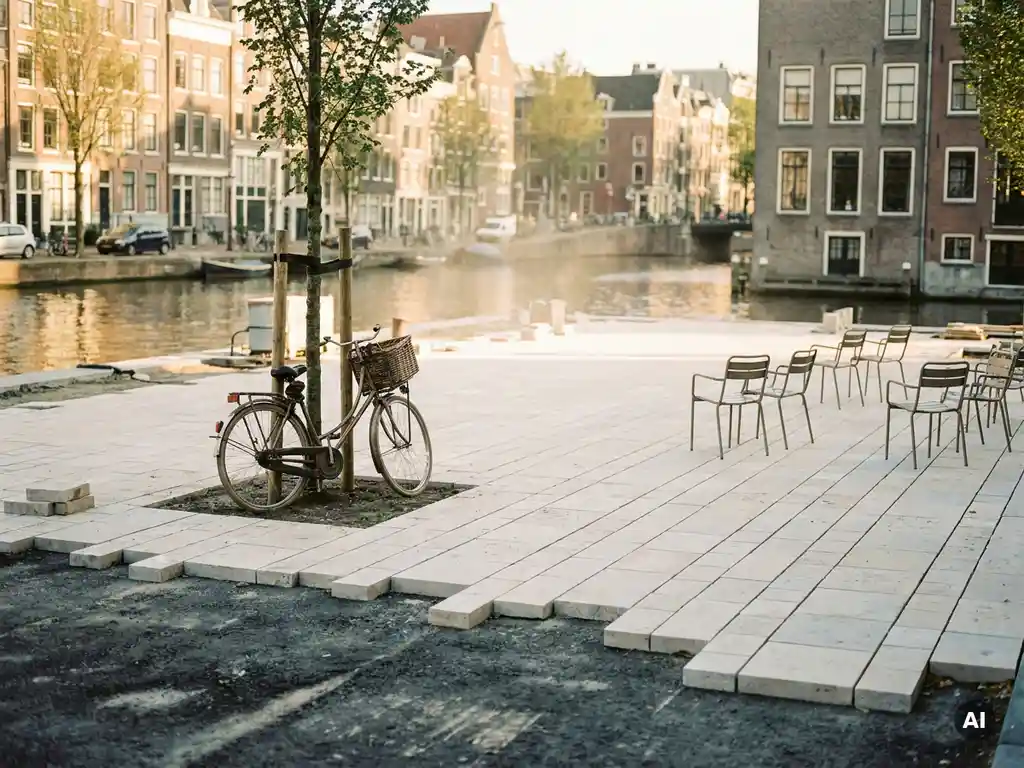
Amsterdam is actively redesigning its public spaces by removing car lanes, expanding cycling infrastructure, widening pavements, and transforming former parking areas into green plazas and social gathering spots. The city is pursuing one of Europe’s most ambitious urban redesign programmes, driven by a long-term commitment to liveability, sustainability, and reclaiming street space for people rather than vehicles. Below, we unpack the key questions residents and visitors are asking about what is actually changing and why.
What specific changes is Amsterdam making to its streets and squares?
Amsterdam’s public space redesign involves removing thousands of on-street parking spaces, narrowing or eliminating car lanes, widening cycling paths, planting trees, and converting asphalt into permeable surfaces, greenery, and seating areas. Squares that once functioned primarily as car parks or traffic thoroughfares are being reimagined as pedestrian-friendly public plazas.
Some of the most visible changes are happening in the city centre and inner-ring neighbourhoods. The Spui, Leidseplein area, and various canal-side streets have all seen or are scheduled to see significant reconfigurations. The city has also invested in improving the quality of street furniture, lighting, and drainage as part of these redesigns, not just moving cars out but actively making the reclaimed space more pleasant to inhabit.
Parking reduction is a central pillar of the strategy. Amsterdam has been systematically eliminating tens of thousands of on-street parking spots over the past decade, and that process is continuing. Residents who own a parking permit in certain areas have been given notice that their spot will disappear, with the city offering financial incentives to give up vehicles entirely or switch to shared mobility schemes.
Cycling infrastructure is also being upgraded beyond simply adding more lanes. The city is widening existing paths to accommodate the growing number of cargo bikes and e-bikes, improving junction safety, and separating cycling traffic more clearly from pedestrians in busy areas where conflicts have become a genuine daily frustration.
Why is Amsterdam removing cars from so many city areas?
Amsterdam is removing cars from city areas primarily because the city was never designed for them. The historic canal ring, built in the seventeenth century, has streets and bridges that simply cannot cope with modern car volumes. Beyond physical constraints, the city has made a deliberate policy choice: public space is too valuable and too scarce to dedicate to parked or moving private vehicles when it could serve far more people as green space, cycling infrastructure, or social space.
There is also a clear environmental logic. Amsterdam has committed to becoming carbon-neutral and reducing air pollution significantly. Private cars are a major contributor to both, and reducing their presence in the urban core is one of the more direct levers the city can pull. Fewer cars also means less noise, which is a genuine quality-of-life issue in densely populated neighbourhoods.
Then there is the economic argument, which often surprises people. Research consistently shows that pedestrianised or car-reduced streets generate more retail spending per square metre than car-dominated ones. Shoppers on foot or by bike visit more frequently and spend more in local businesses than those arriving by car, even if they carry less per trip. Amsterdam’s city planners have leaned into this evidence as part of the case for change.
How do Amsterdam residents actually feel about the redesigns?
Amsterdam residents are genuinely divided on the public space redesigns, though support tends to be stronger among younger residents, cyclists, and those without cars. Those who rely on cars for work, have mobility challenges, or run businesses dependent on deliveries or client parking are often frustrated by the pace and scope of the changes. It is not a simple left-right or old-young divide.
Many long-term residents appreciate the results once a redesign is completed. Streets that were previously dominated by parked cars often feel dramatically more pleasant to walk along, and the addition of trees and seating has been genuinely popular in several neighbourhoods. The Jordaan and De Pijp have benefited visibly from earlier rounds of car reduction, and most residents there would not want to go back.
The tension tends to peak during the transition period. Construction is disruptive, businesses worry about losing passing trade, and the removal of parking can feel aggressive to residents who were not consulted adequately. The city’s communication around these projects has been criticised as insufficiently transparent, with some residents feeling decisions are made and announced rather than genuinely discussed.
There is also a class dimension that does not get discussed enough. Car ownership in Amsterdam is disproportionately concentrated among higher-income residents. Removing parking therefore hits wealthier households harder in one sense, but those same households are often better placed to adapt. Lower-income residents who rely on cars for work in areas poorly served by public transport face a harder adjustment.
What does Amsterdam’s public space look like in 10 years?
In ten years, Amsterdam’s public space will almost certainly be greener, quieter, and more pedestrian-oriented than it is today, if current plans hold. The city has set ambitious targets for tree planting, green rooftops, and permeable surfaces to manage rainfall and reduce urban heat. Streets that currently feel like corridors for traffic are intended to function more like outdoor living rooms for the neighbourhoods they pass through.
Car access to the city centre will be significantly more restricted. The direction of travel is clear: fewer private vehicles, more shared mobility, better cycling infrastructure, and a public transport network that is expected to absorb much of the demand that cars currently handle. Exactly how far this goes depends on political continuity, which in Amsterdam is never entirely guaranteed.
What is harder to predict is whether the redesigned spaces will remain genuinely public in character or drift towards commercialisation. There is a real risk that beautifully redesigned squares attract higher rents, push out local businesses, and become pleasant but somewhat sterile environments that serve tourists and affluent residents better than the broader population. Amsterdam has struggled with this dynamic for decades, and public space redesign alone does not resolve it.
The honest answer is that the physical transformation is well underway and largely irreversible. Whether it produces the equitable, liveable city the plans promise depends on decisions that go well beyond street design.
How Klagen Niet Klagen covers Amsterdam’s changing city
Amsterdam’s public space redesign is exactly the kind of topic that deserves more than a press release summary or a tourism-board gloss. Klagen Niet Klagen exists to provide the kind of honest, opinionated, insider commentary that cuts through the official narrative and reflects what it actually feels like to live in a city that is reinventing itself in real time.
- Long-form essays on Amsterdam city life written from over three decades of lived experience in the city
- Honest takes on urban policy, cultural change, and the tensions between Amsterdam’s past and its future
- Commentary that names the contradictions rather than smoothing them over
- A perspective shaped by genuine skin in the game, not a journalistic brief or a tourism contract
- More articles on Amsterdam life and culture published regularly
If you want commentary on Amsterdam that respects your intelligence and does not pretend the city is either a perfect utopia or a hopeless mess, this is the place. Find out more about the blog and what drives it.
And if you want to experience Amsterdam’s creative energy in person, Boom Chicago has been doing exactly that since 1993. The same city that is ripping up its streets and replanting its squares is also home to one of Europe’s most inventive comedy theatres. A night at Boom Chicago is its own kind of urban experience: sharp, live, and impossible to replicate online. Check out what is on and come and see for yourself.
Frequently Asked Questions
If I own a car and live in Amsterdam, what practical options do I have as parking spaces disappear?
The city offers financial incentives to surrender parking permits, and some residents are eligible for subsidised access to shared mobility schemes or discounted public transport subscriptions. If you genuinely need a vehicle, relocating it to a paid garage is increasingly the realistic option, though costs vary significantly by neighbourhood. It is worth checking your district’s specific timeline on the Gemeente Amsterdam website, as the rollout is phased and your area may not be immediately affected.
Are businesses near redesigned streets actually doing better, or is that just what the city claims?
The evidence is mixed and depends heavily on the type of business and the quality of the redesign itself. Hospitality, independent retail, and service businesses in well-executed pedestrianised areas like parts of De Pijp have generally reported stable or improved footfall over time. However, businesses that depend on quick car access, bulky goods collection, or client parking — such as certain trades, medical practices, or furniture shops — can genuinely struggle during and after the transition, and the city’s compensation mechanisms have been criticised as inadequate.
How does Amsterdam's approach compare to what other European cities are doing?
Amsterdam is ambitious but not unique — cities like Paris, Barcelona, Oslo, and Ghent have pursued similarly radical car-reduction programmes, some moving even faster. Paris’s transformation of the Seine riverbanks and Barcelona’s superblock model are probably the most internationally cited comparisons. What distinguishes Amsterdam is the combination of scale, the historic density of the canal ring, and the pre-existing cycling culture that gives the city a practical alternative infrastructure to lean on, which cities starting from scratch with cycling simply do not have.