
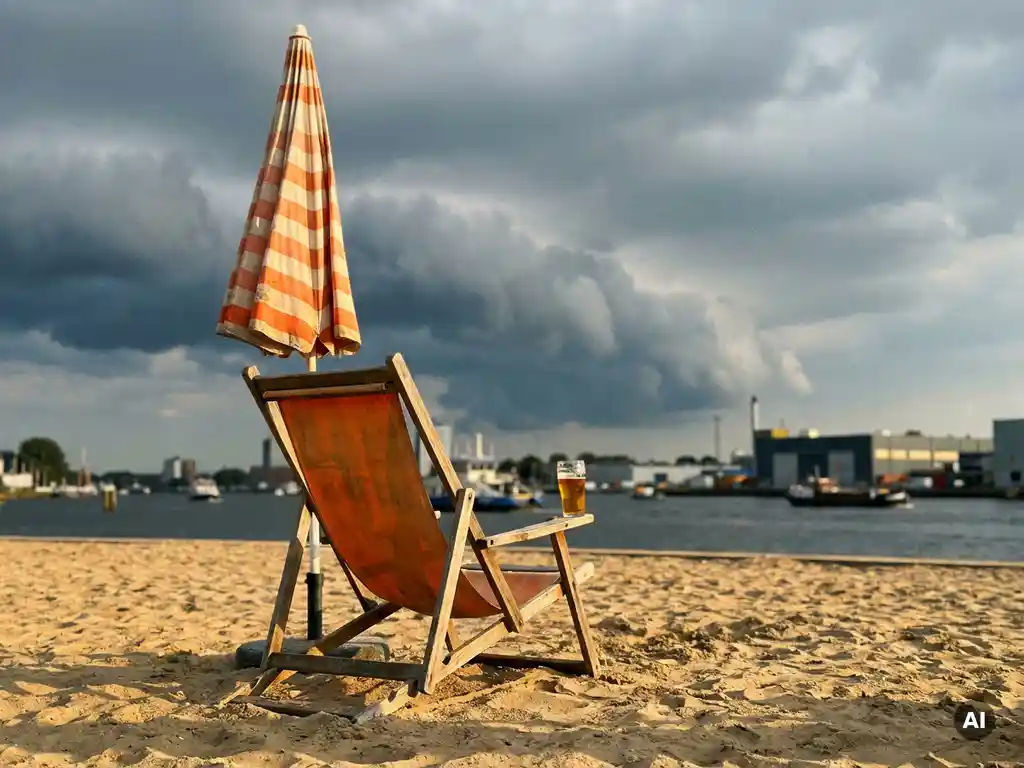
Amsterdam’s city beach season is shaped almost entirely by the weather, and the honest answer is that it runs from roughly late May through early September, with July and August being the only months you can count on with any real confidence. The city’s maritime climate means sunshine and warmth can arrive early or disappear without warning, so flexibility matters more than any fixed calendar date. Below, the key questions about weather and Amsterdam’s beach season get answered directly.
When does the Amsterdam city beach season actually start?
The city beach season in Amsterdam typically starts in late May, when the first stretches of genuinely warm weather arrive and beach bars begin opening their decks. Most city beaches along the IJ waterfront and in parks like Sloterplas officially open around this time, though some venues aim for early May if the forecast looks promising.
In practice, opening day and an actual busy day are two very different things. A beach bar can unlock its gates on May 10th, but if the temperature sits at 14 degrees Celsius with a grey sky, you will be drinking your beer alone. The season finds its rhythm in June and reaches full swing in July. By mid-September, most venues have packed up their sun loungers regardless of the weather, because the evenings turn cold fast and the crowds simply stop coming.
The 2026 season followed this familiar pattern. Operators who bet on a warm May were rewarded with a few good weekends, but the real business did not begin until the third week of June, when temperatures climbed consistently above 20 degrees.
What temperature makes a beach day viable in Amsterdam?
A beach day in Amsterdam becomes genuinely enjoyable once temperatures reach around 22 to 24 degrees Celsius. Below that threshold, the wind off the IJ or across an open park lake makes sitting still in a swimsuit uncomfortable for most people, even in direct sunlight.
This is a lower bar than beach destinations further south, and that is the point. Amsterdammers have learned to calibrate their expectations. At 20 degrees with no wind and full sun, you will see locals in shorts and sunglasses treating a patch of grass like a Mediterranean resort. Visitors from warmer climates often find this puzzling. But context matters: after eight months of grey skies and drizzle, 22 degrees feels like a gift.
What truly kills a beach day is not cold alone but cold combined with wind. Amsterdam sits in a flat, exposed landscape, and a westerly breeze can drop the perceived temperature by five degrees or more. A thermometer reading of 21 degrees in still air is a beach day; 21 degrees with a steady wind off the water is a jacket day.
How does Amsterdam’s weather pattern affect peak beach crowds?
Amsterdam’s unpredictable summer weather compresses beach crowds into very short windows. When a genuinely hot, sunny day arrives, especially above 28 degrees, every city beach fills rapidly and stays packed until the evening. The scarcity of reliably warm days means people respond to good weather with urgency.
This creates a feast-or-famine dynamic. On a grey Tuesday in July, Amsterdam’s urban beaches can feel almost empty. Then a sunny Saturday arrives and the same spot becomes difficult to navigate. Popular spots like Strand West on the IJ or the beaches around Sloterplas see this compression effect most clearly, because they draw from a large urban catchment and Amsterdammers move fast when the sun appears.
The practical implication is that peak beach crowds in Amsterdam are not predictable by calendar week the way they are in, say, Barcelona or Lisbon. They are entirely weather-driven. Arriving early on a sunny day matters more than choosing the right week. By noon on a hot day, the best spots are gone.
Does rain ruin a trip to an Amsterdam city beach?
Light rain does not necessarily ruin a visit to an Amsterdam city beach, especially if the beach bar has a covered terrace, but a full afternoon of steady rainfall makes the experience genuinely unpleasant and most venues will be nearly empty. The good news is that Amsterdam’s summer showers are often short, and the weather can shift meaningfully within an hour.
The Dutch approach to rain is instructive here. Locals do not cancel plans at the first cloud. They check the radar, make a judgment call, and often show up anyway with the expectation that the weather will improve. This is a reasonable strategy in Amsterdam, where summer rain frequently arrives in bursts rather than sustained downpours.
That said, a cold, wet day with no forecast improvement is simply not a beach day, and no amount of Dutch stoicism changes that. The better move on those days is to redirect entirely: a canal-side café, a museum, a comedy show. Amsterdam rewards flexibility. The city beach season is wonderful precisely because it is not guaranteed, and a perfect sunny afternoon on the IJ waterfront feels earned in a way that a beach in a reliably hot country simply does not.
How Klagen Niet Klagen helps you read Amsterdam like a local
Understanding Amsterdam’s city beach season is really about understanding Amsterdam itself: a city where the best experiences are conditional, weather-dependent, and invisible to anyone relying on a standard travel guide. Klagen Niet Klagen exists precisely to fill that gap, offering honest, insider commentary on Amsterdam city life written by someone who has lived and worked here for over three decades.
- Honest takes on what actually works in Amsterdam, including when and where to enjoy the city’s outdoor spaces without the tourist-board gloss
- Long-form essays and opinion pieces that explain the cultural logic behind Dutch behaviour, from their relationship with weather to their approach to public space
- A perspective grounded in real Amsterdam experience, not press releases or sponsored content
- Regular updates in the blog archive covering the rhythms, contradictions, and pleasures of life in the city
If you want to understand Amsterdam beyond the surface, start reading. And if you have questions or want to get in touch, the contact page is always open.
And if you find yourself in Amsterdam on one of those rare, perfect summer evenings when the sun stays out until ten and the whole city feels alive, do yourself a favour and book a show at Boom Chicago. The comedy is sharp, the crowd is international, and the energy matches exactly what a good Amsterdam summer night deserves. Check the shows and agenda and see what is on.
Frequently Asked Questions
What are the best Amsterdam city beaches to visit during peak season?
Strand West on the IJ waterfront and the beaches around Sloterplas are the most popular and well-equipped options, offering sun loungers, beach bars, and a lively atmosphere on warm days. For a slightly quieter experience, Blijburg aan Zee on the eastern IJburg island is worth the extra travel time — it has a more relaxed, alternative vibe and tends to fill up a little later than the central spots. Whichever you choose, arriving before noon on a sunny day is the single most important factor in securing a decent spot.
How can I check whether a beach day in Amsterdam is actually worth it before heading out?
The most reliable tool locals use is Buienradar, a Dutch weather app and website that shows hyper-local rain radar and hourly forecasts — it is far more granular than generic international weather apps and gives you a realistic picture of the next few hours. Beyond rain, pay attention to wind speed: anything above 20 to 25 km/h from the west or north will significantly reduce comfort at open waterfront locations like Strand West. A combination of 23°C or above, low wind, and a clear Buienradar for the afternoon is your green light to go.
Is it worth visiting Amsterdam city beaches on a weekday versus a weekend?
On a hot, sunny day, a weekday visit is almost always a better experience than a weekend one — crowds are noticeably thinner, service at beach bars is faster, and finding a good spot requires far less effort or early arrival. The catch is that weekday beach trips require flexibility in your schedule, which suits locals more than visitors on tight itineraries. If a weekend is your only option, treat it like a concert: arrive early, accept that it will be busy, and lean into the social energy rather than fighting it.