
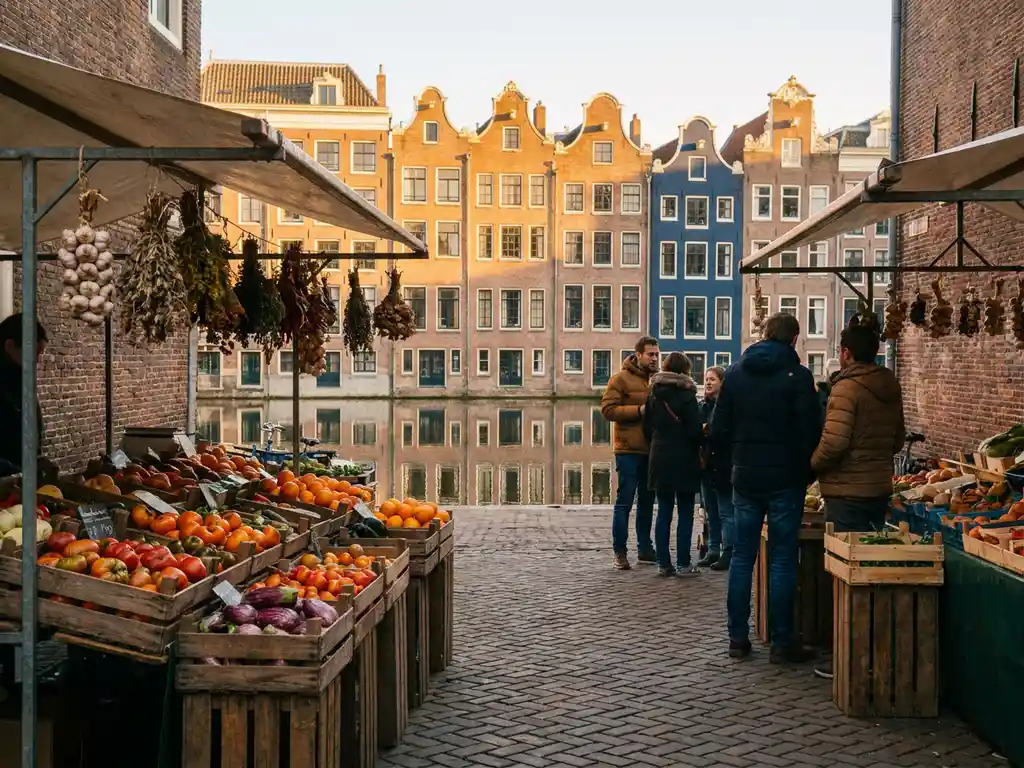
De Pijp is the best Amsterdam neighborhood for food and culture, offering the greatest concentration of diverse restaurants, street food, independent cafes, and creative energy in the city. That said, the Jordaan, the Oud-West, and a handful of emerging neighborhoods each make a strong case depending on what you are looking for. This article works through the key questions neighborhood by neighborhood, from food diversity to arts scenes to where locals actually eat.
Which Amsterdam neighborhood has the most diverse food scene?
De Pijp has the most diverse food scene in Amsterdam, followed closely by the Oud-West and parts of the Indische Buurt in East Amsterdam. These neighborhoods combine long-standing immigrant communities, independent restaurant culture, and a critical mass of food-curious residents who actually demand quality over novelty.
Amsterdam’s food diversity is not spread evenly across the city. The canal ring looks beautiful but is largely given over to tourist-facing restaurants that charge a premium for mediocre pasta and stamppot. The real variety lives in the neighborhoods where people actually live and eat regularly. In De Pijp, you will find Surinamese, Moroccan, Turkish, Indonesian, and South American kitchens within a few minutes’ walk of each other. In the Indische Buurt, a neighborhood shaped by Amsterdam’s colonial and post-colonial history, Indonesian and Moluccan food reaches a depth of authenticity you simply will not find in the tourist center. The Oud-West, meanwhile, has quietly become one of the most interesting eating neighborhoods in the city, with a mix of natural wine bars, serious sandwich shops, and destination restaurants that attract both locals and visitors who have done their homework.
What makes De Pijp the go-to neighborhood for food lovers?
De Pijp earns its reputation as Amsterdam’s top food neighborhood because of the Albert Cuyp Market, the density of independent restaurants, and a local population that is genuinely demanding about what it eats. It is one of the few neighborhoods where you can eat exceptionally well at every price point, from a two-euro stroopwafel to a serious tasting menu.
The Albert Cuyp Market is the anchor. Running through the heart of De Pijp, it is one of the largest outdoor markets in Europe and a genuine cross-section of Amsterdam’s food culture. You will find Dutch herring, fresh stroopwafels, Surinamese roti, Moroccan pastries, and Indonesian snacks all within the same stretch. It is not a tourist market dressed up as local. It is genuinely local, with tourist interest following as a consequence.
Beyond the market, De Pijp has a restaurant culture built on independent ownership rather than chains. The neighborhood has historically attracted artists, students, and working-class families who wanted good food without pretension. That legacy has produced a restaurant scene that rewards exploration. The side streets off Ferdinand Bolstraat and Van Woustraat are particularly worth wandering. Expect to find places with no Instagram presence, no English menu, and food that is considerably better for both of those facts.
Which neighborhood is best for Amsterdam’s arts and cultural scene?
The Jordaan and the Museumplein area are the traditional anchors of Amsterdam’s arts and cultural scene, but the most interesting creative energy in 2026 is concentrated in Amsterdam Noord and the Oud-West. Institutionally, the Museumplein quarter is unmatched. Creatively, Noord is where things are actually happening.
The Museumplein quarter clusters the Rijksmuseum, the Van Gogh Museum, and the Stedelijk Museum within walking distance of each other. This is world-class cultural infrastructure by any standard, and if you are visiting Amsterdam for the first time or want to understand the city’s artistic heritage, this is where you start. The neighborhood around it, including the Oud-Zuid, is wealthy, well-maintained, and culturally serious.
Amsterdam Noord is a different kind of cultural scene entirely. What was once post-industrial waterfront has become a hub for studios, independent galleries, creative agencies, and music venues. The NDSM wharf in particular has developed into one of the most interesting creative spaces in the Netherlands, hosting everything from street art to large-scale performance events. It is rougher around the edges, deliberately so, and that is precisely what makes it feel alive in a way that the polished museum quarter does not.
The Jordaan sits somewhere between these two poles. It has genuine cultural history, excellent independent galleries, and a tradition of artist residency that shaped the neighborhood’s character. But it has also become expensive and somewhat self-conscious about its own charm, which tends to blunt the creative edge.
Is the Jordaan still worth it for food and culture in 2026?
Yes, the Jordaan is still worth visiting for food and culture in 2026, but you need to go in with calibrated expectations. It remains one of Amsterdam’s most beautiful and historically rich neighborhoods, with genuinely good restaurants and independent galleries. The problem is that its reputation has attracted exactly the kind of attention that erodes what made it special.
The Jordaan was originally a working-class neighborhood, home to craftspeople, traders, and artists who could not afford to live in the canal ring. That history produced a particular kind of unpretentious, community-rooted culture that still has traces in the neighborhood today. The brown cafes, the small galleries on Elandsgracht, the Saturday antiques market at Noordermarkt, the organic food market at the same location on Saturday mornings. These things are real and worth your time.
What has changed is the price and the density of visitors. The Jordaan is now one of the most expensive neighborhoods in Amsterdam to eat and drink in, and on weekends the main streets can feel more like a theme park version of Amsterdam than the actual city. The trick is to visit on a weekday, get off the main drag, and look for the places that have been there for decades rather than the ones that opened to capture the tourist wave. They still exist. You just have to look a little harder.
What Amsterdam neighborhoods do locals actually eat in?
Amsterdam locals eat in De Pijp, the Oud-West, the Indische Buurt, and Bos en Lommer. These are the neighborhoods where the restaurant-to-tourist ratio still favors the people who live there, and where the food tends to be better and cheaper as a direct result.
The Indische Buurt in East Amsterdam is probably the most underrated eating neighborhood in the city. Its Indonesian and Moluccan restaurants are the real thing, shaped by communities with deep roots in the neighborhood rather than menus designed for the tourist gaze. Prices are low, portions are generous, and the food reflects a culinary tradition that Amsterdam has genuine historical reasons to take seriously.
Bos en Lommer, further west, has been quietly developing a food scene for years without much outside attention. It is a diverse, working-class neighborhood with a growing number of independent restaurants, Moroccan bakeries, and Turkish grocery stores that supply half the city’s professional kitchens. It is not a destination neighborhood in the conventional sense, but if you want to eat well and cheaply alongside people who actually live in Amsterdam, it rewards the short tram ride.
The Oud-West, between the Jordaan and the Vondelpark, has crossed the threshold from local secret to well-known destination, but it still functions primarily as a neighborhood for residents. The Kinkerstraat and Ten Katestraat area around the Ten Kate Market is a particularly good stretch, with a mix of market stalls, independent food shops, and restaurants that serve the neighborhood rather than visitors passing through.
How does Amsterdam’s food and culture scene compare to other European cities?
Amsterdam’s food and culture scene punches above its weight for a city of its size, but it is not in the same league as London, Paris, or Barcelona at the very top end. What Amsterdam does exceptionally well is the mid-range: interesting, independent, well-executed food and culture that reflects the city’s genuine diversity and creative history without requiring a significant budget.
The honest answer is that Amsterdam spent a long time not taking food seriously, and the city is still catching up in certain respects. The Dutch culinary tradition is not, historically, one of Europe’s great ones. What has changed in the last two decades is the arrival of a genuinely international food culture, driven by immigration, by Dutch people who travel and eat widely, and by a generation of chefs who trained abroad and came back with something to prove. The result is a city where the best restaurants are genuinely excellent, but where the average restaurant is still more likely to disappoint than its equivalent in, say, Lisbon or Madrid.
Culturally, Amsterdam’s strengths are real and specific. The museum infrastructure is world-class. The live music scene, particularly in jazz and electronic music, is among the best in Europe. The theatre scene, including long-running institutions that have shaped the city’s creative identity, is serious and internationally connected. The city is small enough that you can engage with all of this without the overwhelming scale that makes London or Paris hard to navigate. For a certain kind of culturally engaged visitor or resident, that combination of quality and human scale is Amsterdam’s strongest argument.
How Klagen Niet Klagen helps you find the real Amsterdam
Finding the neighborhoods, restaurants, and cultural experiences that locals actually rate is harder than it looks. Most of what appears in search results is either tourist-board content, paid placement, or travel writing by people who spent a long weekend in the city. Klagen Niet Klagen exists to fill that gap with honest, opinionated, insider commentary written by someone who has lived and worked in Amsterdam for over three decades.
- Long-form essays and opinion pieces on Amsterdam neighborhoods, food culture, and city life, written from genuine experience rather than a press trip
- Honest assessments of what is worth your time and what is overrated, without the diplomatic softening that most travel content applies
- Cultural commentary that helps you understand Amsterdam as a place people actually live in, not just a destination to photograph
- A consistent editorial voice that builds real familiarity with the city over time, rather than a collection of disconnected listicles
If you want to go deeper on Amsterdam, the blog archive is the place to start. Or go straight to the Klagen Niet Klagen homepage and see what Amsterdam looks like from the inside.
And if you want to experience Amsterdam’s creative culture in person rather than just read about it, Boom Chicago is the obvious next step. Running since 1993, it is one of the city’s great cultural institutions: a comedy and improv theatre that has shaped Amsterdam’s English-language creative scene for over thirty years. The shows and agenda are always worth checking, whether you are a first-time visitor or someone who has been coming for years and still finds something new every time.
Frequently Asked Questions
I only have one day in Amsterdam — which single neighborhood should I prioritize for the best mix of food and culture?
If you have just one day, De Pijp is the most efficient choice. Start at the Albert Cuyp Market in the morning for street food and a genuine cross-section of Amsterdam’s food culture, spend the afternoon exploring the side streets off Ferdinand Bolstraat, and use the evening for dinner at one of the neighborhood’s independent restaurants. If world-class museums are non-negotiable, base yourself near Museumplein in the morning and then cross into De Pijp for the rest of the day — they are close enough to combine without rushing.
Are there any common mistakes tourists make when trying to eat like a local in Amsterdam?
The most common mistake is eating in or near the canal ring, where proximity to tourist foot traffic almost always means inflated prices and lower quality. A close second is relying on review platforms that are heavily gamed by venues targeting visitors rather than residents. The practical fix is simple: get on a tram heading east or west, pick a neighborhood where people actually live — De Pijp, the Oud-West, the Indische Buurt — and look for restaurants with handwritten menus, no photos on the wall, and a room full of people who walked there.
Is Amsterdam Noord worth the trip across the IJ, or is it more hype than substance?
Amsterdam Noord is genuinely worth the trip, but it rewards visitors who engage with it on its own terms rather than expecting a polished experience. The free ferry from Central Station takes five minutes, and the NDSM wharf area offers a kind of raw, large-scale creative energy that simply does not exist on the south bank. That said, Noord is spread out and uneven — go with a specific destination in mind, whether that is a gallery, a music venue, or one of the better restaurants that have opened in the area, rather than expecting to wander and stumble onto something good.