
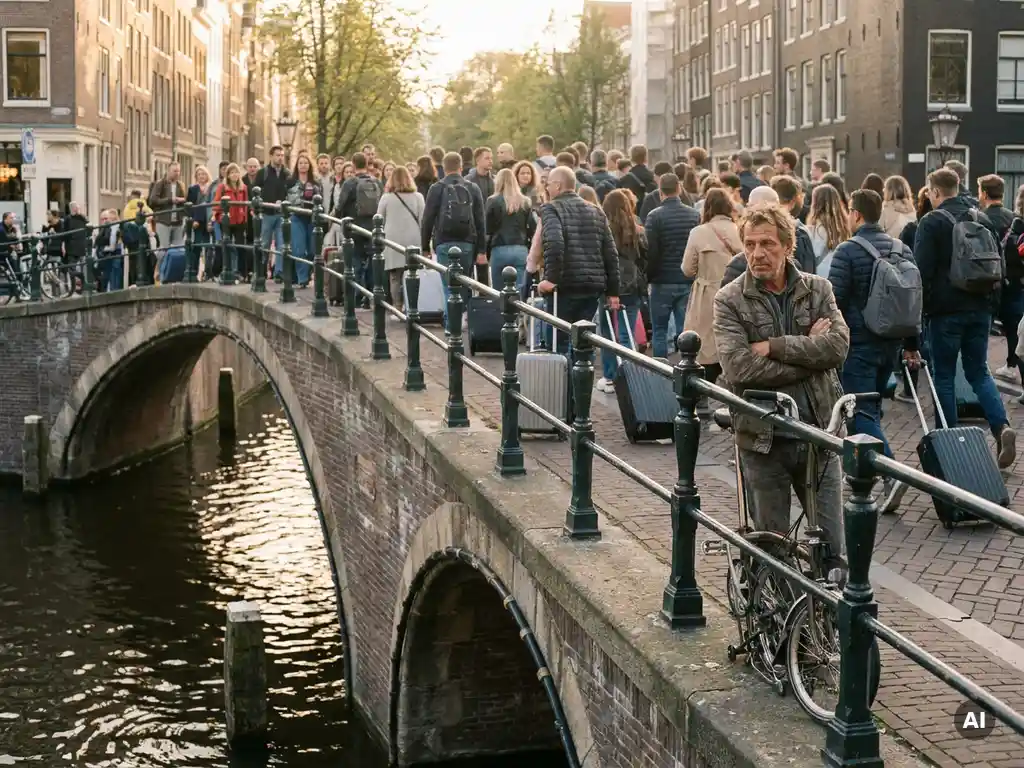
Tourism keeps growing in Amsterdam despite resident complaints because the economic forces driving it are far stronger than the social forces pushing back. The hospitality industry, transport sector, and city tax revenues all depend on visitor spending, which means the institutions with the most power to slow tourism down are also the ones with the most to lose if they do. The questions below unpack exactly how that tension plays out and what, if anything, will ever change it.
Who actually benefits from Amsterdam’s tourism boom?
The biggest beneficiaries of Amsterdam’s tourism boom are businesses in hospitality, retail, and transport, along with the municipal government, which collects substantial tourist tax revenue. These are not small or marginal players. They are well-organised, politically connected, and economically significant. Residents who find the city noisier, more crowded, and more expensive are far more diffuse as a group and far harder to mobilise.
Hotels, Airbnb hosts, restaurants, museums, tour operators, and the Schiphol ecosystem all have a direct financial stake in high visitor numbers. The city of Amsterdam itself collects a tourist tax on every overnight stay, which funds public services that residents also use. That creates a structural conflict of interest: the city government is simultaneously the body most responsible for managing tourism and one of the entities that profits most when more tourists arrive.
Meanwhile, the costs of mass tourism fall on residents in ways that are real but diffuse. Higher rents, crowded streets, noise, and the slow erosion of neighbourhood character are genuine quality-of-life issues. But they don’t show up on a balance sheet. The benefits of tourism are concentrated and measurable. The costs are spread across hundreds of thousands of people and are much harder to quantify. That asymmetry shapes every policy conversation about the balance between tourism and living.
Why don’t resident complaints slow tourism down?
Resident complaints don’t slow tourism down because complaints are not the same as political power, and the economic interests on the other side of the table are far better organised. Dissatisfied residents write letters, sign petitions, and complain on social media. Hotel chains hire lobbyists. That is not a fair fight.
There is also a deeper problem: many residents are themselves economically tied to tourism in ways they don’t always acknowledge. The Amsterdammer who rents out a spare room, works in a creative industry sustained partly by international visitors, or runs a business that serves both locals and tourists is not going to vote for policies that tank the city’s visitor economy. The line between beneficiary and victim is blurrier than it looks.
And then there is the political reality that tourism is genuinely popular at the national level. Schiphol is a point of national pride. The Rijksmuseum is a symbol of Dutch cultural identity. Restricting access to Amsterdam for international visitors is a hard sell in The Hague. Local frustration rarely translates into national political will, and without national support, the city’s hands are tied on some of the biggest levers.
What has Amsterdam actually done to limit tourist numbers?
Amsterdam has taken more concrete steps to manage tourism than almost any other European city, including banning new hotels in the city centre, restricting short-stay rentals, closing the cruise terminal to large ships, and running campaigns that explicitly tell certain tourists they are not welcome. Whether these measures have actually reduced visitor numbers is a different question.
The short-stay rental restrictions have had a genuine effect on Airbnb supply, reducing the number of entire apartments available for tourist use and returning some housing stock to the residential market. The hotel ban has slowed the growth of new accommodation capacity in the most sensitive areas. These are real policy wins, not just symbolic gestures.
But the city has also been careful not to go so far that it triggers a serious economic backlash. Measures that reduce the worst excesses of mass tourism are politically viable. Measures that would genuinely cut visitor numbers by a significant margin are not. The result is a policy approach that manages the symptoms of overtourism more effectively than it addresses the underlying demand. The balance between tourism and living shifts slightly, but the fundamental dynamic stays the same.
Will Amsterdam’s tourism ever stop growing?
Amsterdam’s tourism will almost certainly not stop growing indefinitely, but it may plateau as physical and regulatory constraints tighten. The city has a finite number of hotel beds, a finite airport capacity, and a growing political willingness to use both as tools of demand management. At some point, supply constraints will do what policy has struggled to do directly.
The more interesting question is whether the character of tourism will change even if the numbers don’t fall dramatically. Amsterdam has made a deliberate effort to attract visitors who stay longer, spend more, and concentrate less in the historic centre. Whether that repositioning succeeds depends on factors that are partly within the city’s control and partly not, including global travel trends, the strength of the Dutch brand abroad, and how aggressively competitors like Rotterdam and Utrecht develop their own visitor economies.
What is almost certainly not coming is a dramatic, sustained decline driven by resident pressure alone. Cities that depend on tourism rarely vote themselves out of it. The more realistic scenario is a slow, contested negotiation between growth and livability that produces incremental improvements without ever fully resolving the tension. That tension, by the way, is not unique to Amsterdam. It is one of the defining urban questions of the twenty-first century.
How Klagen Niet Klagen helps you make sense of Amsterdam’s tourism debate
If you live in Amsterdam, visit regularly, or simply care about what happens to one of Europe’s most interesting cities, the tourism debate is not abstract. It shapes where you can afford to live, what your neighbourhood feels like, and whether the city you love will still be recognisable in ten years. Klagen Niet Klagen exists to cut through the polished talking points and give you an honest, insider perspective on exactly these questions.
- Long-form essays on Amsterdam city life written from over three decades of experience living and building here
- Commentary that names the real tensions honestly, without tourism-board spin or diplomatic softening
- A clear Klagen / Niet Klagen framework that holds both the frustrations and the genuine pleasures of Amsterdam in view at the same time
- An independent editorial voice with no advertorial pressure and no agenda beyond telling the truth about this city
If you want commentary that treats you as an intelligent adult who can handle a complicated picture, this is the place. Browse the full archive and find the Amsterdam essays that actually reflect the city you know.
And if you want to experience Amsterdam’s sharpest comedic take on city life in person, Boom Chicago has been doing exactly that since 1993. The same honest, funny, Amsterdam-rooted perspective that runs through this blog has been playing out on stage for over thirty years. If you haven’t been, or haven’t been recently, check what’s coming up in the programme and come see what you’ve been missing.
Frequently Asked Questions
Could Amsterdam realistically redirect tourists away from the city centre to ease pressure on residents?
Redistribution is more achievable than reduction, and Amsterdam has already made tentative moves in that direction by promoting neighbourhoods like Noord and Nieuw-West as visitor destinations. The challenge is that tourists self-select heavily toward the historic centre, and no amount of marketing fully overrides the pull of the canal ring and the Rijksmuseum. Redistribution eases pressure at the margins but doesn’t resolve the core tension between resident livability and visitor demand.
What would it actually take for Amsterdam to make a serious dent in overall visitor numbers?
A genuine, sustained reduction in visitor numbers would require coordinated action across airport capacity, accommodation supply, and national transport policy — none of which the city of Amsterdam controls alone. Schiphol expansion debates, national rail investment, and EU open-skies agreements all shape how many people can physically reach the city, and those levers sit in The Hague and Brussels, not the Amsterdam city council. Without that multi-level alignment, local policy can manage the experience of overtourism but not its scale.
Are there other European cities handling this balance better than Amsterdam, and what can Amsterdam learn from them?
Barcelona and Lisbon are often cited in the same conversation, but both are grappling with the same structural problem: tourism revenue is too embedded in the local economy to cut significantly without serious political cost. Vienna is sometimes held up as a model for higher-value, lower-volume tourism, but it benefits from a very different visitor profile and a national cultural infrastructure that took generations to build. Amsterdam can borrow specific tools — tiered tourist taxes, stricter short-stay enforcement, visitor dispersal incentives — but there is no city that has cleanly solved the problem it is trying to solve.