
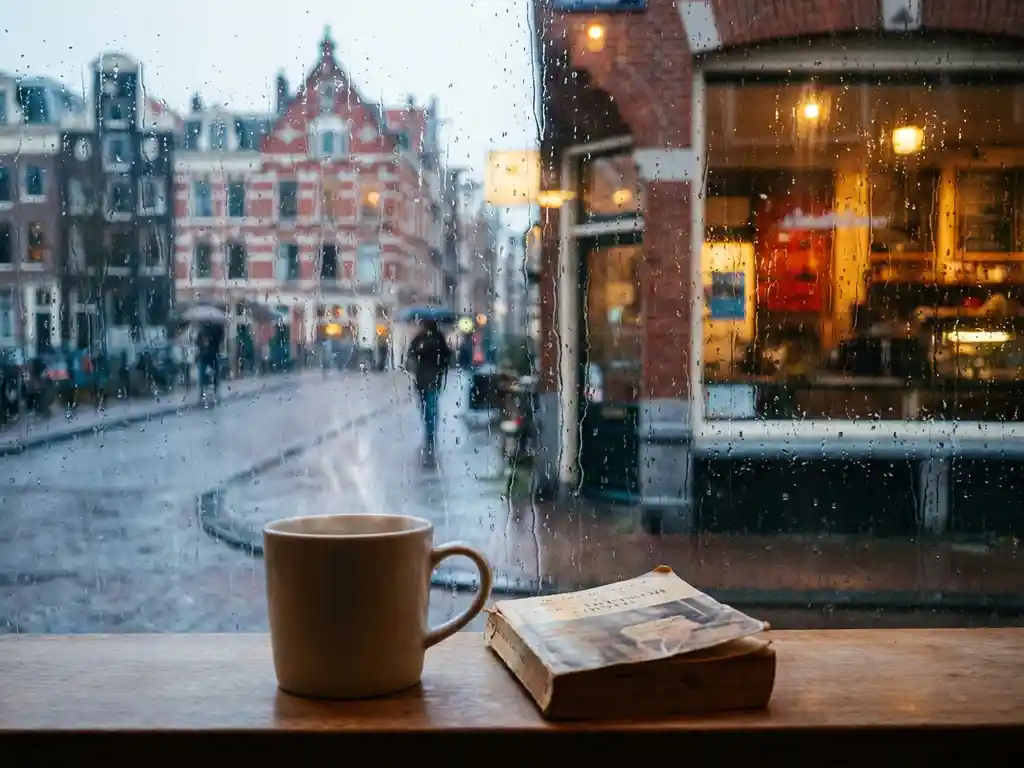
Amsterdam on a rainy day is genuinely enjoyable — and in many ways better than a sunny one. The city has an extraordinary density of world-class museums, cosy brown cafés, and indoor experiences that most visitors never get around to because the weather is too nice to stay inside. Rain is not a problem in Amsterdam; it is practically an invitation.
Amsterdam’s famously unpredictable weather means locals have spent centuries figuring out how to make the most of a wet afternoon. The infrastructure for indoor culture here is among the best in Europe, and the city’s café culture was practically built for grey skies and drizzle.
Below, the most common questions about rainy-day Amsterdam get honest, practical answers — from the museums worth your time to how Amsterdammers actually spend a sodden Saturday.
Which Amsterdam museums are worth visiting on a rainy day?
The Rijksmuseum, the Van Gogh Museum, and the Amsterdam Museum are the strongest choices for a rainy day in Amsterdam. The Rijksmuseum alone can absorb four to five hours without any sense of rushing, and its collection of Dutch Golden Age painting is genuinely one of the great museum experiences in the world. If you only go to one, go there.
That said, the Van Gogh Museum is a more emotional and personal experience — smaller, more focused, and surprisingly moving if you come with even a passing interest in the man rather than just the paintings. Book tickets in advance for both; the queues on wet days are real.
For something less obvious, the Stedelijk Museum (modern and contemporary art) is consistently underrated by visitors who assume it plays second fiddle to its neighbours. It does not. The EYE Film Museum on the north bank of the IJ is another excellent rainy-day option — architecturally striking, intelligently curated, and far less crowded than the Museumplein institutions.
If you want something more offbeat, the Micropia museum — the world’s only museum dedicated entirely to microbes — is genuinely fascinating and takes about ninety minutes. It sits next to Artis zoo and is easy to combine with a visit there.
What indoor experiences in Amsterdam go beyond museums?
Amsterdam’s best indoor experiences beyond museums include live comedy, escape rooms, cooking classes, the Heineken Experience, and a growing number of immersive art installations. The city has quietly become one of Europe’s stronger destinations for Amsterdam immersive experiences, with rotating exhibitions that blend technology, art, and storytelling in ways that traditional galleries do not.
Live comedy is a genuinely excellent rainy-day option and one that many visitors overlook entirely. Boom Chicago’s shows are performed in English and have been running in Amsterdam since 1993 — sharp, political, and consistently funny in a way that holds up whether you are a first-time visitor or a long-term resident who has seen the city change over decades. It is one of the best English shows Amsterdam has to offer, and the kind of evening that feels distinctly Amsterdam rather than generically touristy.
Cooking classes focused on Dutch or Indonesian-Dutch cuisine are another strong option — they are interactive, social, and you leave having learned something genuinely useful about the city’s food culture. The Dutch colonial relationship with Indonesia shaped Amsterdam’s food scene profoundly, and understanding that history through a meal is more interesting than reading about it.
Are there good rainy day options in Amsterdam for families with kids?
Yes — Amsterdam has excellent rainy-day options for families with children. NEMO Science Museum is the strongest choice: a hands-on science centre spread across five floors where children can run experiments, build things, and generally be loud without anyone minding. It is designed for exactly this purpose and handles school-age children particularly well.
Artis, Amsterdam’s zoo, is partly covered and entirely manageable in light rain — the aquarium and the planetarium inside the grounds are fully indoors and well worth the time. The Tropenmuseum has a dedicated children’s section (Tropenmuseum Junior) that handles the under-twelve crowd with real imagination.
For older children and teenagers, the Resistance Museum (Verzetsmuseum) is one of the most thoughtful and affecting museums in Amsterdam — it tells the story of the Dutch experience during World War Two in a way that is honest about the full range of human responses, not just heroism. There is a junior version of the exhibition specifically designed for children aged ten to fifteen.
What’s the best way to experience Amsterdam’s café culture on a wet day?
The best way to experience Amsterdam’s café culture on a rainy day is to find a traditional brown café (bruine kroeg), order a jenever or a beer, and stay for at least two hours. These are not bars in the tourist sense — they are neighbourhood institutions, often family-run for generations, with dark wood interiors, sand on the floor, and a pace of life that actively resists hurrying.
The Jordaan neighbourhood has the highest concentration of genuinely old brown cafés, and wandering that area in the rain is one of the more pleasurable Amsterdam experiences available. Café ‘t Smalle on Egelantiersgracht is one of the oldest and most atmospheric. De Reiger on Nieuwe Leliestraat is excellent for food alongside the drinks.
What makes café culture work on a rainy day is the absence of any pressure to move on. Amsterdammers do not treat cafés as pitstops — they treat them as destinations. Bring a book, bring a friend, or simply sit and watch the rain move across the canal through the window. This is not a tourist activity. It is how the city actually works.
How do locals in Amsterdam actually spend a rainy day?
Amsterdam locals on a rainy day typically do one of three things: they stay home and cook, they go to a brown café with friends, or they run errands they have been putting off because the weather was too nice. What they almost never do is treat rain as a reason to visit the Rijksmuseum — that is a visitor instinct, not a local one.
For a more genuinely local experience on a wet day, consider the Albert Cuyp Market (it runs rain or shine and the covered stalls make it perfectly manageable), the Sunday book market at Spui, or simply walking through the Jordaan or De Pijp with no particular agenda. The Amsterdam best neighborhoods for aimless rainy-day wandering are the ones with the most independent shops and cafés per square metre — the Jordaan, De Pijp, and the area around Haarlemmerdijk.
Locals also use rainy days for the kind of cinema-going that gets squeezed out when the sun is shining. The Pathé Tuschinski on Reguliersbreestraat is one of the most beautiful cinema buildings in Europe — an art deco landmark worth visiting for the interior alone, regardless of what is showing.
Does rain actually ruin a trip to Amsterdam?
Rain does not ruin a trip to Amsterdam — and this is not the kind of reassurance that travel writers dish out to make visitors feel better about the weather. Amsterdam’s canals, architecture, and street life are genuinely more atmospheric in the rain. The light changes, the reflections multiply, and the crowds thin out in a way that makes the city feel more like itself and less like a theme park.
The honest caveat is that cycling in heavy rain is miserable, and Amsterdam’s cycling culture is one of its genuine pleasures. A full week of rain will limit how much of the city you experience on two wheels. But the city’s tram and metro network is good enough that you will not feel stranded, and the density of things to do within walking distance of most central neighbourhoods means you rarely need to travel far.
The bigger risk to an Amsterdam trip is not rain but overcrowding — and rain actually helps with that. Wet weather keeps some visitors inside their hotels or redirects them toward the most obvious tourist sites, which means the quieter neighbourhoods and smaller museums become genuinely accessible. If you want to see Amsterdam without fighting for space, a rainy Tuesday in November is closer to the real city than a sunny Saturday in July.
How Klagen Niet Klagen helps you get more from Amsterdam
Knowing which Amsterdam experiences are genuinely worth your time — rainy day or otherwise — is harder than it looks. Most English-language content about the city is either written for first-time tourists or shaped by commercial interests that have nothing to do with what actually makes Amsterdam interesting. Klagen Niet Klagen exists to fill that gap.
- Honest, opinionated commentary on Amsterdam city life written by someone who has lived and worked here for over thirty years
- No tourism-board influence, no advertorial pressure, no listicles dressed up as insight
- Long-form essays and practical guides covering the neighbourhoods, culture, and contradictions that mainstream media ignores
- Written in English for expats, international visitors, and globally minded locals who want more than a surface-level take
If you want to understand Amsterdam rather than just visit it, the blog archive is a good place to start. There is no algorithm deciding what you should care about — just one person’s honest view of a city he knows very well.
And if you are looking for something to do on that rainy evening after the museums close and the café round is done, Boom Chicago’s show schedule is worth checking. Thirty-plus years of English-language comedy in Amsterdam, performed live, and consistently funnier than anything you will find on your hotel room television. It is the kind of evening that gives you something to talk about the next morning — which is exactly what a good Amsterdam night out should do. Questions about group bookings or private events? Get in touch directly.
Frequently Asked Questions
Is it worth booking a comedy show like Boom Chicago on a rainy evening, or should I save that for a dry night out?
A rainy evening is actually the ideal time for a live comedy show — you’re not sacrificing good weather, and you get a genuinely memorable experience in return. Boom Chicago performs in English and has been a fixture of Amsterdam’s cultural life since 1993, so it fits naturally into a rainy-day itinerary after the museums and cafés. Book in advance on wet evenings, as demand picks up when outdoor options shrink.
What's the best way to get around Amsterdam on a very rainy day without a bike?
Amsterdam’s tram network is reliable, frequent, and covers the central neighbourhoods well enough that you rarely need to wait more than a few minutes. The GVB day ticket is good value if you’re making more than two or three journeys, and the metro connects the centre to areas like De Pijp and Amsterdam Noord quickly. For short distances, walking under a good umbrella is often faster than waiting for a tram — the city centre is compact enough that most major attractions are within fifteen to twenty minutes on foot.
Are there any common mistakes visitors make when planning a rainy day in Amsterdam?
The most common mistake is trying to cram too many museums into a single wet day — the Rijksmuseum alone deserves several hours, and museum fatigue sets in faster than most people expect. A second mistake is skipping the brown cafés in favour of chain coffee shops, which misses one of the most distinctive and genuinely local experiences the city offers. Planning one major museum, one neighbourhood wander, and one evening activity is a more satisfying structure than an exhausting back-to-back itinerary.