
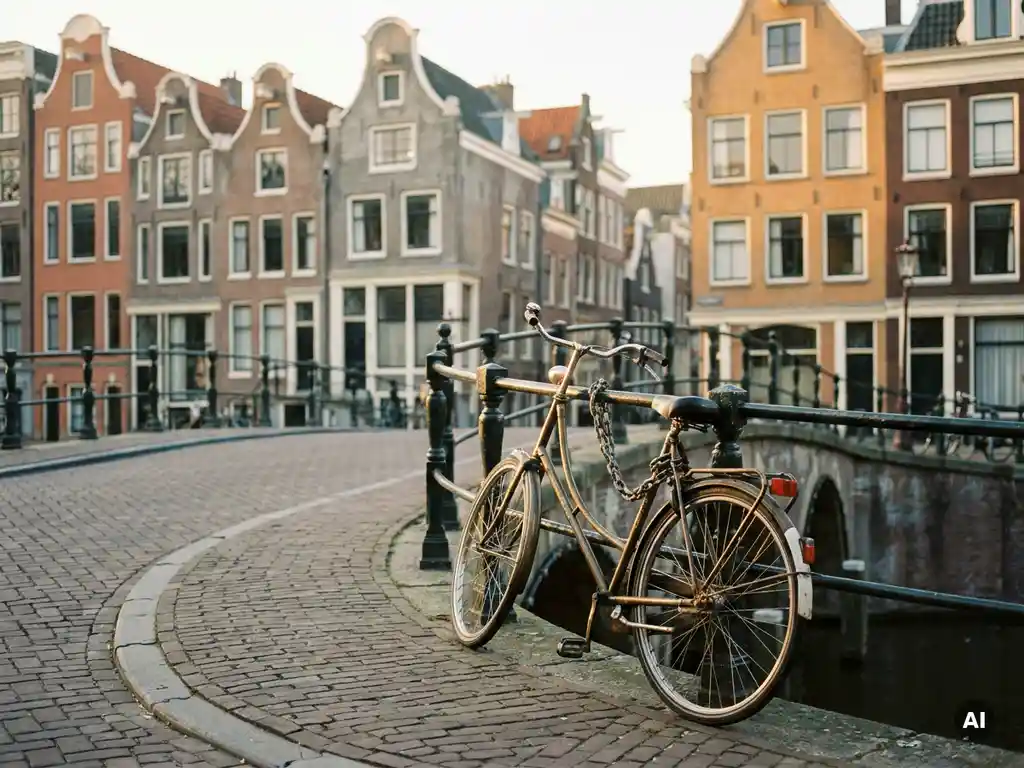
Amsterdam’s new traffic policy for the city center restricts private car access across a significantly expanded zone of the historic inner city, with the goal of reducing congestion, improving air quality, and reclaiming public space for pedestrians and cyclists. The policy builds on years of gradual car-reduction measures and represents the most ambitious step yet in the city’s long-term mobility strategy. Below, the key questions get straight answers.
What changes does Amsterdam’s new traffic policy actually introduce?
Amsterdam’s updated traffic policy for the city center introduces a broader car-free zone, reduced through-traffic routes, lower speed limits on remaining accessible roads, and stricter enforcement of existing parking restrictions. The core ambition is to make private car use in the historic center the exception rather than the default, prioritizing foot traffic, cycling, and public transport.
In practical terms, this means more streets where cars simply cannot enter without a valid permit or exemption. The city has also moved to reduce the number of parking spaces in the center, making it less attractive to drive in, even for those technically allowed to do so. Speed limits on roads that remain open to cars have been lowered in many areas, bringing Amsterdam in line with the 30 km/h zones that have become standard across much of the inner city. The policy also expands the use of automatic number plate recognition cameras to enforce the new restrictions, removing the reliance on physical barriers alone.
Which streets and areas are affected by the new restrictions?
The restrictions primarily affect the historic canal ring, the area within the Singelgracht, and key arterial streets leading into the center from surrounding neighborhoods. Streets that previously allowed limited through-traffic have been reclassified, and several major routes that cars once used as shortcuts through the center are now closed to non-exempt vehicles.
The areas around Leidseplein, Rembrandtplein, and the central shopping streets such as Kalverstraat and Nieuwendijk have seen the most visible changes, with expanded pedestrian zones and fewer entry points for cars. The Jordaan and the Nine Streets area, already largely inaccessible by car, fall under tighter enforcement. Residents living within the restricted zone are still able to access their homes, but the routes available to them have, in some cases, changed.
Who is exempt from Amsterdam’s city center traffic rules?
Exemptions from Amsterdam’s city center traffic restrictions apply to residents with valid permits, emergency services, licensed taxis and ride-share vehicles with appropriate authorization, delivery vehicles during designated time windows, and certain categories of tradespeople working within the zone. Visitors with a disability parking permit also retain access under specific conditions.
Delivery logistics have required particular attention. The city has worked with logistics companies to define narrow time slots, typically early morning hours, during which freight vehicles can enter restricted streets. Outside those windows, deliveries are expected to use cargo bikes or electric cargo vehicles where possible. This reflects a broader push to decarbonize last-mile delivery in the center, not just reduce car volume. Residents who own a car and live within the zone can apply for a residential permit, though the city has made clear that the number of permits available is being progressively reduced over time.
How does this policy compare to other European car-free city initiatives?
Amsterdam’s approach sits within a wider European movement toward car-restricted city centers, alongside cities like Oslo, Paris, Ghent, and Madrid. What distinguishes Amsterdam’s policy is its incremental, infrastructure-led approach rather than a single dramatic ban. The city has been quietly shrinking car access for decades, making this latest phase feel evolutionary rather than revolutionary to those who live here.
Oslo went further, faster, removing virtually all on-street parking in its center in a single political move. Paris has pursued a more confrontational strategy under Mayor Hidalgo, dramatically cutting parking spaces and converting ring roads into pedestrian areas. Ghent introduced a circulation plan that made driving through the center logistically impractical rather than legally prohibited. Amsterdam’s method is closer to Ghent’s: make driving inconvenient and unattractive enough that most people stop doing it, without necessarily banning it outright. The result is a city that still functions for those who genuinely need a car, while steadily shifting the balance toward everyone else.
How Klagen Niet Klagen helps you make sense of Amsterdam’s changing city
Traffic policy sounds dry until you’re the one stuck behind a barrier you didn’t know existed, or circling a neighborhood that no longer has parking where it used to. Klagen Niet Klagen cuts through the official language and gives you the honest, on-the-ground perspective on how Amsterdam’s policies actually play out in daily life. Here’s what you get:
- Long-form essays and commentary on Amsterdam city policy written from over 30 years of lived experience in the city
- An English-language perspective that mainstream Dutch media rarely offers
- Honest takes that don’t soften the frustrations or oversell the idealism behind the city’s decisions
- Regular updates on how urban changes affect residents, expats, and visitors alike
- A clear klagen / niet klagen framework that names what works, what doesn’t, and why it matters
If Amsterdam’s traffic policy has you questioning whether the city is getting better or just harder to navigate, you’ll find plenty of honest reflection in the blog archive. Want to get in touch or share your own experience of the city? Head to the contact page and say hello.
Of course, one of the best ways to experience Amsterdam without worrying about where to park is to simply show up for a night at Boom Chicago. For over 30 years, Boom Chicago has been doing live comedy, improvisation, and sharp cultural satire right in the heart of the city. Check the shows and agenda and book a seat. No car required.
Frequently Asked Questions
What happens if I drive into a restricted area without a permit — will I automatically get a fine?
Yes, Amsterdam’s expanded use of automatic number plate recognition (ANPR) cameras means that unauthorized vehicles entering restricted zones are likely to be detected and fined without any need for a physical check or warden intervention. Fines are issued based on your registered plate, so there’s no grace period for not knowing the rules. If you’re unsure whether your vehicle is authorized to enter a specific street, the Amsterdam municipality’s online permit checker is the most reliable way to verify before you drive.
I'm visiting Amsterdam and staying at a hotel in the city center — how do I get my luggage there without a car?
Most hotels within the restricted zone have arrangements in place for guest arrivals, including designated drop-off windows or coordination with taxi and licensed transfer services that hold the necessary exemptions. It’s worth contacting your hotel directly before your trip to ask about their recommended arrival procedure, as the permitted entry routes and time windows can vary by street. Amsterdam Centraal, with its direct tram, metro, and bus connections, is also a practical hub from which almost every hotel in the center is reachable on foot or by public transport with rolling luggage.
Are Amsterdam's traffic restrictions permanent, or could they be reversed by a future city government?
While no policy is legally irreversible, Amsterdam’s car-reduction measures are deeply embedded in the city’s long-term spatial planning framework and have broad cross-party support that makes a full reversal politically unlikely. Much of the infrastructure underpinning the restrictions — removed parking spaces, redesigned street layouts, and camera networks — represents physical changes that are costly and disruptive to undo. The more realistic scenario, based on the city’s trajectory over the past two decades, is that restrictions will continue to expand incrementally rather than contract.