
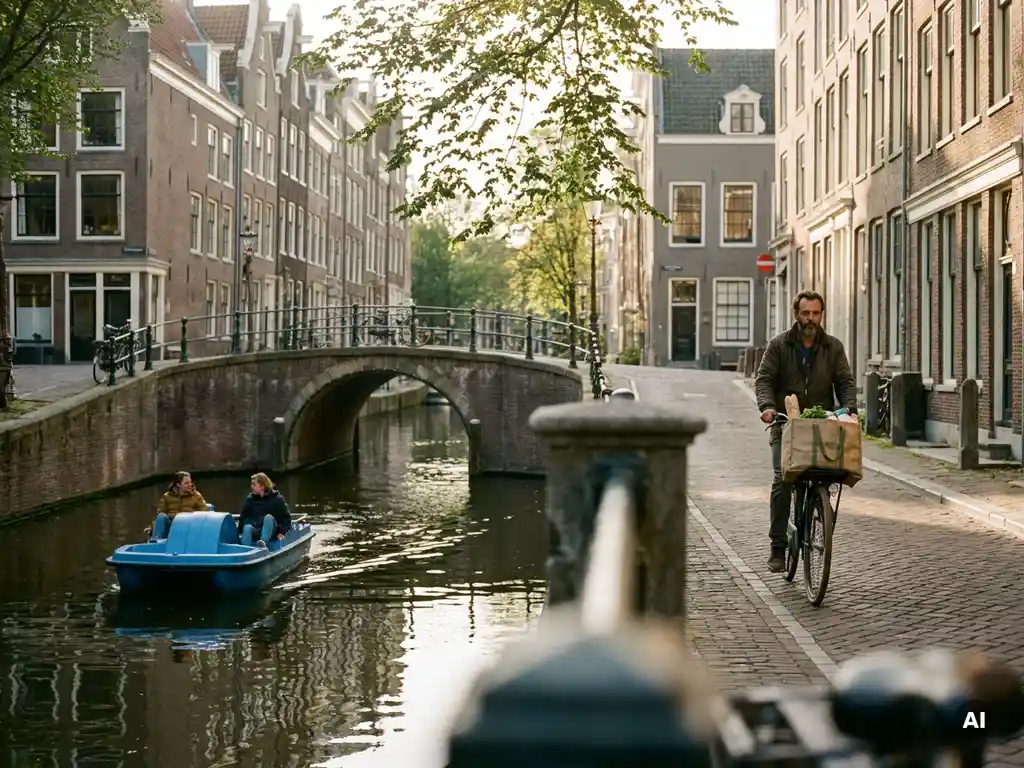
No city has ever fully balanced tourism and residential life, and the honest answer is that none probably ever will. The tension is structural: tourists and residents want fundamentally different things from the same streets, the same neighbourhoods, and the same city. That said, some cities manage the balance far better than others, and the gap between good management and bad management is enormous. Below, we dig into the real questions behind that tension.
What does it actually mean for a city to be ‘overrun’ by tourism?
A city is overrun by tourism when the needs and behaviours of visitors begin to consistently override the daily quality of life of the people who actually live there. It is not simply about crowd size. It is about who the city is designed for, who benefits from its economy, and who bears the costs.
The signs are familiar to anyone who has lived in a heavily visited city. Supermarkets in central neighbourhoods get replaced by souvenir shops. Rents climb because short-term rental platforms make it more profitable to house tourists than residents. Streets that were once genuinely local become stages for a performance of local life rather than the thing itself. Noise, litter, and antisocial behaviour spike in areas with high visitor concentrations, and residents absorb those externalities without compensation.
What makes this particularly frustrating is that the people causing the disruption are not malicious. Most tourists are perfectly decent. The problem is systemic, not personal. When millions of individuals each make reasonable individual choices, the collective result can be genuinely damaging to a community. That is the core of what overtourism actually means, and why the phrase “overrun” captures something real.
Why is balancing tourism and residential life so hard to get right?
Balancing tourism and residential life is so hard because the economic incentives almost always favour more tourism, while the social costs are distributed unevenly and are difficult to measure. Governments collect tax revenue from visitors; residents absorb the noise, congestion, and rising costs. The people who benefit most from tourism are rarely the same people who pay the price for it.
There is also a timing problem. The damage from overtourism accumulates slowly, and by the time a city recognises it has a serious problem, the infrastructure, the economy, and the political expectations around tourism are already deeply entrenched. Pulling back becomes economically painful and politically difficult.
Regulation adds another layer of complexity. Short-term rental platforms, for example, operate across jurisdictions and respond to local rules with creative workarounds. A city can introduce limits on tourist apartments, and the platforms will find ways to reclassify listings. Meanwhile, the hospitality industry, which employs a significant portion of the local workforce, lobbies hard against restrictions. The result is policy that is always slightly behind the problem it is trying to solve.
Finally, there is a cultural dimension that is easy to underestimate. In cities with a strong identity around openness and welcome, restricting tourism can feel like a betrayal of values. Amsterdam is a perfect example. A city that built its entire historical identity on trade, tolerance, and welcoming outsiders finds it genuinely uncomfortable to tell people they are not welcome. That psychological tension makes decisive action harder than it would otherwise be.
Which cities have come closest to getting the balance right?
No city has fully solved the balance between tourism and living, but several have made meaningful progress by treating residents as the primary constituency rather than an afterthought. The cities that do best tend to share a few common traits: they distribute visitors across a wider geography, they use pricing and access controls to manage peak demand, and they invest tourism revenue directly back into neighbourhood infrastructure.
Bhutan is the most cited example of a country that deliberately limits visitor numbers through a high daily fee, though its model depends on being a destination with near-mythical status rather than a city with a functioning residential economy. For urban environments, the more instructive examples are closer to home.
Ghent in Belgium has managed to grow its visitor numbers while maintaining a genuinely liveable city centre, partly because it never allowed short-term rentals to hollow out its housing stock in the way Amsterdam or Barcelona did. Ljubljana in Slovenia has built a strong tourism economy around a relatively small, walkable centre while keeping residential neighbourhoods intact and accessible. Neither city is perfect, but both made deliberate choices early enough to avoid the worst outcomes.
The common thread is timing and political will. Cities that got ahead of the problem, rather than reacting to it after the damage was done, consistently fared better. That is a lesson that is easy to state and very hard to act on when tourism revenues are still climbing and no crisis is yet visible.
Should cities ever say no to more tourists?
Yes, cities should be willing to say no to more tourists when the evidence shows that additional visitor numbers are degrading residential quality of life faster than they are generating community benefit. The balance between tourism and living is not served by treating growth as an inherently positive goal. At some point, more is simply more, not better.
This is still a genuinely controversial position, and it should be. Tourism employs real people, funds real infrastructure, and connects cities to the wider world in ways that have genuine cultural and economic value. Saying no is not costless. But the argument that tourism must always grow because it generates revenue is the same logic that has hollowed out the centres of Venice, Barcelona, and Amsterdam over the past two decades.
The more useful framing is not whether to say no, but how. Absolute visitor caps are blunt instruments that tend to push demand to adjacent areas rather than reduce it. Smarter tools include seasonal pricing, zoning restrictions that protect residential neighbourhoods from commercial tourist infrastructure, and hard limits on short-term rental density per street or district. These approaches allow a city to manage the composition and distribution of tourism rather than simply its volume.
What is clear is that doing nothing while waiting for the market to self-correct is itself a choice, and a costly one. Cities that have watched their residential populations shrink, their rents become unaffordable, and their neighbourhoods lose the authenticity that made them attractive in the first place have all, at some point, decided that the discomfort of saying no was worse than the discomfort of losing what made the city worth visiting in the first place.
How Klagen Niet Klagen covers the tension between tourism and city life
If you have read this far, you probably already sense that this is not a topic that resolves neatly. The Klagen Niet Klagen blog exists precisely for that kind of honest, unresolved conversation about Amsterdam city life. Here is what the blog offers that you will not find in a tourism guide or a city council press release:
- Long-form essays on Amsterdam’s real contradictions, written by someone who has lived and built here for over thirty years
- An English-language perspective that speaks to expats, international visitors, and globally minded Dutch readers alike
- Opinion that is free from tourism board influence, advertorial pressure, or the need to be diplomatic about uncomfortable truths
- A consistent editorial voice grounded in the klagen / niet klagen framework: honest about what is wrong, fair about what is right
If the questions in this article are the kind you keep coming back to, read more about the blog and what drives it. And if you want to get in touch directly, the contact page is right there.
The same instinct that drives this kind of commentary, the refusal to smooth over the rough edges of Amsterdam in favour of a prettier story, is what has powered Boom Chicago since 1993. Comedy that actually says something, performed live in Amsterdam, is a surprisingly effective way to process the contradictions of city life. If you have never been to a show, it is worth knowing that Boom Chicago has been making locals and visitors laugh at the same absurdities for over three decades. Check the current shows and agenda and see what is on. It might be the most honest version of Amsterdam you encounter all trip.
Frequently Asked Questions
What's the single most effective policy tool cities have used to protect residential neighbourhoods from overtourism?
Short-term rental density caps at the street or district level have proven to be one of the most targeted and effective tools, because they address the housing displacement problem directly rather than trying to reduce visitor numbers overall. Cities like Ghent that implemented these restrictions early managed to keep residential housing stock intact while still growing their tourism economies. The key is enforcement: the policy only works if platforms are legally required to verify and display licence numbers, and if violations carry meaningful penalties.
Is overtourism only a problem in iconic, world-famous cities, or can smaller cities face the same issues?
Smaller cities can face overtourism just as severely as iconic destinations, and in some ways are more vulnerable because they have less political and economic leverage to push back. A modest medieval town centre can be overwhelmed by visitor numbers that would barely register in a major capital. Ljubljana and Ghent are instructive here: both acted early precisely because they recognised that their smaller scale made them more fragile, not less, and that waiting for a crisis to become undeniable would leave them with far fewer options.
How can individual tourists make more responsible choices without feeling like they are being blamed for a systemic problem?
The most impactful individual choices tend to be about distribution rather than abstention: visiting in the shoulder season instead of peak summer, staying in residential neighbourhoods rather than the historic centre, and spending money in locally owned businesses rather than international chains. None of these choices require self-denial, and collectively they help spread the economic benefit of tourism more evenly while reducing pressure on the most congested areas. The systemic problem is real and cannot be solved by individual behaviour alone, but small shifts in where and how you visit do add up at scale.