
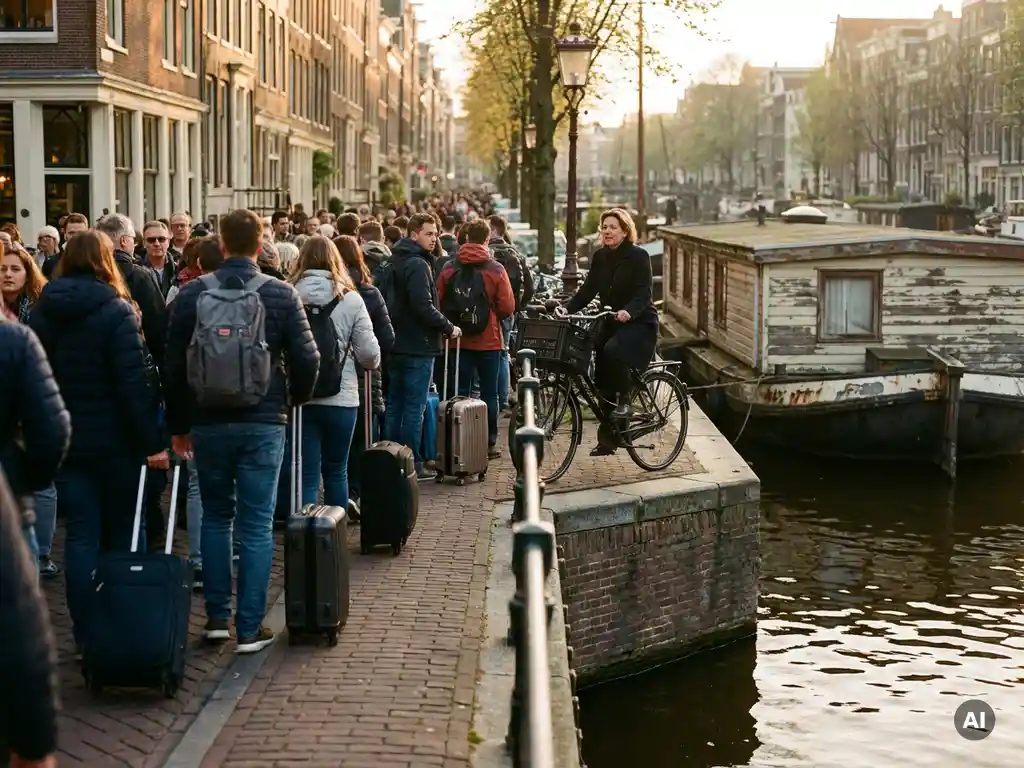
Yes, Amsterdam is losing the balance between tourism and living, and has been for years. The city now welcomes roughly 20 million visitors annually into a city of fewer than 1 million residents, and the pressure on housing, public space, and daily infrastructure has reached a point where many long-term residents feel they are guests in their own neighbourhoods. The questions below unpack exactly how bad things have gotten, what it costs the people who actually live here, and whether there is any realistic path back to something resembling equilibrium.
How bad has Amsterdam’s overtourism actually gotten?
Amsterdam’s overtourism problem is severe by almost any measure. The city consistently ranks among the most tourism-saturated urban centres in Europe relative to its resident population. Neighbourhoods like the Jordaan, De Wallen, and the canal ring were not designed to absorb millions of stag parties, cruise passengers, and selfie-seekers simultaneously, and the strain is visible in every crumbling canal wall, overcrowded tram, and shuttered local shop replaced by a waffle stand.
What makes Amsterdam’s situation particularly acute is the concentration problem. Unlike Paris or London, Amsterdam is a small, dense city where nearly all tourist activity funnels into a compact historic centre. There is nowhere for the pressure to dissipate. The result is a city centre that functions increasingly as a theme park rather than a living neighbourhood, charming to visit for 48 hours, genuinely difficult to actually inhabit.
The growth in short-stay rentals has compounded this. When apartments that once housed families or young professionals become tourist accommodation, the residential fabric of a neighbourhood changes permanently: fewer neighbours, fewer local businesses catering to locals, and a street culture increasingly shaped by what visitors want rather than what residents need.
What does overtourism cost Amsterdam residents in daily life?
The daily cost of overtourism for Amsterdam residents is concrete and cumulative: higher rents, longer commutes, noisier streets, and a city centre that has become genuinely unpleasant to use. Housing is the sharpest pain point. When short-term rental platforms compete with the long-term rental market for the same limited housing stock, prices rise and availability shrinks, a dynamic that hits young people, artists, and lower-income residents hardest.
Beyond housing, the texture of daily life degrades in ways that are harder to quantify but easy to feel. Cycling through Leidseplein on a Friday afternoon means navigating a river of tourists walking four abreast, staring at phones, and stopping without warning. Public transport that residents depend on becomes unreliable when it is also the primary vehicle for tourist movement. Local shops, bakeries, hardware stores, the kind of places that make a neighbourhood function, close because they cannot compete with the rent levels that tourist-facing businesses can sustain.
There is also a subtler cultural cost. When a city’s public spaces are consistently dominated by visitors, residents begin to feel psychologically displaced from their own city. That feeling, of being a minority in your own neighbourhood, erodes the sense of belonging that makes urban life worth choosing in the first place.
What has Amsterdam’s city government actually done about it?
Amsterdam’s city government has been more active on overtourism than most European capitals, though results have been mixed. The city has banned new hotel construction in the historic centre, imposed strict limits on short-term rentals (capping them at 30 nights per year per property), and launched campaigns explicitly telling certain categories of tourists, specifically young men planning alcohol-fuelled weekends, that they are not welcome. The “Stay Away” campaign aimed at rowdy British stag parties attracted international attention and was widely praised as a rare act of municipal honesty.
The city has also raised tourist taxes, restricted cruise ship access, and experimented with pedestrianising sections of the centre that were previously overwhelmed. These are real policy interventions, not symbolic gestures, and they reflect a genuine political will to prioritise residents over visitor numbers.
The honest assessment, though, is that none of these measures have fundamentally reversed the trajectory. Enforcement of short-term rental rules is inconsistent. The economic incentives driving tourism infrastructure are powerful and deeply embedded. And Amsterdam’s global brand as a place of freedom, beauty, and permissiveness continues to draw visitors faster than policy can redirect them.
Can Amsterdam realistically fix the tourism-living balance?
Amsterdam can improve the balance between tourism and living, but a complete fix is unlikely without structural changes that go well beyond municipal policy. The city’s fundamental challenge is that its appeal, compact, beautiful, internationally connected, English-friendly, is precisely what makes it so attractive to mass tourism. Those qualities cannot be regulated away, nor should they be.
What is realistic is a managed redistribution: spreading tourism more evenly across the city and across the calendar, investing in residential infrastructure so that living in Amsterdam remains viable for people who are not wealthy, and continuing to enforce limits on the most disruptive forms of tourism. Some cities in Europe have shown that firm political will, sustained over a decade rather than an election cycle, can stabilise the balance. Amsterdam has the political consciousness for it. Whether it has the patience is another question.
What is not realistic is the idea that Amsterdam can remain one of the world’s most visited cities and simultaneously feel like a quiet, affordable place to live. Those two things are in genuine tension, and honest city planning means acknowledging that trade-off rather than pretending clever policy can dissolve it entirely. The balance between tourism and living in Amsterdam is a dial that can be turned, but it cannot be set to zero on one side.
How Klagen Niet Klagen covers Amsterdam’s tourism debate
Klagen Niet Klagen exists precisely for questions like this one, the kind that Amsterdam’s mainstream media rarely tackles with genuine honesty, and that tourist guides have every incentive to avoid entirely. Written by Andrew Moskos, co-founder of Boom Chicago and a resident of Amsterdam for over three decades, the blog offers something that is genuinely hard to find: long-form, English-language commentary on Amsterdam city life from someone with real skin in the game.
- Honest, independent opinion on Amsterdam’s biggest tensions, including overtourism, housing, and the erosion of neighbourhood culture
- Written from inside the city’s creative and entrepreneurial scene, not from a press trip or a tourism board brief
- Long-form essays that hold up over time, not reactive takes that date within a week
- Accessible to expats, international visitors, and internationally minded Dutch readers who want depth rather than a top-ten list
- Free from advertorial pressure, just a point of view, honestly held
If you want to understand Amsterdam rather than just visit it, read more about the blog and explore what Klagen Niet Klagen has to say about the city you think you already know.
And while you are thinking about Amsterdam’s cultural life, the real, living, breathing kind that tourism threatens to crowd out, it is worth knowing that Boom Chicago has been part of that cultural life since 1993. Sharp, funny, and rooted in the city in a way that very few institutions can claim, Boom Chicago is the kind of Amsterdam experience that actually belongs here. Check out the shows and agenda and come and see what Amsterdam comedy looks like when it is done right.
Frequently Asked Questions
If I'm visiting Amsterdam, how can I be a more responsible tourist and avoid contributing to overtourism?
The most impactful things you can do are to stay in a licensed hotel rather than a short-term rental apartment, visit during the shoulder season (spring or autumn rather than peak summer), and deliberately spend time and money in neighbourhoods outside the historic centre, such as Noord, Oost, or De Pijp. Avoiding the most saturated streets during peak hours, using public transport considerately, and skipping the canal ring for your morning coffee in favour of a local neighbourhood bakery all add up. None of this requires sacrifice; it often makes for a better trip.
What are the most effective short-term rental rules Amsterdam has in place, and are they actually enforced?
Amsterdam currently caps short-term rentals at 30 nights per year per property, requires hosts to register and display a permit number on any listing, and has banned short-term rentals outright in several high-pressure neighbourhoods. Enforcement, however, remains inconsistent: the city relies heavily on tip-offs from neighbours and algorithmic monitoring of platforms like Airbnb, but illegal listings continue to operate. The gap between the rules on paper and the reality on the ground is one of the most persistent frustrations for residents and housing advocates alike.
Are there other European cities that have successfully managed to reverse or stabilise overtourism, and what can Amsterdam learn from them?
Barcelona and Lisbon offer the most instructive comparisons, though neither is a clean success story. Barcelona has been the most aggressive, capping total tourist accommodation licences, banning new short-term rental permits in the city centre, and investing heavily in neighbourhood-level enforcement. The results have been partial but real: growth has slowed in the most saturated districts, even if prices and displacement have not reversed. The consistent lesson from cities that have made progress is that sustained political commitment over a decade, rather than a single policy cycle, is what moves the dial, and that measures must address housing supply and tourist infrastructure simultaneously rather than in isolation.