Author: Andrew

  • What are the best outdoor recreation spots in Amsterdam?

    What are the best outdoor recreation spots in Amsterdam?

    Amsterdam’s best outdoor recreation spots include Vondelpark, the Amsterdamse Bos, the IJ waterfront, and the many smaller neighbourhood parks and canal-side paths scattered across the city. The sheer variety is genuinely surprising for a city this compact. Whether you want a lazy afternoon on the grass, a serious bike ride through the forest, or a swim in open water, Amsterdam delivers, though not always in the ways the tourist brochures suggest.

    Which Amsterdam parks are worth your time?

    The parks genuinely worth your time in Amsterdam are Vondelpark for atmosphere, Amsterdamse Bos for scale and nature, Westerpark for neighbourhood character, and Flevopark for the feeling that you have discovered something most visitors never find. Each serves a different mood and a different kind of outdoor experience.

    Vondelpark is the obvious starting point, and for good reason. It is central, lively, and genuinely beautiful on a warm day. The downside is that it knows exactly how famous it is. On a sunny weekend in June, it can feel more like a festival site than a park. Still, early mornings in Vondelpark are quietly wonderful.

    Amsterdamse Bos is the real revelation. Located just south of the city, this enormous forested park was largely built by hand during the 1930s as a public works project. It has cycling paths, rowing lakes, a goat farm, an outdoor theatre, and enough space to actually feel alone in nature. Locals treat it as their countryside.

    Westerpark, tucked into the west of the city, has transformed dramatically over the past two decades. The old gasworks site next to it has become a cultural hub, and the park itself has a relaxed, neighbourhood feel that Vondelpark has largely lost to tourism. It attracts a creative, local crowd.

    Flevopark, in the east, is genuinely underrated. Quiet, green, and bordered by the Nieuwe Diep, it rewards anyone willing to venture slightly off the beaten path.

    Where do Amsterdam locals actually go outdoors?

    Amsterdam locals tend to go to Amsterdamse Bos, Flevopark, Westerpark, and the canal-side benches of their own neighbourhoods rather than Vondelpark. They also spend a surprising amount of time simply sitting beside canals, cycling along the ring roads, or heading to the beaches at IJburg on the eastern edge of the city.

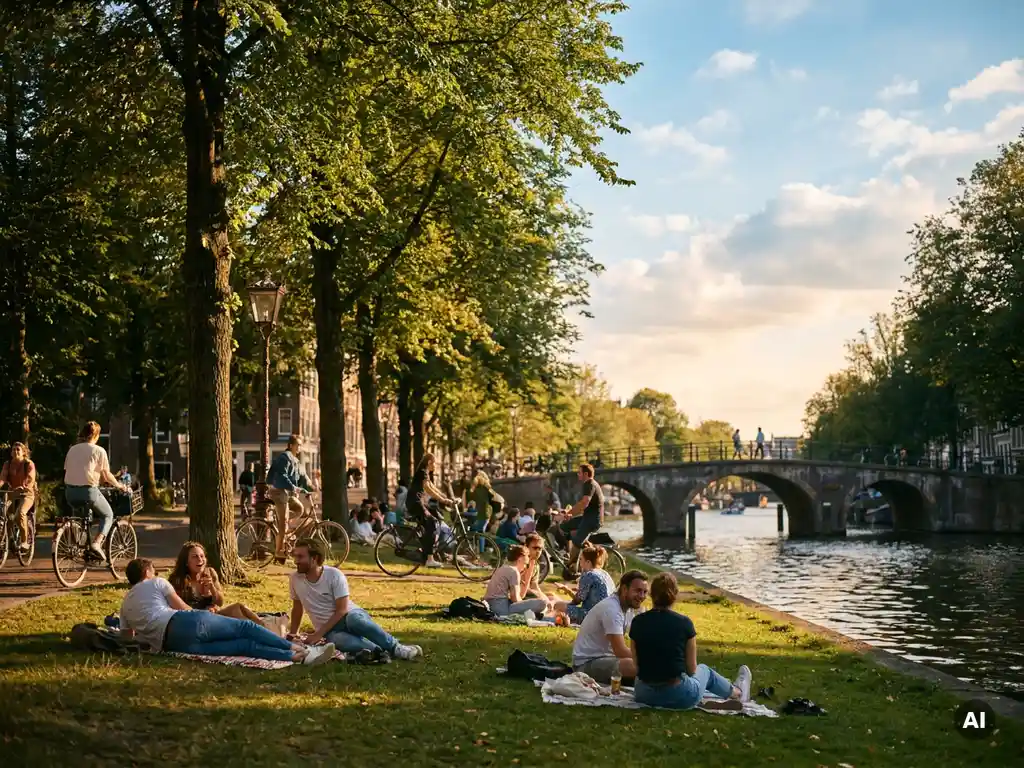
    One thing that defines how locals use outdoor space in Amsterdam is the bicycle. The city’s cycling infrastructure means that getting outdoors is rarely a destination event. It is woven into daily life: cycling to work along the Amstel, stopping at a canal-side café, or cutting through Sarphatipark on the way home. The park visit is often incidental rather than planned.

    In summer, locals head to IJburg, the artificial island neighbourhood in the east of the city, which has proper sandy beaches along the IJmeer. It is not the Mediterranean, but on a warm Dutch summer day, the water is swimmable and the atmosphere is genuinely festive. Amsterdammers are fiercely loyal to it.

    Amstelpark in the south is another local favourite, particularly for families. Less crowded than Vondelpark and with a working windmill, a mini-golf course, and a rhododendron garden, it offers a quieter, more complete afternoon outdoors.

    What outdoor water activities can you do in Amsterdam?

    Outdoor water activities in Amsterdam include open-water swimming, kayaking and canoeing through the canals, stand-up paddleboarding, sailing on the IJ and IJmeer, and rowing in Amsterdamse Bos. The city’s relationship with water is central to its identity, and there are genuine options for both casual and more serious water enthusiasts.

    Open-water swimming has grown enormously in popularity. The city maintains several designated swimming spots, including the Sloterplas, the beaches at IJburg, and the Nieuwe Meer. The water quality has improved significantly in recent decades, and on a warm day these spots attract serious swimmers alongside families with paddling children.

    Canal kayaking is one of the best ways to experience Amsterdam from a completely different angle. Several rental companies offer kayaks and canoes, and paddling through the historic canal ring gives you a perspective that no walking tour can match. Early morning is the best time to do this before canal boat traffic picks up.

    Stand-up paddleboarding has become enormously fashionable on the canals and is a genuinely enjoyable way to spend a few hours, provided you are comfortable with the fact that falling off means landing in canal water of uncertain temperature and debatable clarity.

    For something more ambitious, sailing clubs on the IJ and IJmeer offer lessons and rentals. The open water east of the city gives you real sailing conditions and, on a clear day, views back toward the Amsterdam skyline that are hard to forget.

    When is the best time of year for outdoor recreation in Amsterdam?

    The best time of year for outdoor recreation in Amsterdam is late May through early September, when temperatures are reliably warm, daylight hours are long, and the parks and waterways are at their most inviting. June and July offer the longest days, while late August and early September often bring warm, settled weather with noticeably smaller crowds.

    That said, Amsterdam in spring is genuinely beautiful and underrated for outdoor activity. April and May bring the famous tulip season, warming temperatures, and the particular pleasure of a city slowly waking up after winter. The parks are green, the café terraces open, and the tourist pressure has not yet peaked.

    Winter outdoor recreation is a different proposition entirely. The Dutch cycle year-round regardless of weather, and a brisk walk through Vondelpark or along the canals in December has its own austere charm. In rare cold winters, frozen canals attract skaters, which remains one of Amsterdam’s most magical sights. But for swimming, paddleboarding, or simply lying in the grass, you need summer.

    The honest answer is that Amsterdam’s outdoor season is shorter than the city’s reputation suggests. The weather is genuinely unpredictable, and a sunny forecast can turn grey within hours. Locals learn to act immediately when the sun appears rather than waiting for a better day. It is one of the city’s unspoken rules: when it is nice, you go outside now.

    How Klagen Niet Klagen helps you navigate Amsterdam outdoors

    Finding honest, insider guidance on outdoor recreation options in Amsterdam is harder than it sounds. Most travel content is either too polished, too tourist-focused, or simply written by people who visited once and moved on. Klagen Niet Klagen exists to fill that gap, offering English-language commentary on Amsterdam city life written from over three decades of actually living here.

    • Honest assessments of what is genuinely worth your time versus what is overhyped
    • Local perspective on how Amsterdammers actually use outdoor spaces, not how the tourism board presents them
    • Seasonal and neighbourhood-specific insight that goes beyond the standard park list
    • Long-form essays and opinion pieces that give you the cultural context behind the city’s relationship with public space

    If you want commentary that treats you as an intelligent adult rather than a tourist to be managed, read more about the blog and explore what Amsterdam looks like through an honest, comedically refined lens. Have a question or want to get in touch? reach out directly.

    And if you find yourself in Amsterdam with an afternoon to spare after your time outdoors, consider spending an evening at Boom Chicago. After thirty years of live comedy in this city, the shows remain sharp, surprising, and genuinely Amsterdam. It is the kind of evening that gives you something to talk about on the walk home along the canals, which, as any local will tell you, is exactly the right way to end a good day in this city.

    Frequently Asked Questions

    Is it safe to swim in Amsterdam's canals and open-water spots?

    Swimming in the main historic canals is not recommended and is technically prohibited — the water quality, boat traffic, and currents make them unsuitable. However, Amsterdam’s designated open-water swimming spots, such as the Sloterplas, Nieuwe Meer, and the IJburg beaches, are monitored for water quality and are considered safe for swimming during the summer months. Always check the Zwemwater.nl website for up-to-date water quality reports before heading in.

    Do I need to book canal kayaks or paddleboards in advance, or can I just show up?

    On weekday mornings outside peak summer, you can often walk up to a rental company and get out on the water without a reservation. However, on sunny weekends in June, July, and August, popular rental spots near the Jordaan and Leidseplein can sell out by mid-morning. Booking a slot online the evening before is a simple way to avoid disappointment, especially if your Amsterdam itinerary is time-sensitive.

    What is the easiest way to get to Amsterdamse Bos without a bike?

    From central Amsterdam, tram line 25 runs to Amstelveen and stops near the northern entrance of Amsterdamse Bos, making it accessible without a bicycle. That said, the forest is enormous and genuinely best explored on two wheels — bike rentals are available at the main entrance if you do not have your own. The journey from the city centre by bike takes roughly 30 to 40 minutes and is a pleasant ride in its own right, following the Amstel river south.

  • Where can locals go for outdoor activities away from tourists?

    Where can locals go for outdoor activities away from tourists?

    Locals in Amsterdam escape tourist crowds by heading to the city’s outer neighbourhoods, lesser-known parks, and the waterways that tourists rarely explore. The key is knowing where mass tourism ends and real Amsterdam begins. That boundary is closer than most people think. Below, you’ll find the best outdoor recreation options Amsterdam locals actually use.

    Which Amsterdam neighbourhoods have the least tourist crowds outdoors?

    The neighbourhoods with the fewest tourists outdoors are Amsterdam-Noord, Nieuw-West, and the Bijlmer area in Zuidoost. These districts sit well outside the historic centre and attract almost no casual tourist foot traffic. They offer green space, water, and room to breathe without a selfie stick in sight.

    Amsterdam-Noord deserves special mention. Cross the IJ by free ferry and within minutes you’re in a neighbourhood that feels like a different city entirely. The Vliegenbos is a proper forest, not a manicured park, and it sits right on the edge of the city. Further north, the Waterland polder landscape begins almost immediately, with flat cycling routes through villages like Ransdorp and Holysloot that most tourists have never heard of.

    Nieuw-West is underrated in a different way. The Sloterplas lake sits at its heart, ringed by parks and beaches that fill up with locals on warm days. It has the relaxed, community feel of a neighbourhood that has never needed to perform for visitors. Zuidoost, meanwhile, offers Gaasperplaspark, one of Amsterdam’s largest and genuinely quietest outdoor spaces.

    What are the best outdoor spots in Amsterdam for locals to escape the crowds?

    The best outdoor spots for locals seeking genuine quiet are the Amsterdamse Bos, Gaasperplaspark, Sloterplas, and the Vliegenbos. Each offers something Vondelpark simply cannot: space, nature, and the absence of tourists taking photos of their stroopwafels.

    The Amsterdamse Bos is the standout. It is enormous, roughly three times the size of Central Park in New York, and most of it feels genuinely wild. You can run, cycle, swim in the open-air pool, rent a canoe, or simply walk for an hour without seeing another soul. On a weekday morning it belongs almost entirely to locals.

    Gaasperplaspark in Zuidoost is arguably the city’s best-kept secret for outdoor recreation. The lake is clean, the surrounding greenery is well maintained, and the atmosphere is calm in a way that the more central parks never quite manage. Locals swim, windsurf, and picnic here without the circus of the tourist belt.

    How do locals use Amsterdam’s waterways for outdoor recreation?

    Amsterdam locals use the city’s waterways for swimming, paddleboarding, kayaking, canoeing, and recreational boating. The canals in the historic centre are generally not suitable for swimming, but the lakes, rivers, and open water around and within the city offer genuine outdoor recreation options for Amsterdammers year-round.

    The Sloterplas and Gaasperplas are the two most popular open-water swimming spots within the city limits. Both are monitored for water quality and have proper facilities. On a hot summer day, these lakes are where locals go rather than fighting for a patch of grass in Vondelpark.

    Paddleboarding and kayaking have grown significantly in popularity over the past decade. The quieter canals in Amsterdam-Noord and the open stretches of the IJ offer good paddling routes that feel nothing like the tourist boat traffic in the centre. Several rental spots operate in Noord specifically because the water there is calmer and less congested.

    Recreational boating is deeply embedded in Amsterdam culture. Many locals own or rent small electric boats and spend summer evenings on the water with friends. The key is heading away from the Prinsengracht and Keizersgracht, where tour boats dominate, and instead exploring the ring canals further out or the open water of the Amstel heading south.

    Are there outdoor activities near Amsterdam that tourists rarely visit?

    Yes. Within thirty to sixty minutes of Amsterdam by bike, public transport, or car, there are outdoor destinations that see almost no international tourist traffic. The Waterland region north of the city, the dunes of the North Holland coast, and the Gooi heathlands to the southeast are all within easy reach and largely unknown to visitors.

    The Waterland polder is the most accessible. Cycling north from Amsterdam-Noord through Broek in Waterland, Monnickendam, and Marken takes you through a landscape that has barely changed in centuries. Flat, quiet, and genuinely Dutch in a way that the historic centre no longer is. Tourists who do make it here are rare, and the ones who do are usually the good kind.

    The North Holland dune reserves between Castricum and Bergen are a revelation for anyone who has not discovered them. Miles of protected dune landscape, forest trails, and coastal paths that connect to some of the best beaches in the Netherlands. The train from Amsterdam Centraal to Castricum takes under thirty minutes.

    To the southeast, the Gooi region around Hilversum and Laren offers heathland, forest, and lakes that attract Dutch day-trippers but almost no international visitors. The Naardermeer nature reserve, just east of Amsterdam, is one of the oldest protected nature areas in the Netherlands and can be explored by canoe.

    How Klagen Niet Klagen helps you find the real Amsterdam outdoors

    Klagen Niet Klagen is written for people who want honest, insider knowledge about Amsterdam, not a polished tourism brochure. If you’re looking for outdoor recreation options in Amsterdam that go beyond the obvious, this blog delivers exactly that:

    • Long-form essays and opinion pieces on Amsterdam city life written from over thirty years of lived experience
    • Honest takes on where locals actually go, and why the tourist version of Amsterdam is a different city entirely
    • Cultural context that helps you understand not just where to go, but why Amsterdam works the way it does
    • A consistent, independent editorial voice free from tourism board influence or advertorial pressure

    If this kind of honest, insider Amsterdam commentary is what you’re after, find out more about the blog and explore the archive. There’s plenty more where this came from.

    And if you’re in Amsterdam and looking for something to do on a rainy evening after a day outdoors in the Amsterdamse Bos, consider spending it at Boom Chicago. The comedy theatre Andrew Moskos co-founded in 1993 has been making Amsterdam audiences laugh for over thirty years. Check the shows and agenda and book a seat. It’s the kind of Amsterdam experience that doesn’t show up in any tourist guide either.

    Frequently Asked Questions

    What's the best time of year to enjoy outdoor recreation in Amsterdam like a local?

    Late spring through early autumn (May to September) is the prime season for open-water swimming, paddleboarding, and cycling through the Waterland polder, with long daylight hours and warm enough temperatures to make the most of the lakes and waterways. That said, locals use the Amsterdamse Bos and outer neighbourhood parks year-round — winter cycling through the dune reserves or a foggy morning walk in the Vliegenbos has its own appeal. The shoulder months of May and September offer the best balance: decent weather, fewer crowds even in the more popular local spots, and a city that feels closer to its everyday self.

    Do I need to rent a bike to access most of these local outdoor spots, or are they reachable by public transport?

    Most of the spots mentioned are reachable by a combination of public transport and walking, but a bike genuinely transforms the experience. The Amsterdamse Bos is accessible by tram (line 25 to Amstelveenseweg), Gaasperplaspark is served by the metro (line 54), and the free IJ ferries drop you directly into Amsterdam-Noord. For the wider day trips — Waterland, the North Holland dunes, or the Gooi region — a bike or train is the practical choice, and the train to Castricum for the dune reserves takes under thirty minutes from Amsterdam Centraal.

    Is it safe to swim in Amsterdam's lakes, and are there any rules locals follow?

    The Sloterplas and Gaasperplas are both officially designated swimming locations with regular water quality monitoring by the municipality — they’re safe under normal conditions and have basic facilities like changing areas nearby. The unwritten local rules are straightforward: check the water quality reports on the Amsterdam municipality website before swimming, especially after heavy rainfall when runoff can temporarily affect quality, and avoid the historic canals entirely, which are not monitored or suitable for swimming. Arriving early on hot days is also the local approach — the lakes get busy by midday in summer, and a spot in the shade goes fast.

  • How does Marineterrein compare to other Amsterdam swim spots?

    How does Marineterrein compare to other Amsterdam swim spots?

    Marineterrein is one of Amsterdam’s most distinctive swimming spots, standing out from the city’s lakes and canals thanks to its sheltered harbour location, urban industrial character, and community-driven approach to public space. It offers a genuinely different experience from the open water of places like the Sloterplas or Bosbaan. Below, the key questions about Marineterrein as a swimming destination are answered directly.

    What makes Marineterrein a unique place to swim in Amsterdam?

    Marineterrein is unique because it is a former Dutch Navy compound that has been transformed into an open, experimental urban campus, and swimming is a central part of that identity. Unlike Amsterdam’s recreational lakes, which exist primarily as leisure infrastructure, Marineterrein treats the water as a living part of the city’s public fabric. The swim spot sits in a sheltered tidal inlet connected to the IJ, giving it a distinctly maritime atmosphere you simply do not find at a sandy lakeshore.

    The setting itself is striking. You are surrounded by historic naval buildings, research institutions, and innovation hubs rather than beach bars and paddleboats. The water is tidal, which means it moves and refreshes naturally. There is a floating jetty, clean entry points, and a relaxed, community feel that attracts locals rather than tourists. It is the kind of place where you feel like you have discovered something real about Amsterdam rather than stumbled upon a curated experience.

    What also sets Marineterrein apart is its role as a testing ground. The site has been used for water quality research and urban waterway innovation, which means the people running it are genuinely invested in keeping the water clean and the experience honest. It is not a commercial swim beach. It is a place where Amsterdam experiments with what a city can be.

    How does Marineterrein’s water quality compare to other Amsterdam swim spots?

    Marineterrein’s water quality is generally considered good for an urban swim location, benefiting from tidal flow that continuously refreshes the inlet. This gives it a natural advantage over stagnant or slow-moving urban water. That said, like all Amsterdam swim locations, water quality can vary depending on rainfall, season, and broader IJ water conditions. It is not a controlled lake environment, so swimmers should check current conditions before entering.

    Amsterdam’s designated lakes, such as the Sloterplas and the Bosbaan, are monitored under formal EU bathing water regulations and typically receive official quality ratings each season. These ratings give swimmers a reliable benchmark. Marineterrein operates in a different category: it is an urban tidal location where the water quality conversation is more dynamic and less institutionalised than at the city’s official bathing lakes.

    In practical terms, the Sloterplas and Bosbaan tend to offer more consistent and formally verified water quality data. Marineterrein offers a more adventurous, urban swim experience where you are swimming in the city rather than at a designated leisure facility. Both have genuine appeal, but they serve different kinds of swimmers.

    Which Amsterdam swim spots are officially approved for swimming?

    Amsterdam has several officially designated bathing water locations that are monitored and approved for swimming under EU standards. The main ones include the Sloterplas, the Bosbaan in the Amsterdamse Bos, and the Nieuwe Meer. These spots are tested regularly throughout the swimming season and receive official quality classifications ranging from poor to excellent.

    The city’s official swim locations are managed with safety infrastructure in mind: marked swimming zones, lifeguard presence during peak season at some sites, and regular water quality updates published by the municipality. For families with children or swimmers who want certainty, these approved spots offer the most reliable experience.

    Marineterrein does not appear on the official EU bathing water register in the same way, which means it sits in a different regulatory category. Swimming there is permitted and actively encouraged by the site’s operators, but it lacks the formal seasonal quality certification of the lakes. This is not necessarily a reason to avoid it, but it is worth understanding the difference before you jump in.

    When is the best time to swim at Marineterrein versus the city’s lakes?

    The best time to swim at Marineterrein is during warm, dry spells in summer, typically from late June through August, when water temperatures are most comfortable and the risk of runoff from heavy rainfall is lowest. Because Marineterrein is connected to the IJ, heavy rain can temporarily affect water quality more quickly than at enclosed lakes, so timing your visit after a dry stretch of weather is genuinely good advice.

    Amsterdam’s lakes, by contrast, warm up more predictably during summer and hold their temperature better. The Sloterplas in particular becomes a reliable swim destination from mid-June onward and stays pleasant well into September. If you want a long, leisurely swim in consistently warm water with a sandy shore, a lake on a sunny weekday morning is hard to beat.

    Marineterrein tends to suit those who want an early morning or after-work urban swim with a different kind of atmosphere. The site has a quieter, more contemplative character than the busy lakeshores on a hot weekend. If the lakes feel like Amsterdam’s version of a beach holiday, Marineterrein feels like swimming in the actual city, which is either exactly what you want or not at all what you are looking for.

    How Klagen Niet Klagen helps you navigate Amsterdam’s swim spots

    Finding honest, practical information about swimming in Amsterdam is harder than it should be. Tourist sites tell you where to go without telling you what it is actually like. Local Dutch media covers it in Dutch. Klagen Niet Klagen fills that gap with the kind of direct, experience-based commentary that only comes from someone who has lived in this city for over three decades.

    • Honest takes on what Amsterdam’s swim spots are really like, beyond the official descriptions
    • Practical context about when, where, and why to swim at specific locations
    • Cultural commentary that helps you understand Amsterdam’s relationship with its own water
    • Long-form essays and opinion pieces written for people who actually live here or want to understand the city properly

    If you want more of this kind of writing, find out more about the blog or explore the full archive for more Amsterdam commentary written without a tourism board in sight. Got a question or a topic you want covered? Get in touch directly.

    And while you are thinking about Amsterdam summers, water, and the city at its best: Boom Chicago has been making people laugh in this city since 1993. If an evening of sharp, Amsterdam-rooted comedy sounds like the right way to end a day that started with a swim, check out the current shows and agenda. It is a very good combination.

    Frequently Asked Questions

    Is there anything I need to bring or prepare before swimming at Marineterrein?

    Marineterrein is a no-frills urban swim spot, so it is worth coming prepared. Bring your own towel, water shoes if you prefer a more comfortable entry, and something to change into, as changing facilities are basic compared to the city’s recreational lakes. It is also a good idea to check the current water quality status before heading out, particularly after heavy rainfall, since the tidal connection to the IJ means conditions can shift more quickly than at enclosed lakes.

    Can beginners or non-confident swimmers use Marineterrein safely?

    Marineterrein can be enjoyed by swimmers of varying abilities, but it is not a managed bathing beach with lifeguards on duty, so non-confident or inexperienced swimmers should exercise caution. The tidal nature of the water means currents can be present, which is quite different from the calm, enclosed conditions at the Sloterplas or Bosbaan. If you are new to open water swimming, starting at one of Amsterdam’s officially designated and supervised lakes is a sensible first step before trying a more urban, tidal location.

    What is the easiest way to get to Marineterrein by public transport?

    Marineterrein is located on the eastern waterfront of Amsterdam, close to the city centre, making it straightforward to reach without a car. From Amsterdam Centraal, it is a short bike ride or bus journey eastward along the IJ waterfront, and cycling is by far the most practical option given Amsterdam’s infrastructure. The site is well-signposted once you are in the area, and arriving by bike fits naturally with the relaxed, local character of the place.

  • What facilities are available at Marineterrein for visitors?

    What facilities are available at Marineterrein for visitors?

    Marineterrein Amsterdam is a former naval complex on the eastern edge of the city centre that has been transformed into a public destination combining open-water swimming, food, culture, and innovation. The site sits along the IJ waterfront and offers a genuinely rare mix of industrial history and contemporary Amsterdam life. Whether you are a local looking for a summer swim or a curious visitor wanting something beyond the usual tourist circuit, Marineterrein delivers.

    What can you actually do at Marineterrein Amsterdam?

    Marineterrein Amsterdam is best known as one of the city’s few official open-water swimming spots, where visitors can swim directly in the IJ in a protected harbour area. Beyond swimming, the site functions as a living urban campus where you can walk, cycle, eat, attend events, and explore a working innovation district that blends public life with research and entrepreneurship.

    The swimming area is the headline attraction, particularly in summer. The water quality is monitored regularly, and the setup includes ladders, floating platforms, and enough space to make it feel like a proper outdoor lido rather than a risky dip in a canal. It is one of the cleanest and most accessible urban swimming spots in Amsterdam, which makes it genuinely special in a city surrounded by water that you mostly cannot legally or safely swim in.

    Outside the water, the terrain itself is worth exploring. The historic naval buildings give the site a distinctive atmosphere, and the mix of startups, research institutes, and public spaces creates an energy that feels very different from the polished tourist zones of the city centre. You can walk the waterfront, take in the skyline views across the IJ, and get a feel for a side of Amsterdam that most visitors never find.

    What food and drink options are available at Marineterrein?

    Marineterrein has a small but solid selection of food and drink options centred around the waterfront. The site is home to a café and outdoor terrace where you can grab coffee, lunch, or a drink after a swim. The atmosphere is relaxed and unpretentious, fitting the overall character of the place.

    Do not arrive expecting a full restaurant strip or a range of cuisines. Marineterrein is not that kind of destination. What it does offer is a genuinely pleasant spot to eat and drink outdoors with a view of the water, away from the crowds of Leidseplein or the Jordaan. On warm days, the terrace fills up with a mix of locals, workers from the campus, and visitors who have discovered the site, which gives it a lively but never overwhelming atmosphere.

    It is worth checking what is open before you visit, as offerings can vary by season and event schedule. The summer months are when the food and drink scene on the terrain is at its most active.

    Is Marineterrein Amsterdam open to the public?

    Yes, Marineterrein Amsterdam is open to the public, though it operates on a somewhat hybrid model. Large parts of the site are freely accessible to anyone who wants to walk, cycle, or swim there. Some areas are reserved for the businesses, research institutions, and organisations that are based on the campus, but the waterfront, the swimming area, and the public spaces are genuinely open.

    The swimming spot is typically accessible during the warmer months, roughly from late spring through early autumn, with specific opening hours that are worth checking in advance. Entry to the swimming area itself is free, which is one of the reasons it has become a popular local hotspot rather than just another ticketed attraction.

    Getting there is straightforward. Marineterrein sits close to Centraal Station and is easily reached on foot, by bike, or by public transport. It is one of those Amsterdam spots that feels like it should be harder to find than it actually is.

    What events and activities take place at Marineterrein throughout the year?

    Marineterrein hosts a varied programme of events across the year, ranging from open-water swimming competitions and water sports activities to cultural gatherings, outdoor markets, and innovation-focused public events. The summer season is the most active, when the swimming area becomes a social hub and outdoor programming picks up significantly.

    The site regularly hosts events connected to its identity as an innovation and sustainability campus, including open days, lectures, and community gatherings that reflect the mix of organisations based there. These are not always heavily marketed, which means they tend to draw a local and engaged crowd rather than a tourist audience.

    Seasonal highlights worth looking out for include:

    • Open-water swimming sessions and organised swim events in summer
    • Outdoor cultural and community events on the waterfront
    • Open campus days where the public can explore the innovation district
    • Occasional markets and food events tied to the waterfront location
    • Water sports and recreational activities during the warmer months

    The programming evolves year to year, so checking the Marineterrein website or social channels before visiting in 2026 is the best way to catch what is currently on. The site rewards spontaneous visits, but a little advance research means you are less likely to arrive on a quiet day.

    How Klagen Niet Klagen helps you discover Amsterdam’s real hotspots

    Marineterrein is exactly the kind of place that rarely makes it into tourist guides but that Amsterdammers genuinely love. Finding spots like this takes either years of living here or a reliable source that cuts through the noise. That is what Klagen Niet Klagen is built for.

    • Honest, insider commentary on Amsterdam city life written by someone who has lived and worked here for over thirty years
    • No tourism board influence, no advertorial pressure, no sanitised recommendations
    • Long-form essays and opinion pieces that go beyond surface-level tips to explain what Amsterdam is actually like
    • An English-language perspective on a city where most real commentary happens in Dutch

    If you want more Amsterdam content that tells it straight, find out more about the blog or browse the archive for more articles on what makes this city tick. And if you have a question or want to get in touch, the contact page is right there.

    One more thing worth knowing while you are in Amsterdam: Boom Chicago has been making people laugh in this city since 1993. If Marineterrein gives you the outdoor Amsterdam experience, an evening at Boom Chicago gives you the indoor one. Sharp, funny, and completely unlike anything else in the city, it is the kind of show that makes you feel like you have finally cracked what Amsterdam humour actually is. Take a look at what is coming up in the programme and book before someone else does.

    Frequently Asked Questions

    What is the best time of year to visit Marineterrein Amsterdam for swimming?

    The swimming area is at its best from late June through early September, when water temperatures are most comfortable and the outdoor terrace and food options are fully operational. Weekday mornings tend to be quieter if you prefer a more relaxed experience, while weekends in July and August draw the biggest local crowds. Always check the official Marineterrein website before heading out, as exact opening dates can shift slightly from year to year depending on weather and water quality assessments.

    Is Marineterrein Amsterdam suitable for children and families?

    Yes, Marineterrein is family-friendly, particularly the swimming area, which is set in a protected harbour rather than open moving water, making it calmer and safer than swimming in the canals. The open waterfront spaces are easy to navigate with kids, and the relaxed, non-commercial atmosphere means there is no pressure to spend money or follow a fixed itinerary. That said, there are no dedicated children’s play facilities on site, so it works best as a swimming and outdoor exploration destination rather than a full family theme day.

    Are there any common mistakes visitors make when going to Marineterrein for the first time?

    The most common mistake is arriving without checking whether the swimming area is open, as it operates seasonally with specific hours and occasional closures for events or water quality monitoring. Another is expecting a wide range of food options — the on-site catering is pleasant but limited, so if you are planning a longer visit, it is worth bringing snacks or eating beforehand. Finally, many first-time visitors underestimate how much time they will want to spend simply walking the terrain and taking in the atmosphere, so building in extra time beyond just the swim is a good idea.

  • Is Marineterrein busy or still a hidden gem?

    Is Marineterrein busy or still a hidden gem?

    Marineterrein Amsterdam is no longer a hidden gem, but it is not overrun either. It sits in that interesting middle ground: known enough to attract a steady crowd, but still relaxed enough to feel like a genuine local spot rather than a tourist attraction. Whether it feels busy or quiet depends heavily on the day, the season, and what you are there to do. Here is what you actually need to know before you go.

    What is Marineterrein Amsterdam actually like now?

    Marineterrein Amsterdam is a former naval complex turned open innovation district on the eastern edge of the city centre. It is a working campus during the week, home to tech startups, research institutes, and creative organisations, but it opens up to the public in ways that most Amsterdam neighbourhoods simply do not. The waterfront is freely accessible, the swimming spot in the IJ is one of the few places in the city where you can legally and safely take a dip, and the overall atmosphere is genuinely relaxed.

    What makes Marineterrein feel different from, say, the NDSM wharf or the Houthavens is the mix of functions happening simultaneously. On a warm afternoon you might have people swimming, researchers cycling between buildings, a food truck doing brisk business, and a group of kids playing near the water. It does not feel staged or curated in the way that some Amsterdam “hip neighbourhood” spots do. There is a functional quality to it that keeps things honest.

    The terrain itself is spacious by Amsterdam standards. The open layout means that even when people are around, it rarely feels claustrophobic. That is a genuine rarity in a city where every square metre of public space is contested.

    How busy does Marineterrein get on a typical day?

    On a typical weekday, Marineterrein is quiet. The campus workers are there, but the public areas feel calm and unhurried. Weekends and warm summer days are a different story: the swimming spot draws a real crowd, and the waterfront fills up with people looking to enjoy the sun, the water, and the relative peace. It gets busy, but not unpleasantly so.

    The peak moments to be aware of are:

    • Sunny summer weekends: The IJ swimming spot becomes genuinely popular, and you will share the waterfront with a lot of people. Arrive early or come on a weekday.
    • After-work hours in good weather: The transition from campus to social space happens fast when the sun is out. Expect a lively crowd between 5 and 8 in the evening.
    • Events and open days: Marineterrein occasionally hosts public events that bring in larger numbers. Worth checking before you visit.

    Outside of those windows, the terrain is consistently calm. It is one of the few spots in central Amsterdam where you can genuinely sit by the water without feeling like you are in competition with half the city for a patch of ground.

    Who actually goes to Marineterrein, tourists or locals?

    Marineterrein draws mostly locals and Amsterdam residents rather than tourists. The crowd skews young, educated, and city-savvy: the kind of people who know their way around Amsterdam well enough to have moved beyond the Vondelpark and the Jordaan. You will find expats, students, campus workers, and neighbourhood regulars. International visitors are rare, partly because Marineterrein does not appear prominently on most tourist itineraries and partly because it lacks the obvious “attraction” hook that draws tour groups.

    That local character is a big part of what makes it appealing. The atmosphere is relaxed in the way that only places without a tourist economy tend to be. Nobody is selling you anything particularly hard. Nobody is posing for content in a way that makes you feel like you have stumbled into someone else’s Instagram shoot. It feels like a place people actually use rather than perform in.

    That said, word is spreading. As the Marineterrein swimming spot gets mentioned more frequently as a new hotspot in Amsterdam, the balance may shift. For now, though, it remains predominantly a local affair.

    Is Marineterrein still worth visiting in 2026?

    Yes, Marineterrein is absolutely worth visiting in 2026, particularly if you are looking for a swimming spot that does not feel like a tourist attraction, or if you want a waterfront experience that reflects how Amsterdam residents actually spend their time. It is one of the more genuinely interesting public spaces the city has developed in recent years, and it has not yet lost the quality that makes it interesting.

    The case for going:

    • The IJ swimming spot is one of the best in the city, and access remains free and open.
    • The atmosphere is relaxed and authentically local in a way that is increasingly hard to find in central Amsterdam.
    • The terrain is spacious enough that even on busy days it does not feel overwhelming.
    • It offers a genuinely different side of Amsterdam that most visitors and even many long-term residents have not explored.

    The case for managing your expectations: if you arrive on a hot Saturday afternoon expecting to have the waterfront to yourself, you will be disappointed. And if you come hoping for a polished experience with clear signage, a bar, and a well-staffed swimming area, this is not that. Marineterrein rewards people who are comfortable with a slightly rough-around-the-edges, functional Amsterdam vibe. If that sounds like you, it is one of the better things the city has going right now.

    How Klagen Niet Klagen helps you find the real Amsterdam

    Marineterrein is exactly the kind of place that Klagen Niet Klagen exists to write about: not a tourist trap, not a PR-polished hotspot, but a real part of the city that rewards curiosity and honest assessment. If you want Amsterdam commentary that goes beyond the surface, this is where you will find it.

    • Honest, insider takes on Amsterdam neighbourhoods, spots, and cultural moments, written by someone who has lived and worked here for over three decades.
    • No tourism board influence, no advertorial pressure, no sanitised city-guide framing.
    • Long-form essays and opinion pieces that give you the full picture, including the parts that are less flattering.
    • Content written for expats, curious visitors, and internationally minded Amsterdammers who want more than a top-ten list.

    If this piece gave you a more useful picture of Marineterrein than you would have found elsewhere, there is plenty more where that came from. Explore the full blog archive and find your next Amsterdam rabbit hole. And if you want to get in touch or share your own take, the contact page is always open.

    One more thing: if you are spending time in Amsterdam and want to experience the city at its most alive, come and see a show at Boom Chicago. After more than thirty years, it remains one of the sharpest, funniest, and most genuinely Amsterdam things you can do on a night out. Check the shows and agenda and book before it sells out, it does.

    Frequently Asked Questions

    Can you actually swim at Marineterrein, and is it safe?

    Yes, the IJ swimming spot at Marineterrein is one of the few places in Amsterdam where swimming is both legal and considered safe. The water quality is monitored, and the setup is designed for public use, though it is not a staffed or lifeguarded facility in the traditional sense. Come prepared: bring your own towel, know your swimming ability, and do not expect the infrastructure of a managed lido.

    What is the best time of day to visit Marineterrein if I want to avoid the crowds?

    Weekday mornings are your best bet for a genuinely quiet visit. The campus workers are around, but the public areas feel calm and the waterfront is largely yours. If a weekend visit is unavoidable, aim to arrive before 11am on a sunny day, as the swimming spot fills up quickly once the temperature rises. Overcast days are also surprisingly pleasant and noticeably less busy.

    Is there anything to eat or drink at Marineterrein, or should I bring my own?

    There is usually a food truck or two operating on the terrain, particularly on warmer days and weekends, but the offering is limited and inconsistent. Do not rely on finding a full café setup or a well-stocked bar. The safest approach is to bring your own food and drinks, which also fits the relaxed, self-sufficient vibe of the place far better than expecting a hospitality service.

    How do I get to Marineterrein from the city centre?

    Marineterrein is easily reachable by bike from the city centre in around 10 to 15 minutes, which is by far the most practical option and the way most locals arrive. Public transport is also viable: tram and bus connections to the eastern docklands area are reasonably good, and the terrain is walkable from several stops. Arriving by car is possible but parking in this part of Amsterdam is limited and not really in the spirit of the place.

    Are there any rules or access restrictions I should know about before visiting?

    Marineterrein is a working campus, which means some buildings and areas are not publicly accessible. The waterfront and outdoor public spaces are freely open, but you should expect to encounter gates, security points, or restricted zones if you wander deeper into the campus. Respect the working environment, particularly on weekdays, and stick to the clearly public-facing areas unless you have a specific reason to be elsewhere.

    Is Marineterrein suitable for families with young children?

    It can be, with some caveats. The open space and waterfront make it appealing for families, and the relaxed atmosphere is a genuine plus. However, the swimming area is not a supervised or child-proofed facility, so parents need to be attentive near the water. The terrain is also not particularly set up for young children in terms of play equipment or dedicated family amenities, so manage expectations accordingly.

    Will Marineterrein still feel like a local spot in a few years, or is it heading toward becoming a tourist attraction?

    That is the honest question hanging over the place. For now, it remains predominantly local, but the trajectory is worth watching. As the IJ swimming spot gains more mentions in travel media and Amsterdam recommendation lists, the crowd composition will likely shift gradually. The best way to experience Marineterrein as it currently is, rather than as it might become, is to go sooner rather than later and to visit on a weekday when the tourist-to-local ratio is most favourable.

  • Why did Marineterrein become popular with locals recently?

    Why did Marineterrein become popular with locals recently?

    Marineterrein became popular with Amsterdam locals recently because it opened up as a genuinely accessible, car-free waterfront space where you can swim, relax, and breathe without fighting through tourist crowds. The shift happened gradually as word spread that this former naval complex on the IJ waterfront had transformed into something rare in Amsterdam: a calm, authentic spot that feels like it belongs to the city rather than to its visitors. Below, the key questions about Marineterrein are answered one by one.

    What changed at Marineterrein to attract Amsterdam locals?

    Marineterrein changed because it transitioned from a closed, restricted military site into a publicly accessible innovation district and recreational waterfront area. The opening of the terrain to the general public, combined with the development of a natural swimming zone in the IJ, gave Amsterdam locals something they had been quietly desperate for: a waterfront swimming spot that is clean, calm, and not overrun by selfie sticks.

    For decades, the Marineterrein was off-limits. It sat right on the water, in the heart of the city, essentially invisible to the people who lived nearby. When it began opening up, the contrast was striking. Here was a large, green, relatively quiet stretch of waterfront with actual places to sit, swim, and exist without being marketed at. Locals noticed quickly. The word spread not through advertising but through the oldest Amsterdam channel: one person telling another at a birthday party that they had found somewhere genuinely good.

    The swimming area itself, a filtered natural water zone, deserves particular credit for the spike in local interest. Amsterdam has surprisingly few places where you can actually get in the water safely and comfortably. Marineterrein filled that gap in a way that felt both practical and almost luxurious by city standards.

    What can you actually do at Marineterrein Amsterdam?

    At Marineterrein Amsterdam, you can swim in a monitored natural water zone, walk or cycle through a car-free historic terrain, grab food and drinks at on-site venues, and attend events ranging from markets to cultural programming. It functions as a mix of urban park, innovation campus, and waterfront leisure space.

    The swimming is the headline attraction, especially in summer. The designated swimming area is sheltered from IJ boat traffic, which makes it safer and calmer than trying to swim anywhere else along the waterfront. There are changing facilities, and the setup is relaxed rather than regimented.

    Beyond swimming, the terrain itself is worth exploring. The historic naval buildings give it an atmosphere that is hard to manufacture. There are cafes and food spots that cater to the people who actually work and spend time there, which means the quality tends to be decent without being inflated for tourists. Events pop up regularly, from outdoor film screenings to community markets, and the programming tends to reflect the character of the neighbourhood rather than the tourism calendar.

    It is also simply a pleasant place to walk. The combination of water views, historic architecture, and low car presence makes it feel like a different city from the one grinding away just outside its gates.

    Why do Amsterdam locals prefer Marineterrein over busier spots?

    Amsterdam locals prefer Marineterrein over busier spots because it offers the rare combination of a central location and genuine calm. Most popular Amsterdam waterfront or park areas have been thoroughly absorbed into the tourist circuit. Marineterrein has not, at least not yet, which makes it feel like something that still belongs to the people who live here.

    The Vondelpark is beautiful but can feel like an obstacle course in summer. The IJ waterfront near Central Station is dramatic but relentlessly busy. Even the quieter parks in the Jordaan or De Pijp fill up quickly on a warm weekend. Marineterrein sits in a slightly different category because its access point and overall vibe still filter out a large chunk of casual tourist traffic.

    There is also something psychologically appealing about a space that was previously closed. Locals who remember when you could not enter feel a mild but real sense of ownership over the fact that they can now. It is theirs in a way that the Rijksmuseum square will never be again.

    The Marineterrein swimming spot specifically draws people who want to cool off without the chaos. In a city where summer heat increasingly has nowhere good to go, that matters more than it used to.

    Is Marineterrein a permanent public space or still temporary?

    Marineterrein is not fully permanent in the sense of a traditional public park, but it is not a temporary pop-up either. It operates under a long-term development model where the terrain is being gradually transformed into a mixed-use innovation district with public access built in as a core feature, not an afterthought.

    The city of Amsterdam and the organizations managing the terrain have committed to keeping public access and recreational use central to its identity. The swimming area, the public paths, and the event programming are all part of a deliberate strategy to make Marineterrein a living part of the city rather than a sealed-off tech campus.

    That said, the terrain is still evolving. New buildings are being developed, new tenants are moving in, and the balance between innovation district and public leisure space will continue to shift. The honest answer is that what Marineterrein looks like in five years will depend on decisions being made right now, which is exactly why locals are paying attention and showing up. Presence is a form of influence in Amsterdam, and the people who use a space are the ones who get to shape its future.

    For now, the access is real, the swimming is real, and the calm is real. That is enough to make it one of the more interesting new hotspots in a city that does not produce them as often as it used to.

    How Klagen Niet Klagen helps you navigate Amsterdam like a local

    Finding a place like Marineterrein is exactly the kind of thing that does not show up in a travel guide or a sponsored city roundup. It shows up when you know someone who has been living in Amsterdam long enough to notice when something genuinely good appears. That is what Klagen Niet Klagen is built for.

    • Honest, insider commentary on Amsterdam city life written from over three decades of experience in the city
    • No tourism board influence, no advertorial pressure, no polished PR spin
    • Long-form essays and opinion pieces that go beyond surface-level tips to explain why Amsterdam works the way it does
    • A perspective that is equally useful for expats, international visitors, and curious locals who want a fresh angle on their own city
    • Regular updates on the blog archive covering the places, people, and tensions that make Amsterdam worth paying attention to

    If you want to stay ahead of the next Marineterrein rather than arriving two summers after everyone else, read more about the blog and what it covers. The best Amsterdam spots are always found through the right source.

    And if you want the full Amsterdam experience in one evening, that means a night at Boom Chicago. Sharp comedy, genuine Amsterdam energy, and a room full of people who get the joke. Check the shows and agenda and book before it sells out, because the good things in this city always do.

    Frequently Asked Questions

    How do I get to Marineterrein from Amsterdam city centre?

    Marineterrein is located on the eastern IJ waterfront, roughly a 15-minute walk or a short cycle from Amsterdam Centraal Station. You can reach it via Kattenburgerstraat or cycle along the waterfront from the city centre — both routes are straightforward and bike-friendly. Given that the terrain itself is car-free, arriving by bike or on foot is not just the easiest option, it also sets the right tone for the experience waiting inside.

    Is there an entry fee to visit Marineterrein or use the swimming area?

    General access to Marineterrein as a public terrain is free, and walking or cycling through the area costs nothing. The swimming zone is also free to use during its open season, though it operates within set hours and is supervised for safety reasons. It is worth checking the Marineterrein website before visiting in summer, as specific facilities or events may have their own ticketing or capacity rules.

    What is the best time of year to visit Marineterrein for swimming?

    The swimming area at Marineterrein is typically open during the warmer months, running roughly from late spring through early autumn, with peak season falling in July and August when the water is warmest and the longest days make evening swims genuinely worthwhile. Weekday mornings are the quietest window if you want the water largely to yourself. As the spot grows in local popularity, arriving early on summer weekends is increasingly good advice.

  • What’s a good cheap hotel in Amsterdam?

    What’s a good cheap hotel in Amsterdam?

    A good, cheap hotel in Amsterdam will cost you somewhere between €70 and €120 per night for a basic but decent private room. That range gets you a clean bed, a private bathroom, and a location that does not require a 40-minute commute into the city. Below that price point, you are looking at hostels or shared accommodation rather than a traditional hotel.

    Amsterdam is not a cheap city, and accommodation reflects that. But with the right neighbourhood choice, smart timing, and a clear sense of what to watch out for, a budget stay is entirely doable without sacrificing your sanity. Here is what you need to know before booking.

    What counts as cheap for a hotel in Amsterdam?

    In Amsterdam, a cheap hotel is generally anything under €120 per night for a private room with an en-suite bathroom. Below €80 per night, you are entering genuinely budget territory, and your expectations should adjust accordingly. Anything under €60 for a private room is rare and almost always involves a trade-off in location, cleanliness, or noise.

    For comparison, mid-range hotels in Amsterdam typically start around €150 to €200 per night, and anything near the canal belt or the main tourist corridor will push higher than that. Budget hotels in Amsterdam are not budget hotels in Southeast Asia. The city has high operating costs, tight regulations, and limited space, all of which push prices up across the board.

    That said, value is not just about price. A €95 hotel in a good neighbourhood with a comfortable bed and a reliable shower is a better deal than a €70 hotel next to a nightclub on Leidseplein that will keep you awake until 4am.

    Which Amsterdam neighbourhoods have the cheapest hotels?

    The cheapest hotels in Amsterdam are generally found in Oost (East), Noord (North), and the areas around Sloterdijk and Amsterdam West. These neighbourhoods sit outside the historic centre but are well connected by tram, metro, and ferry, making them practical choices for visitors who do not need to be in the middle of everything.

    The city centre, the Jordaan, and the canal ring are the most expensive areas for accommodation. The closer you are to Dam Square or the Rijksmuseum, the more you will pay. Moving one or two metro stops east or taking the free ferry across the IJ to Amsterdam Noord can cut your nightly rate significantly without adding much to your commute.

    Amsterdam Oost in particular has developed into a genuinely interesting neighbourhood with good food, local bars, and easy access to the Vondelpark and the city centre via the metro or tram. Staying there feels less like a compromise and more like a choice.

    What’s the difference between a budget hotel and a hostel in Amsterdam?

    The key difference between a budget hotel and a hostel in Amsterdam is privacy. A budget hotel gives you a private room with your own bathroom. A hostel typically offers dormitory-style sleeping with shared bathrooms, common areas, and a more social, transient atmosphere. Hostels are cheaper, often starting around €30 to €50 per bed per night, but they suit a specific kind of traveller.

    Amsterdam has a strong hostel scene, and some of the city’s hostels are genuinely well run with good facilities and a lively community feel. If you are travelling solo on a tight budget and enjoy meeting other travellers, a well-reviewed hostel can be an excellent choice. If you value quiet, privacy, or are travelling as a couple, a budget hotel is worth the extra spend.

    There is also a middle category worth knowing about: budget boutique hotels and aparthotels. These offer private rooms and a more considered design aesthetic at prices that can overlap with the upper end of the hostel market. They tend to be better value than traditional budget hotels and often have better locations.

    When is the cheapest time to book a hotel in Amsterdam?

    The cheapest time to book a hotel in Amsterdam is during the low season, which runs roughly from November through February, excluding the Christmas and New Year period. Prices during these months can drop by 30 to 50 percent compared to peak summer rates. The city is quieter, the museums are less crowded, and the canal light in winter has its own appeal.

    Peak season runs from April through August, with a particular spike around King’s Day at the end of April and the summer school holiday period in July and August. During these windows, even budget hotels fill up quickly and prices rise sharply. Booking well in advance is essential if you are travelling during peak season on a limited budget.

    Midweek stays are also consistently cheaper than weekends year-round. If your schedule allows it, arriving on a Tuesday or Wednesday and leaving on a Friday can make a meaningful difference to your total accommodation cost.

    What should you watch out for when booking a cheap Amsterdam hotel?

    When booking a cheap hotel in Amsterdam, the main things to watch out for are hidden fees, misleading location descriptions, noise, and cancellation policies. Amsterdam has a tourist tax that is added on top of the listed room rate, so the price you see on a booking platform is rarely the price you pay. Always check the total cost including taxes and fees before confirming.

    Location descriptions can be creative. “Close to Amsterdam Centraal” can mean a 25-minute walk or a tram ride away. Always check the hotel’s address on a map before booking, and look at how close it is to public transport rather than just the centre.

    Noise is a real issue in budget hotels near entertainment areas. Rembrandtplein, Leidseplein, and the Red Light District are loud late into the night, and budget hotels in those areas often have thin walls. Read recent reviews specifically for noise complaints before booking.

    Finally, pay attention to cancellation policies. Non-refundable rates are cheaper upfront but leave you exposed if your plans change. Given how much Amsterdam prices fluctuate, it is often worth paying a small premium for a flexible rate, especially if you are booking months in advance.

    How Klagen Niet Klagen helps you plan a smarter Amsterdam visit

    Finding a decent, cheap hotel is only one part of getting Amsterdam right. The harder part is knowing what to actually do once you are there, and how to experience the city beyond the obvious tourist trail. That is exactly what Klagen Niet Klagen is for.

    • Honest, insider commentary on Amsterdam neighbourhoods, written by someone who has lived and worked here for over three decades
    • Practical cultural context that helps you understand the city rather than just pass through it
    • Opinion pieces on the things to do in Amsterdam that actually hold up, alongside the things that are overrated
    • No tourism board influence, no sponsored content, no sanitised city guide nonsense

    If you want to go deeper than the average Amsterdam trip, start with the blog archive and pick the topics that match where your curiosity is pointing.

    And while you are planning what to do in Amsterdam, put Boom Chicago on your list. It is the comedy theatre that has been running in Amsterdam since 1993, and it is genuinely one of the best nights out the city offers. Sharp, funny, and nothing like what you would expect from a night at the theatre. Get in touch if you have questions about shows or group bookings.

    Frequently Asked Questions

    Is it worth using a booking platform or going directly to the hotel for the cheapest rate?

    Both approaches have merit, and the smartest strategy is to compare both before committing. Booking platforms like Booking.com or Expedia often offer competitive rates and flexible cancellation options, but some budget hotels in Amsterdam will match or beat those rates if you contact them directly — and you may get a better room in the process. Always check the hotel’s own website after finding it on a platform, as direct bookings sometimes come with small perks like late checkout or room upgrades.

    How far in advance should I book a cheap Amsterdam hotel to get the best price?

    For peak season travel (April through August, King’s Day, and major holidays), booking two to three months in advance is strongly recommended — budget rooms at decent hotels genuinely sell out. For low season travel between November and February, you have more flexibility, and last-minute deals occasionally appear, though they are not reliable enough to count on. If you have a fixed travel window and a tight budget, early booking is almost always the safer and cheaper option.

    What questions should I ask a budget Amsterdam hotel before booking?

    Three things are worth confirming directly with the hotel before you book: whether the room rate includes the Amsterdam tourist tax (currently 12.5% of the room rate), whether there is a lift if you have luggage or mobility considerations, and what the check-in and check-out times are. Budget hotels in Amsterdam often have unstaffed reception desks outside of limited hours, so knowing the check-in window in advance can save you a frustrating arrival experience.

  • What to be careful of in Amsterdam?

    What to be careful of in Amsterdam?

    Amsterdam is a genuinely safe city by European standards, but it has a handful of specific traps that catch visitors off guard every single year. The risks are rarely violent or dramatic — they tend to be financial, legal, or physical, and almost all of them are avoidable once you know what to look for. Below, the most common questions about staying safe and smart in Amsterdam get direct, honest answers.

    What are the most common scams targeting visitors in Amsterdam?

    The most common scams in Amsterdam target tourists in predictable ways: overpriced currency exchange, fake or tampered ATMs near tourist hotspots, and street vendors selling low-quality or counterfeit goods. The city centre, particularly around Centraal Station and the Red Light District, is where most of these encounters happen.

    Currency exchange booths with no visible rate display are a classic trap. Always check the rate before handing over any cash, and avoid the booths clustered around Centraal Station unless the rate is clearly posted and competitive. Legitimate GWK Travelex counters inside the station are a safer option.

    Another persistent scam involves men approaching tourists near Leidseplein or Rembrandtplein offering to sell them drugs. The product is almost always not what it claims to be, and engaging with street dealers puts you at legal risk as well as financial risk. The same goes for anyone offering to “help” you buy a tram or metro ticket — these individuals are not official staff and will pocket your money.

    Friendship bracelets, CD handouts, and unsolicited “gifts” followed immediately by aggressive requests for money are also common in high-traffic areas. The rule is simple: if someone approaches you on the street with something in their hand, keep walking.

    Is cycling in Amsterdam dangerous for tourists?

    Cycling in Amsterdam is genuinely risky for visitors who have not spent time in a Dutch cycling culture. The city has over 500 kilometres of bike lanes, but those lanes operate with their own unwritten rules and fast-moving traffic. Tourists who rent bikes without understanding the flow cause accidents, frustrate locals, and sometimes end up seriously hurt.

    The biggest dangers are the tram rails that cross bike paths at angles — a narrow tyre catching a rail at the wrong angle will throw you off the bike instantly. Riding near Centraal Station, Dam Square, and the main shopping streets means navigating a constant mix of pedestrians wandering into bike lanes, delivery vehicles, and experienced Dutch cyclists moving at speed.

    If you do rent a bike, stay off the main arterial roads in the centre until you have a feel for the rhythm. The quieter canal streets and the Vondelpark area are far more forgiving. Always use hand signals, never ride side by side on narrow paths, and be aware that Dutch cyclists will not slow down or swerve for you — they assume you know the rules.

    Where in Amsterdam should you watch your pockets and bags?

    Pickpocketing in Amsterdam is concentrated in a small number of high-density tourist areas. The most active spots are Centraal Station (particularly the main hall and tram platforms), the Albert Cuyp market, Waterlooplein flea market, Leidseplein, and the streets immediately around the Rijksmuseum and Anne Frank House.

    Crowded trams — especially lines 1, 2, 5, and 7 heading from Centraal Station toward the museum quarter — are prime locations. The moment a tram fills up is exactly when professional pickpockets work. Keep bags in front of you, avoid putting your phone in your back pocket, and be especially alert when someone creates a distraction near you.

    The risk is not violent. Amsterdam pickpockets are professionals who rely on misdirection and crowding. A cross-body bag worn in front, or a money belt for passports and larger amounts of cash, eliminates most of the risk entirely. Backpacks worn on your back in crowded areas are an open invitation.

    What are the legal rules visitors most often accidentally break?

    Visitors to Amsterdam regularly break local rules without realising it, and the consequences range from a fine to a genuinely unpleasant encounter with police. The most commonly broken rules involve cycling, public drinking, and cannabis consumption in the wrong locations.

    • Cycling on pedestrian paths: Many visitors assume any paved path is fair game for a bike. It is not. Pedestrian zones are clearly marked, and cycling in them can result in a fine.
    • Cannabis outside designated areas: While cannabis is tolerated in licensed coffeeshops, smoking it on the street in most of the city centre is now prohibited. Fines are actively enforced in areas like the Red Light District and near schools.
    • Public drinking in restricted zones: Drinking alcohol in public is banned in large parts of the city centre, including around Centraal Station. The rules are enforced more strictly than many visitors expect.
    • Photography in the Red Light District: Taking photos of sex workers in the windows is illegal and will be met with immediate confrontation — from the workers themselves, from residents, and from police.
    • Jaywalking near trams: Crossing tram tracks when the light is red is dangerous and technically illegal. Trams cannot stop quickly and have right of way.

    Amsterdam has genuinely tightened enforcement of these rules in recent years as part of a broader effort to manage overtourism. Ignorance is not treated as a valid excuse by enforcement officers.

    How dangerous is the Red Light District at night?

    The Red Light District at night is not particularly dangerous in terms of personal safety, but it is chaotic, crowded, and specifically designed to separate visitors from their money and good judgement. Serious violent crime is rare. What is common is harassment, aggressive sales tactics, overpriced establishments, and an environment that is deliberately disorienting.

    The area around Oudezijds Achterburgwal and the surrounding streets fills up dramatically after 10pm, particularly on weekends. Large groups of drunk tourists, narrow streets, and a concentration of bars, clubs, and adult entertainment venues create an atmosphere where petty crime and confrontations do happen. Walking through as a small group, staying on well-lit main streets, and avoiding engagement with anyone aggressively trying to pull you into a venue are the basics.

    The city has introduced significant restrictions on bachelor parties and large group tourism in the Red Light District, including a ban on guided tours through the area at night. This has reduced some of the worst behaviour, but the neighbourhood remains one of the few places in Amsterdam where you genuinely need to stay alert.

    What food and drink traps should you avoid in Amsterdam?

    The food and drink traps in Amsterdam are almost entirely about location rather than quality. The restaurants immediately surrounding Dam Square, the Anne Frank House, and Centraal Station serve mediocre food at premium prices specifically because they do not need repeat customers. The turnover of tourists is sufficient to keep them full regardless of what ends up on the plate.

    The clearest warning sign is a menu displayed outside with photos of every dish and prices that seem reasonable until you notice the service charge and the “tourist menu” pricing. Any restaurant aggressively staffed by someone standing outside trying to wave you in is almost always a better experience to walk past.

    Drinks in the main tourist squares — Leidseplein and Rembrandtplein in particular — come with a significant location premium. A beer on those terraces costs considerably more than the same beer two streets away. This is not a scam, exactly, but it is worth knowing before you sit down.

    For genuinely good food at honest prices, moving even one or two streets away from the main tourist corridors makes a substantial difference. The Jordaan neighbourhood, the streets around De Pijp, and the area around Nieuwmarkt all have restaurants serving local and international food to a mixed local and visitor crowd — a reliable indicator of quality.

    How Klagen Niet Klagen helps you navigate Amsterdam honestly

    Tourist guides give you the sanitised version of Amsterdam. Klagen Niet Klagen gives you the honest one — written by someone who has lived and built a business in this city for over three decades, with no tourism board agenda and no advertorial pressure. Here is what the blog offers on exactly this kind of topic:

    • Insider perspective on how Amsterdam actually works, from someone with genuine skin in the game
    • Honest assessments of where the city is genuinely great and where it will disappoint or catch you out
    • Long-form essays and opinion pieces that go beyond surface-level advice into the cultural and social logic behind the city’s quirks
    • Regular content written in English for expats, international visitors, and globally minded Dutch readers who want more than a listicle

    If this kind of honest, city-literate commentary is what you are looking for, the full blog archive is the place to start. Read it before your trip, during your time in Amsterdam, or as a way of making sense of the city after you leave.

    And if you want to experience Amsterdam’s sharpest comedic voice live, Boom Chicago has been doing exactly that since 1993. The company that introduced improvisation theatre to the Netherlands is still going strong, still Amsterdam-rooted, and still genuinely funny. Check the current shows and agenda — it is one of the few things in this city that is impossible to replicate anywhere else.

    Frequently Asked Questions

    Is it safe to use ATMs in Amsterdam, and how do I avoid card skimming?

    Stick to ATMs located inside bank branches or inside Centraal Station’s GWK Travelex counter rather than freestanding machines on busy tourist streets — these are the most common targets for skimming devices. Before inserting your card, give the card slot a firm tug to check for any attachments, and shield the keypad when entering your PIN. Contactless payment is widely accepted across Amsterdam, so using your phone or a tap-to-pay card for most transactions reduces your ATM exposure significantly.

    What should I do if I'm approached by someone trying to scam me or I realise I've already been scammed?

    If you are mid-interaction, the most effective response is simply to walk away without engaging — scammers rely on social pressure and your reluctance to seem rude. If money has already changed hands, report the incident to the nearest police post (there are several in the city centre, including at Centraal Station) or file a report online via the Dutch police website at politie.nl. While recovering lost cash is unlikely, reporting helps local authorities track patterns and protects future visitors.

    Are there any neighbourhoods or areas in Amsterdam that tourists should avoid entirely?

    Amsterdam does not have neighbourhoods that are genuinely dangerous or off-limits to visitors in the way some cities do. The areas that require the most awareness — the Red Light District at night, the immediate surroundings of Centraal Station — are covered in detail above, and heightened alertness rather than outright avoidance is the right approach. If anything, the neighbourhoods most worth skipping are not unsafe but simply overpriced and underwhelming: the streets immediately around Dam Square offer little that cannot be found better and cheaper two minutes in any direction.

  • How do you find cheap hotels in Amsterdam near the city center?

    How do you find cheap hotels in Amsterdam near the city center?

    You can find cheap hotels in Amsterdam near the city center by staying in neighborhoods like De Pijp, Oud-West, or the area around Leidseplein, booking well in advance or last-minute during the low season, and using comparison platforms to catch deals before tourist demand drives prices up. Amsterdam is a small, dense city, so “near the center” stretches further than most visitors assume. The sections below break down exactly what to look for, where to look, and what to watch out for.

    What counts as ‘near the city center’ in Amsterdam?

    In Amsterdam, anything within a 20-minute walk or a short tram ride from Dam Square counts as near the city center. The city is genuinely compact compared to most European capitals, which means neighborhoods that sound distant on a map are actually very accessible. The historic canal ring, Leidseplein, Rembrandtplein, and the Jordaan all sit within easy reach of the main attractions.

    This matters for hotel hunting because properties marketed as “central Amsterdam” often command a significant premium, while hotels just one or two tram stops away offer comparable access at noticeably lower prices. The tram network is fast, frequent, and covers the entire inner city, so proximity to a tram stop often matters more than raw distance from Dam Square.

    One thing worth knowing: Amsterdam’s tourist pressure is concentrated in a relatively small core. Step outside that core by even ten minutes, and both the prices and the crowds thin out considerably.

    What’s the cheapest type of hotel accommodation in Amsterdam?

    The cheapest hotel-style accommodation in Amsterdam is typically a budget hotel or a hostel with private rooms, followed by aparthotels and smaller guesthouses. Shared hostel dorms are the absolute cheapest option if you’re comfortable with that setup, but for solo travelers or couples wanting a private room, small family-run guesthouses and budget hotel chains consistently offer the best value.

    Aparthotels have grown in popularity and can be cost-effective for stays of three nights or more, particularly because they include kitchen facilities that cut food costs. Chain budget hotels like those operated by well-known European budget brands tend to offer consistent quality at predictable prices, though they often sit slightly outside the historic center.

    Boutique guesthouses in residential neighborhoods are worth seeking out. They often undercut the big chains on price while offering a more genuine Amsterdam experience, and their owners frequently have real local knowledge rather than a laminated tourist map at the front desk.

    Which neighborhoods have the best cheap hotels near Amsterdam’s center?

    The neighborhoods with the best combination of affordable hotels and central access are De Pijp, Oud-West, the area around Leidseplein, and the eastern edge of the canal ring near Weesperplein. These areas sit just outside the most tourist-saturated zones, which keeps prices lower without sacrificing convenience.

    De Pijp

    De Pijp is one of Amsterdam’s most livable and characterful neighborhoods, and it remains relatively affordable for accommodation compared to the Jordaan or the canal ring proper. It has excellent tram connections, a real neighborhood feel, and the Albert Cuyp market on its doorstep. Hotels here tend to be smaller, often guesthouse-style, and priced more reasonably than anything directly on the main tourist circuit.

    Oud-West

    Oud-West sits between Vondelpark and the Jordaan, which puts it within easy cycling or walking distance of most major sights. It has a strong local café and restaurant scene, which is genuinely useful when you’re trying to eat well without spending tourist-zone prices. Budget hotels and aparthotels in Oud-West offer solid value, particularly for visitors who plan to spend time in the city rather than just photograph it.

    When is the cheapest time to book a hotel in Amsterdam?

    The cheapest time to book a hotel in Amsterdam is during the low season, which runs roughly from mid-November through February, excluding the Christmas and New Year period. Hotel prices in Amsterdam are strongly seasonal, with summer (June through August) and major events like King’s Day in late April driving rates to their peak.

    January and early February are consistently the most affordable months for accommodation. The city is quieter, the museums are less crowded, and hotels drop their rates noticeably to attract visitors. Winter in Amsterdam is genuinely atmospheric rather than miserable, provided you dress for it.

    If you need to visit during peak season, booking as early as possible, ideally three to four months in advance, gives you the best chance of securing lower rates before demand fills the inventory. Last-minute deals do occasionally appear, but Amsterdam is popular enough that gambling on availability in summer is risky.

    What are the best booking platforms for cheap Amsterdam hotels?

    The most reliable booking platforms for cheap Amsterdam hotels are Booking.com, which has particularly strong Amsterdam inventory given its Dutch origins, along with Google Hotels for price comparison across platforms, and Hostelworld for budget and hostel-style options. Each platform has different strengths, and cross-referencing two or three before committing is worth the extra five minutes.

    Booking.com tends to have the widest selection of smaller guesthouses and family-run hotels that don’t always appear on larger international platforms. Google Hotels is useful as a neutral comparison layer because it aggregates prices from multiple booking sites without pushing a particular provider.

    It’s also worth checking the hotel’s own website directly after finding a rate on a comparison platform. Some smaller Amsterdam hotels offer a small discount for direct bookings to avoid paying platform commission fees, and they may also offer more flexible cancellation terms when you book directly.

    What hidden costs should you watch for when booking a cheap Amsterdam hotel?

    The main hidden cost to watch for when booking a cheap Amsterdam hotel is the city’s tourist tax, which is charged per person per night and added on top of the room rate at checkout. Amsterdam’s tourist tax is among the higher ones in Europe, so on a multi-night stay it can add a meaningful amount to a budget that looked tight on paper.

    Beyond the tourist tax, watch for the following:

    • Breakfast charges: Many Amsterdam budget hotels advertise room-only rates and charge separately for breakfast. A quick walk to a local bakery or supermarket will almost always be cheaper and more enjoyable.
    • Non-refundable rates: The cheapest listed rates are frequently non-refundable. If your plans might change, the price difference between a flexible and a non-refundable rate is often worth paying.
    • Parking fees: If you’re arriving by car, Amsterdam’s parking costs are genuinely eye-watering. Budget for it separately, or better yet, leave the car outside the city and take public transport in.
    • Resort or facility fees: Less common in Amsterdam than in US hotels, but some larger properties add these. Read the small print before confirming.

    The tourist tax in particular catches visitors off guard because it doesn’t always appear in the headline price shown on comparison platforms. Check whether the rate shown is inclusive or exclusive of taxes before making a final comparison between properties.

    How Klagen Niet Klagen helps you navigate Amsterdam accommodation

    Finding a genuinely good deal on a hotel in Amsterdam takes more than a quick search. It takes knowing which neighborhoods are worth staying in, which compromises are acceptable, and which “deals” are only cheap because something important has been left out of the price. That’s exactly the kind of honest, insider perspective Klagen Niet Klagen exists to provide.

    • Long-form guides to Amsterdam’s neighborhoods written by someone who has lived and worked in the city for over three decades
    • Honest commentary on what Amsterdam is actually like, not what the tourism board wants you to think
    • Practical, opinion-driven content for expats, frequent visitors, and anyone who wants to understand the city rather than just pass through it
    • Regular articles covering everything from cheap restaurants to cultural experiences across the full range of Amsterdam life

    If you want to get more out of Amsterdam than a hotel room and a canal boat, start by reading what someone with real skin in the game has to say about the place.

    And while you’re planning your Amsterdam trip, it would be a genuine shame to leave without catching a show at Boom Chicago. Comedy, improv, and sharp cultural satire performed in English, in the heart of Amsterdam, by a company that has been making the city laugh since 1993. It’s the kind of evening that turns a good trip into one you actually remember. If you have questions or want to know more, the Boom Chicago team is easy to reach.

    Frequently Asked Questions

    Is it safe to book a last-minute hotel in Amsterdam, or will I end up with poor options?

    Last-minute booking in Amsterdam can work well during the low season (November through February), when hotels drop prices to fill unsold rooms and availability is less of a concern. In peak season, however, last-minute searches often leave you choosing between overpriced rooms and poorly located properties, so it’s a strategy best reserved for off-peak travel. If you do go last-minute, use Google Hotels to scan across platforms quickly and prioritize hotels with free cancellation in case something better appears.

    How do I avoid ending up in a hotel that looks central on the map but is actually inconvenient to get around from?

    Before booking, check the property’s proximity to a tram or metro stop rather than just its distance from Dam Square — Amsterdam’s public transport network is the real measure of accessibility. Look for hotels within a 5-minute walk of a GVB tram line, and cross-reference the location using Google Street View to get a realistic sense of the surroundings. Reading recent guest reviews specifically mentioning transport links is also a reliable way to validate what the map is telling you.

    Are there any common mistakes first-time visitors make when booking cheap Amsterdam hotels?

    The most common mistake is locking in a non-refundable rate without accounting for Amsterdam’s tourist tax, which can meaningfully inflate the final bill compared to what was shown at the search stage. Another frequent error is overlooking breakfast costs — many budget hotels advertise room-only rates, and adding breakfast at the hotel can push the total above what a mid-range property with breakfast included would have cost. Finally, first-timers often underestimate how far parking costs can stretch a budget if they’re driving into the city, where daily parking fees can rival the cost of the room itself.

  • What’s the cheapest month to go to Amsterdam?

    What’s the cheapest month to go to Amsterdam?

    January and February are the cheapest months to visit Amsterdam. Hotel prices drop significantly, flights cost less, and the city’s main attractions remain open and far less crowded. The savings are real, and the trade-off is weather you need to dress for, not fear. The questions below break down exactly what to expect and whether the off-peak deal is genuinely worth it.

    Which months have the lowest hotel prices in Amsterdam?

    January and February consistently offer the lowest hotel prices in Amsterdam, with rates often running well below peak summer levels. November and early December also see softer pricing, though the Christmas market period pushes costs back up. If budget is your primary driver, the first six weeks of the year are your window.

    Amsterdam’s hotel market is heavily shaped by tourism volume, and volume is driven by weather and events. Summer, particularly July and August, is the most expensive period by a wide margin. King’s Day in late April and the tulip season in March and April also spike demand and prices. The window between New Year and mid-February sits in the valley between those peaks, which is where the real savings are.

    Weekends in any month will cost more than weekdays. If you can travel mid-week in January or February, you are stacking two separate discounts on top of each other. A central hotel that costs a significant amount per night in July can look very different in the first weeks of the year.

    What’s the weather like in Amsterdam’s cheapest months?

    Amsterdam in January and February is cold, grey, and frequently wet. Temperatures typically sit between 2 and 7 degrees Celsius. Rain is common, and wind coming off the flat Dutch landscape makes it feel colder than the thermometer suggests. Snow is possible but not guaranteed, and it rarely sticks for long.

    This is not the kind of cold that makes a trip impossible. It is the kind that requires a proper coat, waterproof shoes, and realistic expectations. Amsterdam is a walking and cycling city, and both remain entirely viable in winter if you dress for it. The canals in winter light have a particular quality that the summer crowds never get to see.

    The upside of the grey skies is that the city’s indoor culture comes into its own. Museums, brown cafes, the markets, and Amsterdam’s extraordinary restaurant scene are all at their best when you are not fighting through tourist crowds to reach them. Off-peak Amsterdam is, in many ways, the version locals actually prefer.

    Are Amsterdam’s main attractions open in the off-peak season?

    Yes, Amsterdam’s major attractions remain open throughout the winter months. The Rijksmuseum, the Van Gogh Museum, the Anne Frank House, the Royal Palace on Dam Square, and the major canal boat operators all operate year-round. Off-peak season is one of the best times to visit them, because queues are shorter and the experience is less frantic.

    The Anne Frank House in particular is worth noting. In summer, the wait can stretch to several hours even with a timed ticket. In January, the same visit is a quieter, more reflective experience that actually suits the subject matter. Advance booking is still recommended for the most popular venues, but the pressure is considerably lower.

    Outdoor markets like the Albert Cuyp and the Noordermarkt continue to operate in winter, though they may run reduced hours or fewer stalls in the coldest weeks. The Keukenhof tulip gardens, one of the country’s most visited attractions, are closed in winter and only open from late March to mid-May. If that is your primary reason for visiting, January is not your month.

    How much cheaper are flights to Amsterdam in winter?

    Flights to Amsterdam in January and February are typically among the cheapest of the year. The difference compared to peak summer travel can be substantial depending on your departure city, airline, and how far in advance you book. Budget carriers serving Schiphol often drop prices significantly to fill seats in the low-demand months.

    Amsterdam Schiphol is one of Europe’s major hub airports, which means competition on most routes is strong year-round. That competition, combined with low passenger demand in January, creates genuine fare pressure. Travellers coming from within Europe often find the best deals by being flexible about which days they fly rather than hunting for a specific date.

    Transatlantic fares from North America also tend to dip in January and February, though the savings are proportionally less dramatic than on short-haul routes. The combination of cheaper flights and cheaper hotels in the same period is what makes winter travel to Amsterdam the strongest value proposition the city offers.

    What are the hidden costs that offset cheap Amsterdam travel?

    The main hidden cost is the tourist tax, which Amsterdam charges per person per night and applies year-round regardless of season. It is not absorbed into the cheaper winter rates. Beyond that, Amsterdam is an expensive city by any measure, and the costs of eating, drinking, and getting around do not drop in January the way hotel and flight prices do.

    A few costs worth factoring in before you book:

    • Tourist tax: Applied per person per night at all registered accommodation. Check the current rate when booking, as Amsterdam has adjusted it upward in recent years.
    • Dining: Amsterdam restaurants are not cheap, and the city’s best spots have no reason to discount in winter. Budget accordingly.
    • Museum entry: The Rijksmuseum and Van Gogh Museum charge significant entry fees. A museum card (Museumkaart) can pay for itself quickly if you plan to visit several venues.
    • Warm clothing: If you are travelling from a warmer climate and do not own a proper winter coat, factor in the cost of acquiring one.
    • Heating and comfort: Budget accommodation in Amsterdam’s older buildings can be cold. Check reviews specifically for winter stays before booking the cheapest option.

    None of these costs make winter travel a bad deal. They are simply worth knowing before you assume the cheap hotel rate tells the whole financial story.

    Should you visit Amsterdam in January or wait for spring?

    Visit in January if budget is your priority and you are comfortable with cold, grey weather. Wait for spring if you want pleasant outdoor conditions, the tulip season, and a more energetic city atmosphere. Spring in Amsterdam is genuinely beautiful, but it comes with higher prices and significantly more tourists. The choice depends on what you value more.

    January offers something spring cannot: the city without the performance. There is no tulip-backdrop Instagram queue, no canal boat traffic jam, no hostel groups blocking the pavements outside the Rijksmuseum. The Amsterdam you encounter in January is the one people who actually live here navigate every day. For a certain kind of traveller, that is exactly the point.

    Spring, particularly April, is objectively more comfortable and more photogenic. King’s Day on 27 April is one of the world’s genuinely great street parties and worth planning a trip around on its own merits. But April hotel prices reflect exactly how desirable the city is at that time of year. You will pay for it.

    If you are torn, consider late February or early March as a middle ground. Prices are still well below peak levels, the worst of winter is fading, and you avoid the full crowds that arrive with the tulip season. It is not a period that gets much attention in travel writing, which is precisely why it can work so well.

    How Klagen Niet Klagen helps you plan a smarter Amsterdam trip

    Travel content about Amsterdam tends to fall into two categories: glossy tourism board material that tells you nothing useful, and anonymous review aggregators that tell you everything except what it actually feels like to be there. Klagen Niet Klagen exists in neither of those camps.

    • Honest, insider commentary on Amsterdam city life written by someone who has lived and built here for over thirty years
    • No tourism board influence, no advertorial pressure, no incentive to make the city sound better than it is
    • Practical cultural context that helps you understand what you are actually looking at when you visit
    • Long-form essays and opinion pieces that go well beyond the surface of what Amsterdam is and how it works
    • A full archive of articles covering the city’s contradictions, charms, and frustrations in equal measure

    If you want to arrive in Amsterdam knowing more than your fellow travellers, start here.

    And while you are planning what to do with your evenings in Amsterdam, put Boom Chicago on the list. Founded in 1993, it is one of Amsterdam’s most enduring and genuinely funny institutions, and a live show there is exactly the kind of thing that makes a winter trip worth the cold. If you have questions about what is on or want to reach out directly, the contact page has everything you need.

    Frequently Asked Questions

    Is it worth booking accommodation in advance for a January or February trip to Amsterdam?

    Yes, even in the off-peak season it is worth booking ahead, particularly if you want a central location at the best available rate. While last-minute deals do exist in winter, the most well-reviewed mid-range hotels in central Amsterdam still fill up, especially over weekends. Booking two to four weeks out gives you enough lead time to secure a good room without paying the premium that comes with peak-season advance booking pressure.

    What should I actually pack for Amsterdam in January or February?

    Prioritise a waterproof outer layer over pure warmth, since Amsterdam’s winter is more wet and windy than deeply frozen. A good base layer, a mid-layer fleece or wool jumper, a windproof and waterproof coat, and genuinely waterproof shoes or boots will cover most conditions you will encounter. Avoid packing light trainers or fashion footwear — wet cobblestones and canal-side paths will make you regret it within the first hour.

    Are there any winter-specific events or reasons to visit Amsterdam in January or February beyond the savings?

    Amsterdam Light Festival runs from late November through late January and is one of the more compelling winter-specific reasons to visit, turning the city’s canals into an illuminated outdoor exhibition that is genuinely worth seeing after dark. Beyond that, January and February are when Amsterdam’s cultural calendar focuses inward — theatre, music, and the museum circuit are all active without the distraction of outdoor tourism. It is not a dead season; it is a different season.