Author: Andrew

  • What is the best bike route in Amsterdam along the canals?

    What is the best bike route in Amsterdam along the canals?

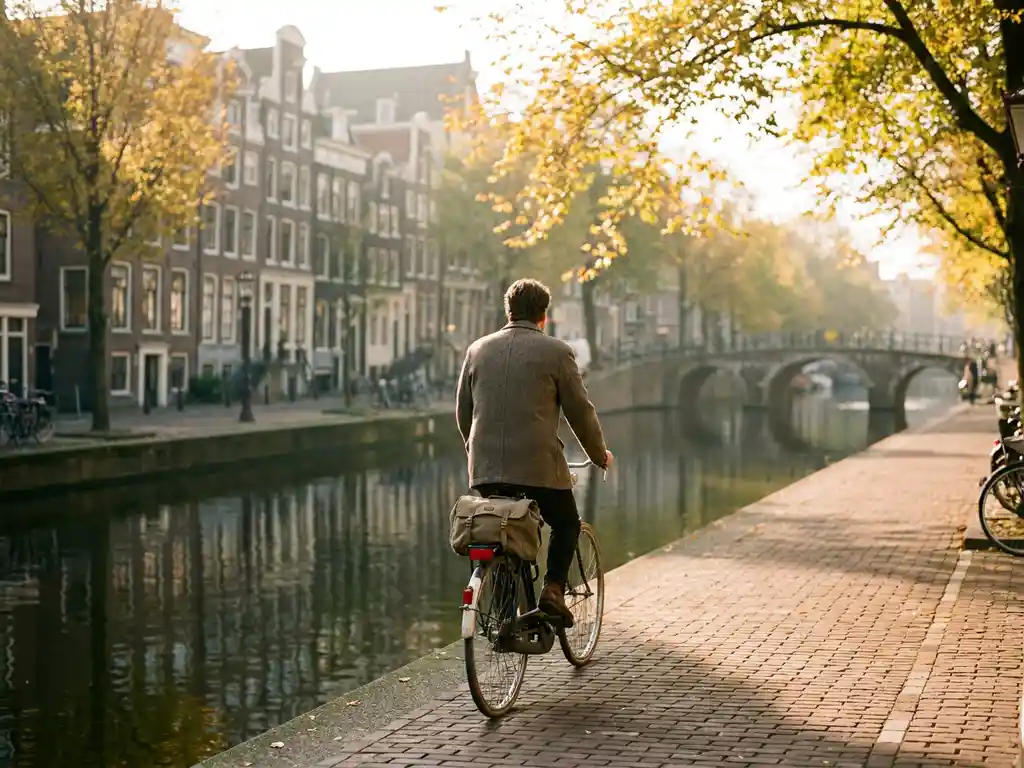
    The best bike route along Amsterdam’s canals follows the four main canal ring roads — Prinsengracht, Keizersgracht, Herengracht, and the Jordaan side streets — in a roughly counterclockwise loop starting near Leidseplein. This route keeps you on quieter stretches, away from the worst tourist congestion, and gives you the full visual sweep of the canal ring that UNESCO put on its World Heritage list for good reason. The sections below answer every practical question you need before you clip into those pedals.

    Which canals are actually worth cycling along?

    The four canals genuinely worth your time are Prinsengracht, Keizersgracht, Herengracht, and Brouwersgracht. These form the historic canal ring and offer the combination of visual drama, architectural variety, and manageable cycling infrastructure that makes Amsterdam’s waterways famous. Skip Singel for cycling — it is narrow, busy with trams and delivery traffic, and the least rewarding of the inner canals.

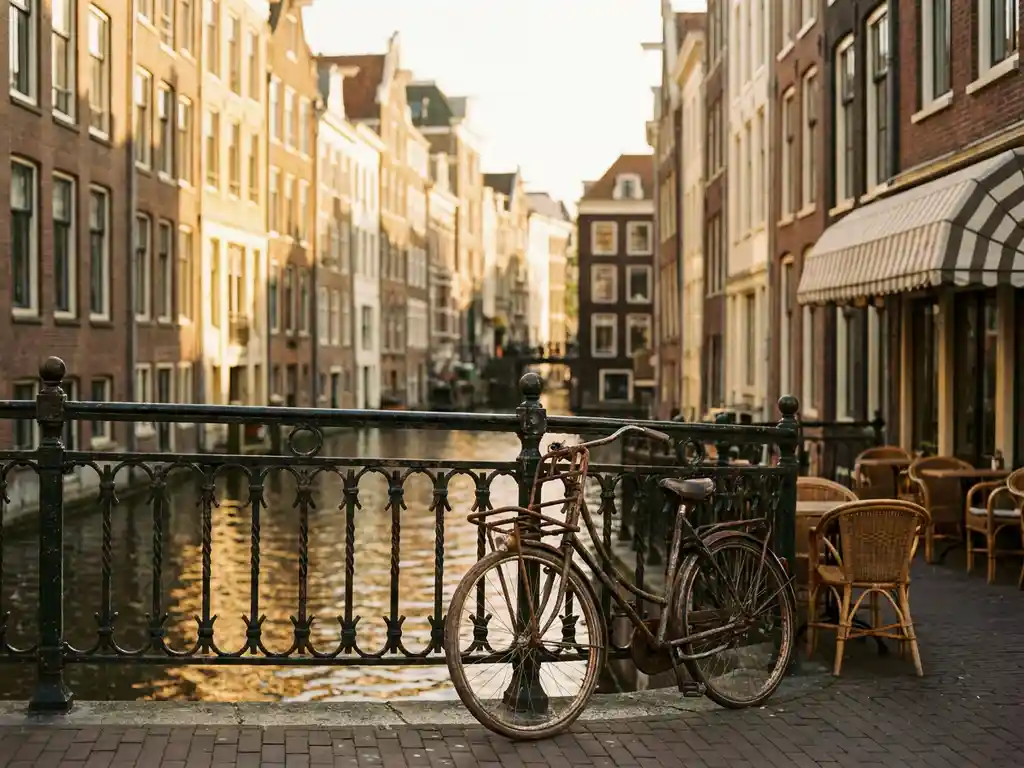
    Prinsengracht is the widest and the most atmospheric. It has the Anne Frank House, the Westerkerk tower as a constant landmark, and enough breathing room on the cycle path to actually look around without riding into a tourist. Keizersgracht is the grandest in terms of architecture — the canal of merchant wealth, lined with double-width canal houses that have barely changed since the seventeenth century. Herengracht is more formal and slightly less busy, particularly beautiful between Vijzelstraat and the Amstel where it widens into the so-called Golden Bend.

    Brouwersgracht deserves special mention. It is short, connects the top of the canal ring, and is consistently voted the most beautiful canal in Amsterdam by people who actually live here. If you cycle it and feel nothing, check your pulse.

    What is the best direction to cycle the canal ring?

    Cycling counterclockwise — heading north on Prinsengracht from Leidseplein, crossing Brouwersgracht, then looping back south on Herengracht or Keizersgracht — puts the canals on your right side for most of the route. This matters because the best views, the houseboats, and the tree canopy are all more accessible when you are riding close to the water rather than on the inland side of the road.

    There is also a practical reason. Amsterdam’s cycling infrastructure along the canal ring tends to flow more smoothly counterclockwise when you start from the Leidseplein area. You avoid the worst pinch points around Centraal Station and the Jordaan’s narrower cross streets, which become genuinely chaotic on summer afternoons. Going with the natural flow of local cyclists — rather than against it — is the difference between a pleasant ride and a stressful one.

    How long does a canal bike ride through Amsterdam take?

    A relaxed full loop of the main canal ring takes between 60 and 90 minutes of actual riding time. Add stops for photos, coffee, or a look inside a courtyard garden and you are comfortably looking at a half-day activity. A shorter version covering just Prinsengracht and Brouwersgracht can be done in 30 to 40 minutes.

    Distance is not the issue — the full ring is only around 12 to 15 kilometres depending on your exact route. The variable is traffic. On a quiet Tuesday morning in March, you can ride it smoothly and efficiently. On a Saturday afternoon in July, the same route will have you stopping constantly for pedestrians stepping off pavements, confused rental cyclists braking without warning, and tour groups that have somehow spread across the entire road. Build in extra time in summer and on weekends.

    Where should you start a canal cycling route in Amsterdam?

    The best starting point for a canal cycling route in Amsterdam is Leidseplein or the stretch of Prinsengracht just south of it. This puts you at the southern edge of the canal ring with the entire loop ahead of you, clear navigation in both directions, and easy access to bike rental shops if you need one.

    Leidseplein works as a starting point for several practical reasons. It is well-connected by tram and metro, so you can arrive without a bike and rent one nearby. It sits at a natural junction between the canal ring and the Jordaan neighbourhood, meaning you have options to extend or shorten your ride easily. And crucially, you avoid starting in the Centraal Station area, which is the single most chaotic cycling environment in the city and a genuinely bad introduction to Amsterdam by bike for anyone not already confident in dense urban traffic.

    If you are staying in the east of the city, starting from the Amstel and heading north along Herengracht is a solid alternative that gives you the Golden Bend early and keeps you away from the western crowds until you have warmed up.

    What are the biggest cycling mistakes tourists make on Amsterdam canals?

    The biggest mistakes tourists make cycling Amsterdam’s canals are renting the wrong bike, riding on the wrong side of the path, stopping suddenly without warning, and underestimating how fast local cyclists move. These are not minor inconveniences — they cause real accidents and make the experience miserable for everyone, including the tourist.

    • Renting a heavy city bike when you want a lighter one: Most rental shops push the standard black oma fiets. Fine for short trips, exhausting on a full canal loop. Ask specifically for a lighter option if you plan to cover real distance.
    • Treating the cycle path like a pavement: Amsterdammers cycle fast and with purpose. Stopping in the middle of a cycle lane to check your phone or take a photo is the equivalent of braking suddenly on a motorway. Pull over to the side completely before stopping.
    • Ignoring tram tracks: The canal ring has tram lines crossing it at several points. Riding parallel to the tracks and then turning across them at a shallow angle is how you fall off your bike. Cross tracks at a 90-degree angle, always.
    • Cycling on the pavement: It is illegal, it annoys pedestrians, and it marks you out immediately as someone who has no idea what they are doing. The cycle infrastructure in Amsterdam is excellent — use it.
    • Not locking the bike properly: Amsterdam has one of the highest bike theft rates in Europe. Lock through the frame and to a fixed object. Always.

    When is the best time of day to cycle the Amsterdam canals?

    The best time of day to cycle the Amsterdam canals is early morning, between 7 and 9 a.m., or in the early evening after 6 p.m. These windows give you the canal ring with a fraction of the daytime tourist traffic, better light for the visual experience, and the genuine feeling of cycling through a living city rather than a theme park.

    Early morning in particular is transformative. The canal surfaces reflect the light cleanly, the houseboats are quiet, and the only other people on the road are locals heading to work. You see Amsterdam as Amsterdammers see it daily — functional, beautiful, and entirely unsentimental about its own charm. This is the version of the city that does not make it onto postcards, which is precisely what makes it worth seeing.

    Midday in summer is the worst possible time. The canal ring between Leidseplein and Centraal Station becomes genuinely dangerous between noon and 5 p.m. in July and August — a combination of rental cyclists with no experience, pedestrians wandering into cycle lanes, and the sheer volume of people that the city’s infrastructure was never designed to handle at this scale. If midday is your only option, stick to the quieter stretches of Keizersgracht and avoid Prinsengracht between the Anne Frank House and Centraal entirely.

    Spring and autumn are the best seasons overall. April and May give you the canal ring in full bloom without the summer crowds. September and October offer cooler air, lower tourist numbers, and a quality of light on the water that genuinely justifies every cliché ever written about Amsterdam.

    How Klagen Niet Klagen helps you navigate Amsterdam like a local

    A canal bike route is one of the best things to do in Amsterdam — but knowing which stretch to cycle, when to go, and what to avoid is the difference between a great experience and a frustrating one. That is exactly what this blog exists to provide: honest, insider commentary on Amsterdam from someone who has lived and worked here for over thirty years, with no tourism board agenda and no advertorial softening.

    • Practical, experience-based guides to Amsterdam bike routes, neighbourhoods, and hidden gems — written for people who want the real city, not the brochure version
    • Honest takes on what is genuinely worth your time and what is overhyped, from canal tours to restaurants to cultural experiences
    • Long-form essays and opinion pieces that give you the cultural context to understand Amsterdam beyond the surface level
    • An English-language perspective written from inside the city’s creative and entrepreneurial scene — not from a press trip

    If this kind of commentary is what you are looking for, the full blog archive has plenty more. And if you want to know what the Klagen Niet Klagen framework is really about — the Dutch tension between complaining and counting your blessings — that is a good place to start.

    And while you are planning your Amsterdam visit, do yourself a favour and put Boom Chicago on the list. After thirty-plus years of bringing sharp, improvised comedy to Amsterdam, it remains one of the most genuinely entertaining things you can do in the city — and unlike a canal bike ride, it works just as well in the rain. Check the current shows and agenda to see what is on, or get in touch if you have a group or event in mind. It is the kind of Amsterdam experience that people talk about for years.

    Frequently Asked Questions

    Can I cycle the Amsterdam canal ring on a rented e-bike, and is it worth it?

    Yes, most rental shops in Amsterdam now offer e-bikes, and for the canal ring they are genuinely worth considering — especially if you plan to extend your ride beyond the main loop into areas like the Pijp or Plantage. The flat terrain means you will not need the motor much on the canal ring itself, but the assist makes a real difference if you are covering 20-plus kilometres or cycling with children. Just be aware that e-bikes move faster than standard rental bikes, which requires even more attention to tram tracks and pedestrian crossings than usual.

    Are there any sections of the canal ring that are not suitable for less confident cyclists?

    The stretch of Prinsengracht between the Anne Frank House and Centraal Station is the most challenging section for less confident riders — it narrows, tourist foot traffic spills onto the cycle path, and the volume of other rental cyclists braking unpredictably makes it genuinely stressful. If you are not comfortable in dense urban cycling environments, take the parallel route along Keizersgracht instead, which carries less pressure and gives you equally strong architecture. The Brouwersgracht and the southern stretches of Herengracht near the Golden Bend are consistently the most relaxed sections of the entire loop.

    What should I do if it rains during my canal bike ride?

    Carry on — Amsterdammers cycle in the rain without a second thought, and the canal ring is actually beautiful in wet weather, with the reflections on the water and the emptier streets. A lightweight rain jacket that fits over your regular clothes is all you need; dedicated cycling gear is not necessary for a leisure ride. If the rain turns heavy, duck into one of the covered markets or a brown café (bruine kroeg) along the route — there are several on Prinsengracht and in the Jordaan — and wait it out over a coffee before continuing.
  • What are the best things to do in Amsterdam right now?

    What are the best things to do in Amsterdam right now?

    The best things to do in Amsterdam right now combine the city’s world-class cultural institutions, its extraordinary outdoor life, and a local food and nightlife scene that most visitors never find. Amsterdam rewards curiosity far more than it rewards a checklist. Whether you have a weekend or a week, the experiences that stick are the ones you find slightly off the beaten path, guided by someone who actually lives here. Below, I answer the questions that matter most, from where to eat to whether you should bother with the tourist hotspots at all.

    What makes something worth doing in Amsterdam right now?

    Something is worth doing in Amsterdam in 2026 if it gives you genuine contact with the city rather than a packaged version of it. The best Amsterdam experiences are ones where you feel the actual texture of the place: the pace of the canals, the bluntness of the locals, the particular light on a winter afternoon. If an experience could exist in any European city, it probably is not the one to prioritise here.

    Amsterdam is a small city with an outsized cultural identity, and the gap between the tourist layer and the real city is enormous. The tourist layer is fine, but it is not Amsterdam. The real Amsterdam is the neighbourhood cafe where the same ten people have been sitting every Saturday morning for fifteen years. It is the market stall where the vendor tells you your cheese selection is wrong. It is the cycling infrastructure so seamlessly integrated into daily life that a visitor on a bike feels both exhilarated and mildly terrified.

    The best experiences in Amsterdam are also the ones that respect the city’s scale. This is not a place that needs to be rushed. A single afternoon spent properly in the Jordaan or De Pijp, eating well and walking slowly, will teach you more about Amsterdam than a full-day bus tour ever could.

    What are the best outdoor things to do in Amsterdam this season?

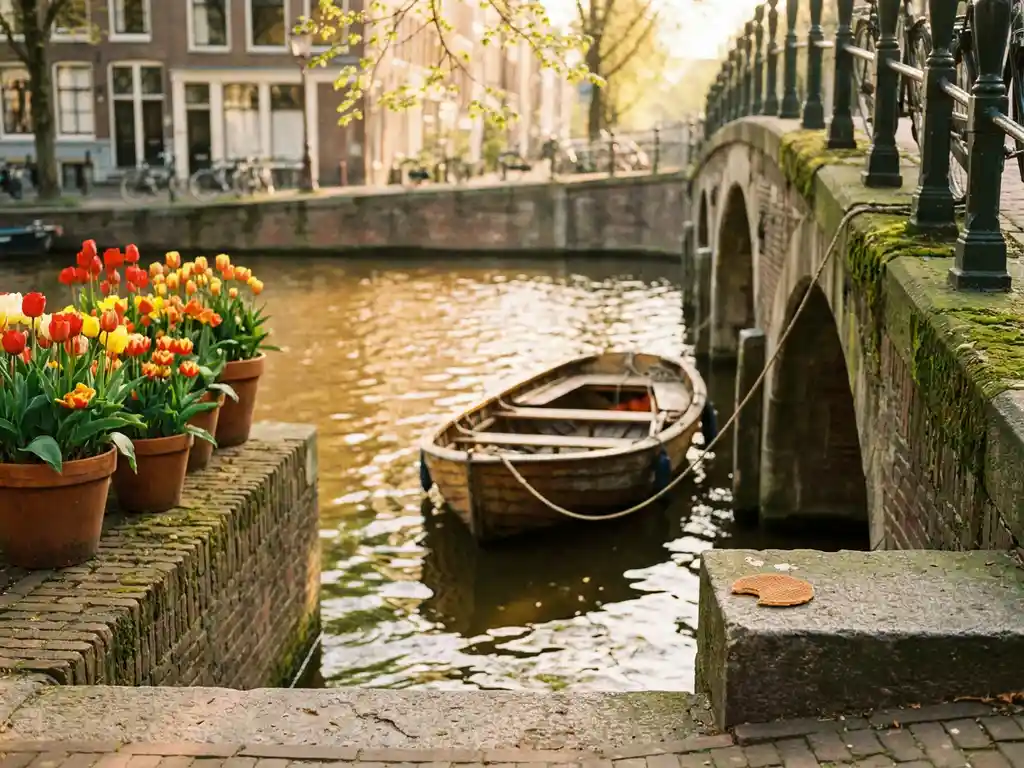
    The best outdoor things to do in Amsterdam include cycling the canal ring, visiting the Vondelpark, exploring the Jordaan on foot, and taking a boat out on the IJ waterfront. Amsterdam’s outdoor life is genuinely excellent in every season, though the city transforms most dramatically in spring when the trees along the canals come into bloom and the terraces fill up with people who have been waiting all winter.

    Amsterdam bike routes are where the city truly reveals itself. The canal ring is the obvious starting point, but the more interesting rides go east toward the Indische Buurt or north across the IJ to Amsterdam-Noord, where the NDSM wharf area offers a completely different visual vocabulary from the historic centre. Cycling here is not a tourist activity, it is how the city actually moves, and joining that flow even briefly changes how you see Amsterdam.

    For those who prefer water, an Amsterdam canal tour remains one of the more honest pleasures the city offers, provided you choose the right one. The big open boats with recorded commentary are efficient but soulless. A smaller private boat, or better still, a rented electric boat you pilot yourself, gives you the freedom to stop, drift, and look at the city from angles no walking tour can provide.

    The Vondelpark is worth a visit not because it is spectacular, but because it is the living room of Amsterdam’s west side. On a warm afternoon, it is one of the most sociable and genuinely local outdoor spaces in the city. Bring food from the Albert Cuyp market and you have a perfect afternoon for almost no money.

    Which Amsterdam museums are actually worth the queue?

    The Rijksmuseum and the Van Gogh Museum are worth the queue. The Anne Frank House is worth it for reasons that go beyond aesthetics. Everything else depends on your specific interests, and several excellent Amsterdam museums have no queue at all because visitors consistently overlook them.

    The Rijksmuseum is one of the great art museums in the world, and the building itself is extraordinary. If you go, book in advance, arrive when it opens, and resist the urge to see everything. Two hours with genuine attention in the Golden Age galleries is worth more than four hours of tired shuffling. Rembrandt’s Night Watch is genuinely impressive in person in a way that reproductions do not prepare you for.

    The Van Gogh Museum is excellent and well-organised, but it is also extremely popular with visitors who have no particular interest in Van Gogh specifically. If you are a serious admirer of his work, it is unmissable. If you are going because it is on the list, consider the Stedelijk next door instead, which has a world-class modern and contemporary collection and rarely has a queue of more than ten minutes.

    The EYE Film Museum in Amsterdam-Noord is one of the most undervisited great buildings in the city. The architecture alone justifies the ferry ride across the IJ. The Moco Museum offers Banksy and modern art in a beautiful canal house and tends to attract a younger, less museum-habituated crowd. The Jewish Historical Museum and the Dutch Resistance Museum are both deeply serious and deeply Amsterdam, and neither is ever overcrowded.

    Where do Amsterdam locals actually eat and drink right now?

    Amsterdam locals eat in De Pijp, the Jordaan, Oud-West, and increasingly in Amsterdam-Noord and the Indische Buurt. They avoid the canal ring tourist corridor for anything other than a drink with a view, and they rarely eat near Leidseplein or Rembrandtplein unless they are there for a show. The best cheap restaurants in Amsterdam are almost always one neighbourhood removed from wherever the tourists are concentrated.

    For lunch, the Albert Cuyp market in De Pijp is the honest answer. Stroopwafels made in front of you, herring, Indonesian snacks, fresh bread, and coffee from one of the surrounding cafes. It is busy, it is real, and it costs almost nothing. For dinner, De Pijp and the Jordaan both have a density of good, independent restaurants that reward walking and looking rather than booking based on a list.

    Amsterdam has a genuinely excellent Indonesian food scene, which makes sense given the country’s history, and this is one of the places where the city’s culinary identity is most distinct. A rijsttafel at a well-run Indonesian restaurant is one of the most Amsterdam meals you can have. It is also, when done properly, one of the most satisfying.

    For drinks, Amsterdam’s brown cafes (bruine kroegen) are irreplaceable. These are the old, wood-panelled neighbourhood pubs that smell of decades of conversation and serve beer and jenever with no particular interest in your Instagram. Café ‘t Smalle in the Jordaan and Café de Dokter near the Spui are two of the most authentic. They are not hidden gems in the sense that nobody knows about them, but they remain genuinely local in atmosphere because the experience does not scale or perform.

    What’s on in Amsterdam for live music, comedy, and theatre?

    Amsterdam has a rich live performance calendar year-round, with strong offerings in jazz, classical music, comedy, and theatre. For English-language comedy specifically, Boom Chicago at the Rozentheater is the city’s leading venue, offering improv and sketch shows that have been a fixture of Amsterdam’s cultural life since 1993. For live music, Paradiso and Melkweg are two of Europe’s best mid-sized concert venues and consistently book excellent international acts.

    The Concertgebouw is one of the finest concert halls in the world and is far more accessible than its reputation suggests. Wednesday lunchtime concerts are free and open to everyone. The Royal Concertgebouw Orchestra is genuinely world-class, and catching a performance there is one of those Amsterdam experiences that costs relatively little but stays with you for years.

    For theatre in Dutch, Internationaal Theater Amsterdam (formerly Toneelgroep Amsterdam) produces work of exceptional quality, and even without Dutch fluency, their productions are often visually and dramatically powerful enough to be worth attending. For English-language theatre and comedy, the options are more concentrated but consistently strong. Amsterdam immersive experiences have also grown significantly in recent years, with several companies offering interactive and site-specific work that uses the city’s architecture and canal infrastructure as part of the experience itself.

    The Amsterdam weekend guide for any given month should start with checking the Paradiso and Melkweg listings, the Boom Chicago schedule, and the Concertgebouw calendar. Between those four venues, you will find something excellent on almost any night of the week.

    Should you avoid Amsterdam’s tourist hotspots entirely?

    No, you should not avoid Amsterdam’s tourist hotspots entirely, but you should visit them on your own terms rather than at peak times. The canal ring, the Rijksmuseum, the Vondelpark, and the Anne Frank House are popular because they are genuinely extraordinary. The problem is not the places themselves but the conditions under which most people experience them: midday, in summer, surrounded by crowds, on a schedule.

    The canal ring at 7am on a weekday morning is one of the most beautiful urban environments in the world. At 2pm on a Saturday in August, it is a pleasant but crowded experience that feels less like Amsterdam and more like a theme park version of it. The difference is timing, not destination.

    The Leidseplein and Rembrandtplein areas are worth understanding rather than avoiding. They are where Amsterdam’s nightlife concentrates, and they are lively and fun on their own terms. The mistake is treating them as representative of the city’s food or cultural life, which they are not. Have a drink there. Do not have dinner there unless the restaurant has earned it independently of its location.

    The honest answer for navigating Amsterdam’s best neighborhoods is to use the tourist hotspots as anchors and then walk outward. The Jordaan is five minutes from the Anne Frank House. The Spiegelkwartier antique district is adjacent to the Rijksmuseum. The Pijp is a short cycle from the Van Gogh Museum. Every famous Amsterdam landmark has a more local world immediately next to it, and that world is usually where the best version of Amsterdam is waiting.

    How Klagen Niet Klagen helps you navigate Amsterdam like a local

    Finding genuinely useful, honest information about Amsterdam in English is harder than it should be. Most travel content is either written by people who visited for a long weekend or shaped by tourism board priorities that have nothing to do with what the city is actually like. Klagen Niet Klagen exists to fill that gap, written from over three decades of living, building, and performing inside Amsterdam’s creative and entrepreneurial scene.

    • Honest, opinionated commentary on Amsterdam city life that does not pretend everything is charming
    • Neighbourhood guides, cultural essays, and takes on Amsterdam’s best experiences written for people who want depth, not a checklist
    • An insider’s perspective on where locals actually go, what is genuinely worth your time, and what to skip
    • Long-form content that stays useful long after the trend pieces have expired
    • A consistent editorial voice with real skin in the game, not anonymous blog content or sponsored copy

    If you want to understand Amsterdam rather than just visit it, the blog archive is a good place to start. Or head to the Klagen Niet Klagen homepage to see what is new.

    And while you are planning your Amsterdam weekend, put Boom Chicago on the list. Improv comedy in English, in Amsterdam, at a venue that has been part of the city’s cultural fabric since 1993. It is funny, it is sharp, and it is one of those nights that reminds you why Amsterdam is genuinely one of the world’s great cities for live performance. If you want to know more or book for a group, get in touch directly.

    Frequently Asked Questions

    How far in advance should I book tickets for the Rijksmuseum and Van Gogh Museum?

    For both museums, booking at least two to three weeks in advance is strongly recommended, especially between April and October and during school holiday periods. Same-day or walk-up tickets are rarely available for either venue, and queuing without a booking can cost you an hour or more of your trip. The Anne Frank House requires advance booking almost year-round and sells out weeks ahead during peak season, so treat that one as a calendar item to sort before anything else.

    What are the most common mistakes first-time visitors make in Amsterdam?

    The biggest mistake is concentrating everything in the canal ring and Leidseplein area and assuming that is the whole city. A close second is renting a bike without understanding that Amsterdam cycling infrastructure is genuinely fast-moving and rule-governed — riding slowly in a cycle lane or stopping unpredictably will earn you the full force of Dutch directness from commuters behind you. Third, and most avoidable, is eating dinner near the major tourist landmarks without checking whether the restaurant has any independent reason to exist beyond its postcode.

    Is Amsterdam worth visiting outside of spring and summer?

    Absolutely, and for many visitors autumn and winter are actually the better seasons. The crowds thin dramatically after October, accommodation prices drop, and the city’s indoor life — its brown cafes, concert halls, museums, and restaurants — comes into its own. Winter light on the canals is genuinely beautiful, and the Christmas market period adds a particular atmosphere to the Jordaan and the city centre. The one honest caveat is weather: Amsterdam in January is cold, grey, and occasionally very wet, and if outdoor cycling or terrace culture is central to your plans, that matters.

  • What is the best canal tour in Amsterdam for a rainy day?

    What is the best canal tour in Amsterdam for a rainy day?

    The best canal tour in Amsterdam for a rainy day is one with a fully enclosed or covered boat — and there are plenty of good options. Most of the larger commercial canal tour operators run glass-topped or fully enclosed vessels, which means the rain becomes scenery rather than a problem. Below are the key questions answered so you can pick the right tour, show up prepared, and actually enjoy it.

    Which canal tours have covered or enclosed boats?

    Most of the major Amsterdam canal tour operators run fully enclosed glass-topped boats, making them genuinely suitable for rainy weather. Companies like Blue Boat, Lovers Canal Cruises, and Amsterdam Canal Cruises all operate enclosed vessels with panoramic windows and climate control. The glass-roof design lets you see the canal houses and bridges without getting soaked.

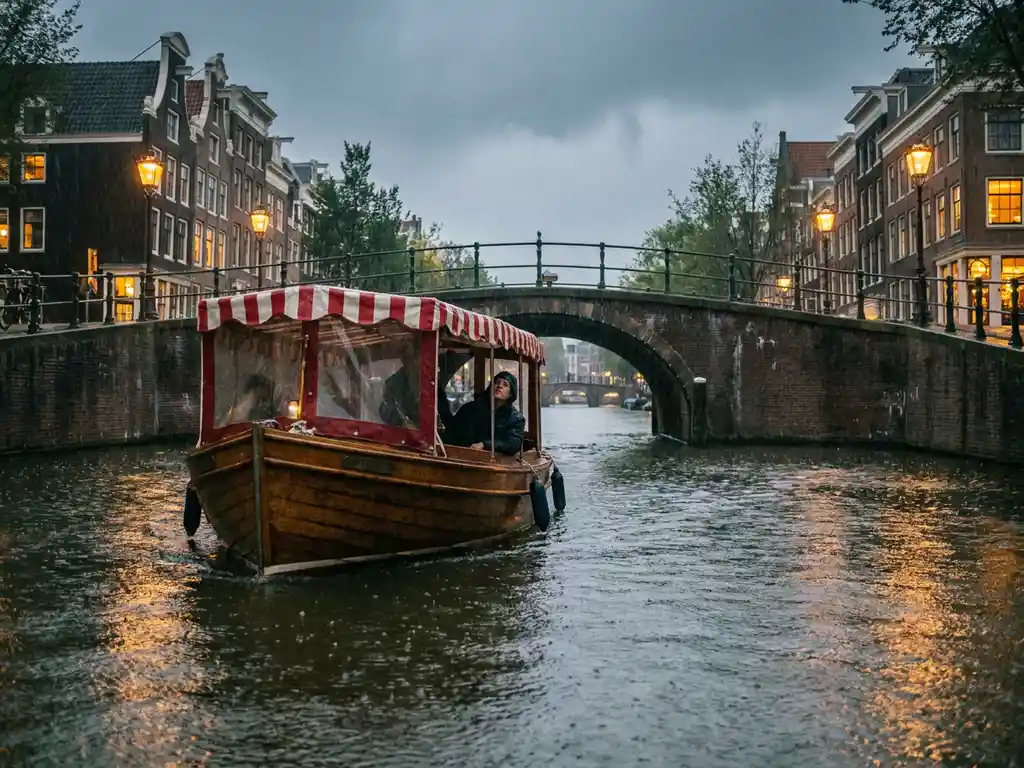
    If you want a more intimate experience, smaller private boat operators sometimes offer covered wooden salon boats — often called salonboten — which have a cabin section that keeps passengers dry. These tend to feel more authentic and less like a floating bus, though they come at a higher price point. For a rainy day specifically, the fully enclosed glass boats are the most practical choice: you stay completely dry, the windows are large enough to actually see the city, and the heating makes the whole experience comfortable even in February.

    One thing worth knowing: open-top boats do exist, and some operators run a mix of vessel types. When booking, always confirm the boat type explicitly rather than assuming. “Canal tour” does not automatically mean “covered boat.”

    What’s the difference between a private and a group canal tour in Amsterdam?

    A group canal tour follows a fixed route with recorded or live commentary, typically lasting 60 to 75 minutes, and you share the boat with strangers. A private canal tour means you rent the entire boat — often with a captain and sometimes a host — and can customise the route, timing, and atmosphere to suit your group.

    Group tours are significantly cheaper, usually ranging from around 15 to 25 euros per person. They are efficient and informative, but the experience is standardised. You stop where everyone stops, hear the same commentary as everyone else, and cannot linger at a particular spot that catches your eye.

    Private tours cost considerably more — often starting at 150 to 200 euros for a small group — but they offer a fundamentally different experience. You can bring your own food and drinks, set your own pace, and actually have a conversation rather than listening to a headset. On a rainy day, a private salon boat with a small group of friends or family feels genuinely special rather than just functional. If budget allows, it is the better choice for a memorable Amsterdam experience rather than a box-ticking exercise.

    How long does a typical Amsterdam canal tour last?

    A standard Amsterdam canal tour lasts approximately 60 to 75 minutes. This is enough time to cover the main canal ring, pass the Anne Frank House, see the Westerkerk, and get a sense of the city’s historic waterfront without feeling rushed or exhausted.

    Longer tours of 90 minutes to two hours also exist and typically extend into the eastern harbour area or the Jordaan neighbourhood. These are worth considering if you have a genuine interest in Amsterdam’s architectural history, but for most visitors, the standard 60-minute tour covers the essential highlights comfortably.

    On a rainy day, the duration question matters more than it might seem. An hour on a warm, enclosed boat watching the rain fall on the canals is pleasant. Two hours starts to test even the most enthusiastic tourist’s patience, especially if you have children with you. For most people, the 60-minute option is the sweet spot.

    Where do Amsterdam canal tours depart from?

    Most Amsterdam canal tours depart from one of three main areas: the Damrak (near Centraal Station), the Rokin, or the Leidseplein area. The Damrak and Rokin departure points are the most convenient if you are arriving by train, as they are within walking distance of Centraal Station.

    The Leidseplein departure points tend to be slightly less crowded and drop you into the canal ring more quickly, which means more time actually seeing the city and less time navigating out of the busy tourist corridor around the station. If you have a choice, Leidseplein is generally the more pleasant starting point.

    Some private operators depart from quieter locations along the Prinsengracht or Keizersgracht, which immediately puts you in the heart of the canal ring rather than the commercial centre. These are worth seeking out if you want the experience to feel less like a theme park queue and more like a genuine Amsterdam afternoon.

    Should you book a canal tour in advance or just show up?

    For group tours, booking in advance is strongly recommended during spring and summer, and on weekends year-round. In peak season, popular departure times sell out. In autumn and winter — including most rainy days — walk-up availability is usually fine, though booking online often gets you a small discount and saves you from standing in a queue.

    For private tours, always book in advance. Good operators fill up quickly, and the better salon boats are often reserved days or even weeks ahead. Last-minute private bookings are possible but limit your options significantly.

    The honest answer is that booking ahead costs you nothing and saves you the frustration of arriving at the canal with a group of wet, impatient people only to find the next available slot is in two hours. Five minutes online the night before is worth it.

    What should you bring on an Amsterdam canal tour in the rain?

    On an enclosed canal tour in the rain, you need less than you might think. The boats are heated and fully covered, so heavy rain gear is unnecessary inside. That said, you will be walking to and from the departure point, so a compact umbrella or a waterproof jacket is practical.

    A few things worth bringing regardless of weather:

    • A charged phone or camera — the canal houses look spectacular in moody, overcast light, and the reflections on wet cobblestones are genuinely beautiful
    • A light layer — the boats are heated but the temperature can vary, and stepping off into the cold after an hour in a warm cabin is a sharp contrast
    • Cash or a card — some smaller operators do not accept all payment methods, and buying a warm drink at the dock is always a good idea
    • Comfortable shoes — canal tour docks are often on slippery stone steps, and heels or slick-soled shoes are a bad idea in wet weather

    One underrated tip: a rainy afternoon is actually one of the better times to take a canal tour. The crowds thin out, the light on the water is dramatic, and the city looks the way it does in all those classic Dutch paintings — grey, atmospheric, and genuinely beautiful. Do not let a bit of rain talk you out of it.

    How Klagen Niet Klagen helps you navigate Amsterdam like a local

    Canal tours are just one slice of what Amsterdam has to offer — and finding the honest, unvarnished version of the city takes more than a booking platform and a tourist map. That is exactly what Klagen Niet Klagen is here for: independent, opinionated commentary on Amsterdam life, written by someone who has lived it for over three decades.

    • Honest takes on Amsterdam experiences — what is genuinely worth your time and what is overpriced and overrated
    • Practical guides on things to do in Amsterdam across every season and every kind of weather
    • Long-form essays on the city’s culture, contradictions, and hidden character — the stuff no tourism board will ever tell you
    • A consistent, trustworthy editorial voice rather than anonymous listicles or sponsored content

    If you want to go deeper than the canal tour, explore the full blog archive for more Amsterdam perspectives written from the inside.

    And if you are already in Amsterdam and looking for something to do after the boat docks, consider spending an evening at Boom Chicago — the comedy theatre that has been making Amsterdam laugh since 1993. Live improvisation, sharp political humour, and a warm room full of people who came for a good time: on a rainy Amsterdam evening, there are worse places to end up. Take a look at the shows and agenda and see what is on.

    Frequently Asked Questions

    Are Amsterdam canal tours worth it in winter, or is the experience too limited by the weather?

    Winter is actually one of the more underrated times to take a canal tour in Amsterdam. The crowds are significantly smaller, the atmosphere on the water is moody and cinematic, and the enclosed boats are fully heated — so the cold outside becomes part of the charm rather than a deterrent. If you visit in late November or December, you may also catch the Amsterdam Light Festival, which transforms the canals into an open-air art exhibition best viewed from the water.

    Can I take a canal tour with young children, and are there any practical things to know?

    Yes, canal tours are generally very child-friendly — the enclosed boats are stable, warm, and require no physical exertion, which makes them a good option even with toddlers. Most major operators offer free or reduced fares for young children, so check the age thresholds when booking. For restless kids, the 60-minute tour is the right call; anything longer tends to push the limits of their patience, especially on a grey day when there is less visual variety to keep them engaged.

    Is there a best time of day to take a canal tour in Amsterdam for photography?

    The golden hour before sunset — roughly 4 to 6 PM depending on the season — gives the canal houses a warm, flattering light that makes for the most striking photographs. On overcast or rainy days, the soft diffused light actually works in your favour: it eliminates harsh shadows and brings out the texture of the brick facades and the reflections on the water. Morning departures are also worth considering if you want fewer boats in your shots and a quieter experience overall.

  • What are the best immersive art experiences in Amsterdam in 2026?

    What are the best immersive art experiences in Amsterdam in 2026?

    Amsterdam’s best immersive art experiences in 2026 include WONDR Experience, Moco Museum’s digital exhibitions, and a growing number of projection-based and sensory shows that have made the city one of Europe’s most interesting destinations for this format. The quality varies considerably, and not every experience justifies the ticket price — but the standouts are genuinely impressive. Below, the most useful questions are answered honestly, from a local who has seen more than a few of them.

    Which immersive art venues in Amsterdam are worth visiting in 2026?

    The venues most consistently worth your time in Amsterdam right now are WONDR Experience in Amsterdam-Noord, the Moco Museum on Museumplein, and whatever rotating large-scale projection show is currently running at one of the city’s repurposed industrial spaces. These three represent different ends of the spectrum — playful and Instagram-friendly, commercially polished, and genuinely ambitious — and between them they cover most of what the format can do.

    WONDR is probably the most talked-about. It occupies a sprawling space in Noord and delivers room after room of interactive, sensory environments. It leans heavily into the shareable aesthetic — bright colours, fog machines, mirrors — but it does it well enough that even the cynical visitor tends to enjoy it. The Moco Museum has built a strong reputation for its Banksy collection, but its digital and immersive wing, featuring work from artists like Refik Anadol, pushes it into more intellectually serious territory.

    Beyond the permanent or semi-permanent venues, Amsterdam regularly hosts travelling large-format shows. Productions built around Van Gogh, Klimt, and other canonical artists have cycled through the city in recent years, typically taking over a warehouse or event space for a season. These vary enormously in quality. Some are genuinely moving. Others feel like a screensaver projected on a very large wall. Check what is currently running before you book.

    What’s the difference between immersive art and interactive art?

    Immersive art surrounds you with an environment — light, sound, projection, scent — designed to absorb your attention and alter your sense of being in a space. Interactive art goes a step further by responding to your presence or actions. The key distinction is agency: immersive art envelops you, interactive art changes because of you.

    In practice, Amsterdam’s most popular experiences blend both. WONDR, for instance, includes rooms where your movement triggers visual or audio responses alongside rooms where you simply stand inside a carefully constructed environment. The Moco’s digital installations tend toward the immersive end — you watch and absorb rather than participate.

    The distinction matters when you are deciding what to book. If you are visiting with children or a group that wants to feel actively involved, prioritise venues with strong interactive elements. If you are looking for something more contemplative — closer to a conventional art experience but with a heightened sensory dimension — a purely immersive show may suit you better.

    How much do immersive art experiences in Amsterdam cost?

    Most immersive art experiences in Amsterdam cost between €15 and €30 per adult, with children’s tickets typically available at a reduced rate. Premium or limited-run shows can push above €30. WONDR Experience sits in the €20 to €25 range depending on the session and any add-ons. The Moco Museum is similarly priced, though it covers considerably more than just the digital wing.

    It is worth booking in advance for most of these venues. Popular time slots sell out, particularly on weekends and during school holidays. Booking online also tends to be slightly cheaper than buying at the door, and some venues offer early-bird or off-peak pricing if you are flexible on timing.

    If you are watching your budget, keep an eye on Amsterdam’s cultural discount schemes. The Museumkaart, which gives unlimited access to hundreds of Dutch museums for an annual fee, covers some immersive venues but not all — check before assuming it applies. For visitors rather than residents, the I Amsterdam City Card bundles museum access with public transport and may include relevant venues depending on the current partnership agreements.

    Are Amsterdam’s immersive art experiences actually worth it?

    Honestly, it depends on what you are after. The best immersive experiences in Amsterdam are genuinely worth it — they are well-produced, often surprising, and offer something you cannot get from a conventional gallery visit. The weaker ones feel like expensive novelties that exhaust their concept within the first ten minutes. The honest answer is that the format has a ceiling, and not every show reaches it.

    The experiences that tend to hold up are those with a strong artistic concept behind the spectacle. Refik Anadol’s data-driven installations at Moco, for instance, give you something to think about beyond the visual effect. WONDR works because it commits fully to the playful, physical experience it promises rather than pretending to be something more profound than it is. The ones that disappoint are usually the ones that use a famous artist’s name as a branding exercise and then deliver a glorified slideshow.

    A useful test: if the venue’s marketing leads with the number of square metres or the number of projectors, be sceptical. If it leads with the artist or the concept, it is more likely to deliver something with actual substance.

    Where are Amsterdam’s immersive exhibitions located?

    Amsterdam’s immersive art experiences are spread across several distinct parts of the city. Museumplein, in the south, is home to the Moco Museum and sits within easy walking distance of the Rijksmuseum and Van Gogh Museum. Amsterdam-Noord, accessible via a free ferry from Centraal Station, has become the city’s main hub for larger, more experimental venues — WONDR is based there, and the area’s former industrial buildings make it a natural fit for large-format shows.

    The city centre occasionally hosts pop-up or temporary immersive exhibitions in repurposed spaces, though these come and go quickly. The Eastern Docklands and the area around Westerpark have also hosted significant productions in recent years. If you are planning a visit specifically around an immersive experience, it is worth mapping the location in advance — Amsterdam’s neighbourhoods are distinct enough that combining a show in Noord with dinner in De Pijp requires a bit of planning.

    When is the best time to visit immersive art shows in Amsterdam?

    Weekday mornings are the best time to visit immersive art shows in Amsterdam. Crowds are thinner, the experience is less rushed, and you are more likely to have key rooms or installations to yourself for at least a few minutes — which matters enormously for the quality of the experience. Weekend afternoons, particularly in summer, can feel more like queuing than exploring.

    Seasonally, the quieter months for tourism in Amsterdam — roughly November through February, excluding the holiday period — mean shorter queues and a more relaxed atmosphere across the board. That said, some shows are specifically designed for the darker months, with light and projection-based work often hitting differently when the city outside is grey and cold. There is something to be said for stepping into a room full of colour and warmth when it is raining sideways on the Prinsengracht.

    If you are visiting during peak season and weekday mornings are not possible, booking the first slot of the day remains the next best option. Venues are freshest, staff are most energetic, and the cumulative effect of hundreds of visitors has not yet taken its toll on the experience.

    How Klagen Niet Klagen helps you navigate Amsterdam’s art scene

    Finding the genuinely good experiences in Amsterdam — the ones worth your time and money — is harder than it should be. Most online content about Amsterdam is either written for first-time tourists or produced by venues promoting themselves. Klagen Niet Klagen exists to fill that gap: honest, experienced, opinionated commentary on what Amsterdam actually has to offer, written by someone who has lived and worked here for over thirty years.

    • Honest assessments of Amsterdam experiences — no advertorial pressure, no tourism board spin
    • Long-form cultural commentary that goes beyond the surface of what the city offers
    • Written from genuine insider knowledge, not a journalist’s weekend visit
    • Covers the full range of Amsterdam life — art, comedy, neighbourhoods, food, and the city’s contradictions
    • Relevant for expats, international visitors, and curious locals alike

    If you want more of this kind of honest, locally grounded perspective on Amsterdam, the full blog archive has you covered across a wide range of topics.

    And if immersive experiences are your thing, it is worth knowing that live performance — done well — is the original immersive art form. Boom Chicago has been putting audiences inside sharp, surprising, and genuinely funny shows in Amsterdam since 1993. Improvisation theatre responds to the room in real time in a way no projection wall ever can. Check the current shows and agenda — there is a good chance something is on that will stay with you longer than any Instagram-friendly fog room.

    Frequently Asked Questions

    Can I visit multiple immersive art venues in Amsterdam in a single day?

    It is possible but not always advisable. Most immersive experiences are designed to be absorbed slowly, and back-to-back visits can lead to sensory fatigue that dulls the impact of each show. A more practical approach is to pair one immersive venue with a conventional gallery or neighbourhood walk — for example, WONDR in the morning followed by a wander through Amsterdam-Noord’s creative district in the afternoon. If you are set on two in a day, prioritise the more contemplative experience first and the more playful, high-stimulation one second.

    What should I bring or wear to get the most out of an immersive art experience?

    Comfortable, flat shoes are genuinely important — most venues involve a lot of standing, walking, and occasionally sitting on the floor. Avoid bulky bags where possible, as some installations are physically tight and large bags become a nuisance for both you and other visitors. If you plan to take photos, a phone with a decent low-light camera will serve you better than a DSLR in most environments. One underrated tip: arrive without a rigid schedule for how long you will spend, since the best experiences tend to reward those who linger rather than move through at a fixed pace.

    Are Amsterdam's immersive art experiences suitable for young children?

    Many are, but with caveats worth knowing in advance. WONDR Experience is generally well-suited to children — it is physical, colourful, and designed to engage visitors of all ages. However, some installations use loud sound design, strobing light effects, or very dark environments that can be distressing for younger or more sensitive children. Check the venue’s website for any age guidance or sensory warnings before booking, and if you are visiting with a child under five, weekday morning slots will give you a much calmer experience than peak weekend sessions.

  • How do you experience Amsterdam beyond the tourist trail?

    How do you experience Amsterdam beyond the tourist trail?

    You experience Amsterdam beyond the tourist trail by spending time where locals actually live, eat, socialise, and argue about city politics. That means leaving the canal belt and the Jordaan postcard version of the city behind and heading into neighbourhoods, venues, and routines that no tour operator will ever put on a brochure. The questions below unpack exactly what that looks like in practice.

    Where do locals in Amsterdam actually spend their time?

    Locals in Amsterdam spend their time in neighbourhood cafes, covered markets, community sports parks, and the kind of brown bars where the same regulars have occupied the same stools for twenty years. The best Amsterdam experiences for anyone wanting to understand the city happen in De Pijp, Oud-West, Noord, and the eastern harbour islands rather than along the main tourist drag of the Leidseplein and Damrak corridor.

    The Albert Cuyp Market is genuinely used by residents for weekly shopping, not just visited as an attraction. Vondelpark on a sunny afternoon is full of locals having picnics, playing chess, and doing absolutely nothing in a very purposeful Dutch way. The Hallen in Oud-West, a converted tram depot, draws a neighbourhood crowd for its cinema, food hall, and weekend market. These are not hidden gems in the Instagram sense. They are simply places where the city functions as a city rather than as a theme park.

    One thing worth knowing: Dutch people are creatures of habit. A local’s Amsterdam is often a very small geographic radius, repeated with great loyalty. Finding good cheap restaurants in Amsterdam often means following that logic, looking for the place where the same neighbourhood crowd returns every Friday rather than the place that just opened and is trending online.

    What makes Amsterdam’s cultural scene different from its tourist image?

    Amsterdam’s cultural scene is far more experimental, politically engaged, and community-driven than its tourist image suggests. The tourist version of Amsterdam culture is the Rijksmuseum, Anne Frank House, and a canal tour. The actual cultural scene runs on independent theatre, improvised performance, grassroots music venues, and a long tradition of creative institutions that have been fighting for space in an increasingly expensive city.

    The best comedy in Amsterdam, for instance, is not found in a tourist trap venue near the Heineken Experience. It lives in places like Boom Chicago, which has been producing English-language comedy and improvisation in Amsterdam since 1993 and has shaped what live performance looks like in the Netherlands. Amsterdam immersive experiences and live shows that genuinely reflect the city’s creative DNA tend to be English-friendly, internationally minded, and rooted in the kind of sharp cultural commentary that the Dutch themselves appreciate.

    The city also has a strong tradition of squatted cultural centres that became legitimate institutions, artist collectives that turned industrial spaces into creative hubs, and a film and theatre scene that punches well above its weight for a city of this size. None of that shows up in a weekend guide built around canal boat selfies.

    How do Dutch social norms shape the experience of living in Amsterdam?

    Dutch social norms shape life in Amsterdam in ways that take years to fully decode. The most important one is directness. Dutch people say what they mean, and they expect you to do the same. This is not rudeness. It is a cultural value, and once you understand it, it becomes one of the most refreshing things about living here. The confusion comes when people raised in more indirect cultures interpret honesty as hostility.

    The second major norm is a deep suspicion of showing off. The Dutch have a phrase, doe maar gewoon, dan doe je al gek genoeg, which roughly translates as “just act normal, that’s already crazy enough.” Ambition is fine. Loudly advertising your success is not. This shapes everything from how business meetings run to why Amsterdam neighbourhoods tend to feel understated even in affluent areas.

    For expats and visitors, the third norm that surprises people most is the Dutch relationship with planning. Spontaneity is not a virtue here. If you want to see a Dutch friend, you schedule it two weeks in advance. Showing up unannounced is considered inconsiderate rather than charmingly spontaneous. Once you accept this, navigating social life in Amsterdam becomes much easier. Before you accept it, it can feel like the city is keeping you at arm’s length.

    Which Amsterdam neighbourhoods are worth exploring in depth?

    The Amsterdam neighbourhoods most worth exploring in depth are De Pijp, Amsterdam-Noord, the Indische Buurt, and the eastern harbour islands of Java and KNSM. Each offers a distinct character that reflects a different layer of the city’s history, social makeup, and current direction of travel.

    De Pijp and Oud-West

    De Pijp is the neighbourhood that most closely resembles the Amsterdam of imagination while still functioning as a real place where people live. It is dense, walkable, ethnically mixed, and full of the kind of small businesses that survive on neighbourhood loyalty rather than tourist footfall. Oud-West sits adjacent and has a slightly more polished feel, but still retains the residential energy that makes Amsterdam’s best neighbourhoods worth the label.

    Amsterdam-Noord and the eastern harbour

    Noord has transformed dramatically over the past fifteen years. What was once an industrial area across the IJ ferry is now home to creative studios, independent restaurants, and a growing community of people who moved there because they could no longer afford the canal belt but found something better anyway. The eastern harbour islands, built on reclaimed land in the 1990s, represent one of the most ambitious urban planning projects in recent Dutch history and are worth exploring for that reason alone.

    Why is overtourism changing what Amsterdam feels like?

    Overtourism is changing Amsterdam by eroding the residential character of its most distinctive neighbourhoods, pricing out the businesses and residents that made those neighbourhoods worth visiting in the first place, and creating a feedback loop where the city becomes less interesting the more popular it gets. This is not a minor complaint. It is the defining urban challenge Amsterdam faces in 2026.

    The Jordaan, once a working-class neighbourhood that became a bohemian creative hub, is now almost entirely given over to short-stay rentals, souvenir shops, and restaurants priced for people who are here for the weekend and will never return. The same process is advancing through De Pijp. When the locals leave, the local culture leaves with them, and what remains is a stage set of what the neighbourhood used to be.

    The city government has taken steps to restrict short-term rentals and limit cruise ship arrivals, but the economic incentives pushing in the other direction are enormous. For anyone genuinely interested in Amsterdam as a living city rather than a destination, understanding this tension is not optional background reading. It is the central story of what Amsterdam is right now.

    How can you tell the difference between authentic Amsterdam and tourist Amsterdam?

    You can tell the difference between authentic Amsterdam and tourist Amsterdam by asking one simple question: is this place financially dependent on people who are here for less than 72 hours? If the answer is yes, you are in tourist Amsterdam. If the answer is no, you are getting closer to the real thing.

    Authentic Amsterdam has menus that do not have photographs. It has staff who are regulars at the place across the street. It has prices that a person earning a Dutch salary can afford without treating it as a special occasion. The best cheap restaurants in Amsterdam are not hidden because they are obscure. They are hidden because they are not optimised for discoverability by people who will never come back.

    The same logic applies to experiences. An Amsterdam bike route that takes you through Noord and along the eastern waterfront is not a tourist product. It is just how people get around. An Amsterdam canal tour that loads you onto a glass boat with recorded commentary in six languages is a tourist product. Both involve Amsterdam. Only one involves the Amsterdam that Amsterdammers actually inhabit.

    The most reliable guide is time. Spend a week in the same neighbourhood, go to the same cafe three mornings in a row, and watch how the city operates when it is not performing for visitors. That is when Amsterdam reveals itself. And it is considerably more interesting than anything on the official tourist trail.

    How Klagen Niet Klagen helps you find the real Amsterdam

    Most English-language content about Amsterdam is written for people who are visiting for a long weekend. Klagen Niet Klagen is written for people who want to understand the city properly, whether they live here, plan to stay, or simply want more than a polished tourist version of what Amsterdam is.

    • Long-form essays on Amsterdam neighbourhoods, cultural life, and social dynamics written from over thirty years of lived experience in the city
    • Honest commentary on overtourism, city policy, and the tensions that mainstream Amsterdam media tends to smooth over
    • A consistent editorial voice grounded in the city’s creative and entrepreneurial scene, not in tourism board talking points
    • English-language content that treats its readers as intelligent adults with a genuine curiosity about how Amsterdam actually works
    • A growing archive of articles covering everything from Dutch social norms to the best Amsterdam experiences that locals actually value

    If you want commentary on Amsterdam that is honest, funny, and written by someone with genuine skin in the game, the Klagen Niet Klagen homepage is the place to start.

    And if you want to experience the best of Amsterdam’s live cultural scene firsthand, Boom Chicago has been doing exactly that since 1993. English-language comedy and improvisation, rooted in the city, performed by an international cast, and sharper than anything you will find in a tourist venue. Check the current shows and agenda and come and see what Amsterdam’s creative scene actually looks like from the inside. If you have questions or want to get in touch, the contact page is always open.

    Frequently Asked Questions

    How long does it realistically take to feel like you're experiencing Amsterdam like a local rather than a tourist?

    Most people need at least a week in the same neighbourhood before the city starts to reveal its everyday rhythms — the same faces at the corner café, the morning cycling patterns, the Friday evening crowd at the neighbourhood bar. A long weekend is enough to visit Amsterdam; it is not enough to understand it. If you are serious about going deeper, anchoring yourself in one area like De Pijp or Oud-West and resisting the urge to tick off landmarks will get you further than any curated itinerary.

    What are the most common mistakes people make when trying to avoid the tourist trail in Amsterdam?

    The biggest mistake is treating ‘authentic’ as a destination in itself — hunting for hidden gems based on online recommendations that have already been discovered by thousands of other people doing the same search. A place stops being local the moment it is optimised for people looking for local places. The more reliable approach is to follow habit and repetition: find a neighbourhood, pick a café, and go back. The second common mistake is avoiding Dutch entirely and sticking to English-speaking expat circles, which keeps you permanently on the surface of the city.

    Is it still worth visiting Amsterdam given the overtourism problem, or are there better alternatives in the Netherlands?

    Amsterdam is absolutely still worth visiting, but the honest answer is that what makes it worth visiting is increasingly found in the parts of the city that tourism infrastructure has not yet fully colonised — Noord, the eastern harbour islands, the Indische Buurt. If you are looking for alternatives, cities like Rotterdam, Utrecht, and Haarlem offer genuine urban culture without the same density of tourist pressure. But Amsterdam remains the most complex, contradictory, and interesting city in the Netherlands, and that tension between what it is and what it is becoming is itself part of what makes it worth paying attention to.

  • What should you actually do in Amsterdam on a long weekend?

    What should you actually do in Amsterdam on a long weekend?

    A long weekend in Amsterdam — three or four days — is genuinely enough time to get a real feel for the city, provided you stop trying to see everything and start being selective. Amsterdam rewards depth over breadth. The visitors who leave feeling like they actually understood the place are rarely the ones who sprinted through every museum on the tourist checklist. Below, I answer the questions that actually matter before you arrive.

    How many days do you actually need to see Amsterdam properly?

    Three full days is the honest minimum to experience Amsterdam beyond the postcard version. Four days is the sweet spot for a long weekend. With three days, you can explore two or three neighbourhoods properly, visit one or two major attractions without feeling rushed, eat well, and get a genuine sense of how the city moves. More than five days and you start running out of central city to discover.

    The mistake most visitors make is treating Amsterdam like a capital city with an inexhaustible list of districts. It is not London or Paris. The historic centre is compact, and the neighbourhoods worth your time sit within cycling distance of each other. What takes time is not covering ground — it is slowing down enough to actually absorb what you are seeing.

    If you only have two days, concentrate entirely on the Jordaan and the canal belt, eat at a neighbourhood brown café, and skip the Rijksmuseum queue entirely unless you have booked well in advance. Two days of depth beats two days of frantic ticking.

    What are the most overrated things to do in Amsterdam?

    The most overrated Amsterdam experiences are the Heineken Experience, the Anne Frank House queue without a pre-booked ticket, and any canal tour that boards near Centraal Station. None of these are bad in themselves — the Anne Frank House is genuinely moving — but the way most visitors approach them turns them into expensive, exhausting exercises in crowd management rather than meaningful experiences.

    The Heineken Experience is essentially a theme park built around a beer brand. If you want a brewery tour, there are smaller, more interesting options in the city. If you want a beer, sit down at a canal-side terrace and order one for a fraction of the price.

    The Red Light District walking tour is another one. Thousands of people shuffle through De Wallen every evening on guided tours that reduce a genuinely complex neighbourhood to a set of talking points about legal prostitution and drugs. The area is worth seeing, but it is best experienced early in the morning when it is quiet, not as part of a group of thirty people blocking the narrow streets.

    The canal cruise boats that depart from the main tourist piers near Centraal Station are also worth skipping in favour of smaller, independent operators who run routes through the quieter western canals. The difference in experience is significant.

    Which Amsterdam neighbourhoods are actually worth your time?

    The Jordaan, De Pijp, and Oud-West are the three Amsterdam neighbourhoods most worth your time on a long weekend. The Jordaan is the historic heart of residential Amsterdam — narrow streets, independent shops, and brown cafés that have barely changed in decades. De Pijp is livelier, younger, and more international, with the Albert Cuyp market and some of the best affordable restaurants in the city. Oud-West sits between them in character and is less visited, which is precisely its appeal.

    The canal belt itself — the UNESCO-listed ring of seventeenth-century canals — is obviously worth your time, but it functions more as connective tissue between neighbourhoods than as a destination in its own right. Walk or cycle along the Prinsengracht or Keizersgracht in the early morning before the tourist groups arrive and you will understand why people fall in love with this city.

    Noord, across the IJ behind Centraal Station, is worth a half-day if you are curious about where Amsterdam’s creative scene has been migrating. The free ferry takes five minutes, and the contrast with the historic centre is striking. It is not essential, but it adds genuine texture to your understanding of the city.

    Avoid spending significant time in the immediate vicinity of Centraal Station, Leidseplein, or Rembrandtplein unless you have a specific reason. These areas are fine, but they represent the most tourist-saturated version of Amsterdam and the least representative of how the city actually lives.

    What’s the best way to get around Amsterdam on a long weekend?

    The best way to get around Amsterdam on a long weekend is by bicycle. Full stop. Amsterdam is one of the most cycle-friendly cities in the world, the distances between neighbourhoods are short, and cycling puts you at street level in a way that trams and taxis simply do not. Rental bikes are widely available and inexpensive, and within twenty minutes of picking one up you will understand why locals consider the bike the only serious mode of transport.

    If cycling is not an option, the tram network is excellent and covers most of the central city effectively. A multi-day OV-chipkaart or a tourist travel card loaded with credit will get you onto trams, buses, and the metro without the friction of buying individual tickets each time.

    Taxis and ride-share apps exist and work, but they are expensive relative to other options and largely unnecessary for central Amsterdam. Walking is underrated for the canal belt specifically — the distances look larger on a map than they feel on foot, and you will notice far more at walking pace than from a tram window.

    One practical note: if you rent a bike, lock it properly with both the frame lock and a separate chain lock attached to a fixed object. Bike theft in Amsterdam is not a myth.

    Where should you actually eat in Amsterdam without getting ripped off?

    The best cheap restaurants in Amsterdam are concentrated in De Pijp, the Jordaan, and along the streets immediately surrounding the Albert Cuyp market. As a general rule, the closer a restaurant is to a major tourist attraction or a canal-side terrace with laminated menus and photographs of the food, the worse the value. Walk two streets back from the main tourist corridors and the quality goes up and the prices come down.

    Indonesian food is the single best value category in Amsterdam. The Netherlands has a deep historical connection with Indonesia, and the city has some genuinely excellent Indonesian restaurants that offer rijsttafel — a spread of small dishes — at prices that represent extraordinary value compared to what you would pay for equivalent quality in most European cities.

    For a quick lunch, the Albert Cuyp market in De Pijp is hard to beat. Fresh stroopwafels, raw herring, Dutch cheese, and a range of international street food from vendors who have been trading there for years. It is not a tourist market performing Dutchness — it is a working neighbourhood market that happens to be excellent.

    Avoid the tourist trap of eating in the immediate canal-side restaurants on the Prinsengracht or Keizersgracht. The views are lovely, but you are paying a significant premium for the location and the food rarely justifies it. Eat well somewhere cheaper, then take your coffee to the canal.

    Should you book Amsterdam attractions in advance or just show up?

    For the Anne Frank House and the Rijksmuseum, you must book in advance — showing up without a reservation will almost certainly mean you cannot get in, particularly during peak season. Both attractions operate on timed-entry systems and sell out days or weeks ahead. The Van Gogh Museum also requires advance booking. For everything else in Amsterdam, booking ahead is helpful but rarely essential.

    The Anne Frank House is the most important of the three to pre-book. It operates with very limited capacity relative to demand, and the experience of visiting it is significantly better with a morning time slot before the crowds build. If you cannot get a ticket, the Anne Frank House website occasionally releases a small number of same-day tickets at 9am — worth checking, but do not rely on it.

    For smaller museums, neighbourhood galleries, and most restaurants, Amsterdam operates with a more relaxed walk-in culture than many European capitals. Brown cafés never require booking. Most neighbourhood restaurants are fine with same-day reservations or even walk-ins, especially for lunch. The exception is popular dinner spots in De Pijp or the Jordaan on a Friday or Saturday evening, where booking a day or two ahead is sensible.

    Comedy and live performance venues, including shows and events at Boom Chicago, are worth booking ahead for weekend performances — they sell out more often than visitors expect.

    How Klagen Niet Klagen helps you plan your Amsterdam weekend

    Planning a long weekend in Amsterdam is easier when you have a guide that tells you the honest version rather than the polished tourist board version. That is exactly what this blog exists to do. At Klagen Niet Klagen, every article is written from thirty-plus years of living, working, and building something real in Amsterdam — not from a press trip or a sponsored itinerary.

    • Honest neighbourhood guides that tell you what is worth your time and what is not
    • Restaurant and café recommendations from someone who actually eats there regularly
    • Cultural commentary that helps you understand the city beneath the surface, not just the surface itself
    • An independent, English-language perspective free from tourism board influence or advertorial pressure

    If you want more of this kind of insider perspective before your trip, the full blog archive covers Amsterdam life in depth — from the things that make the city genuinely great to the things that drive even its biggest fans quietly mad.

    And while you are planning your Amsterdam weekend, do yourself a favour and put Boom Chicago on the list. It has been running comedy and improvisation in Amsterdam since 1993, and a live show there is one of the best evenings you can have in this city — sharp, funny, and entirely unlike anything else on offer. Check the current shows and agenda and book ahead. You will not regret it.

    Frequently Asked Questions

    What's the best time of year to visit Amsterdam for a long weekend?

    Late spring (April to early June) is widely considered the sweet spot — the tulip season is in full swing, the days are long, and the summer crowds have not yet peaked. That said, Amsterdam is a genuinely year-round city. Winter weekends have a quieter, more local atmosphere, canal-side terraces give way to cosy brown cafés, and you will share the Rijksmuseum with a fraction of the August crowd. Avoid late July and August if you are sensitive to crowds and inflated accommodation prices.

    Is Amsterdam actually safe for solo travellers or first-time visitors?

    Amsterdam is one of the safer major European cities for solo travellers, including solo women travellers. The main risks are practical rather than personal: bike theft, pickpocketing around Centraal Station and the main tourist corridors, and the occasional aggressive tout near the Red Light District. Stay aware in the busiest tourist areas, use the same common sense you would in any European city, and you will almost certainly have no issues whatsoever.

    How much should I budget per day for a long weekend in Amsterdam?

    A realistic daily budget for Amsterdam, excluding accommodation, sits somewhere between €80 and €150 per person depending on how you eat and what you visit. Accommodation is the biggest variable — central hotels are expensive, and the city’s tourist tax adds a few euros per night on top. You can significantly reduce daily spend by eating at market stalls and neighbourhood restaurants rather than canal-side tourist spots, cycling instead of taking taxis, and being selective about paid attractions rather than trying to visit everything.

  • ‘TikTok Lines are Stupid’ …But Not Ice Cream Lines!

    ‘TikTok Lines are Stupid’ …But Not Ice Cream Lines!

    Oh, Dutch people. Nothing makes them madder than ‘TikTok lines,’ when tourists are tricked into waiting in long lines by their social media feeds. And the place that makes them most mad is Fabel Friet, the delicious and reasonably priced fries stand that is good, but so are most dedicated fries places in town. Not that Amsterdammers have ever been to Fabel Friet, because, well they would never wait in line for fries. That you see is dumb.

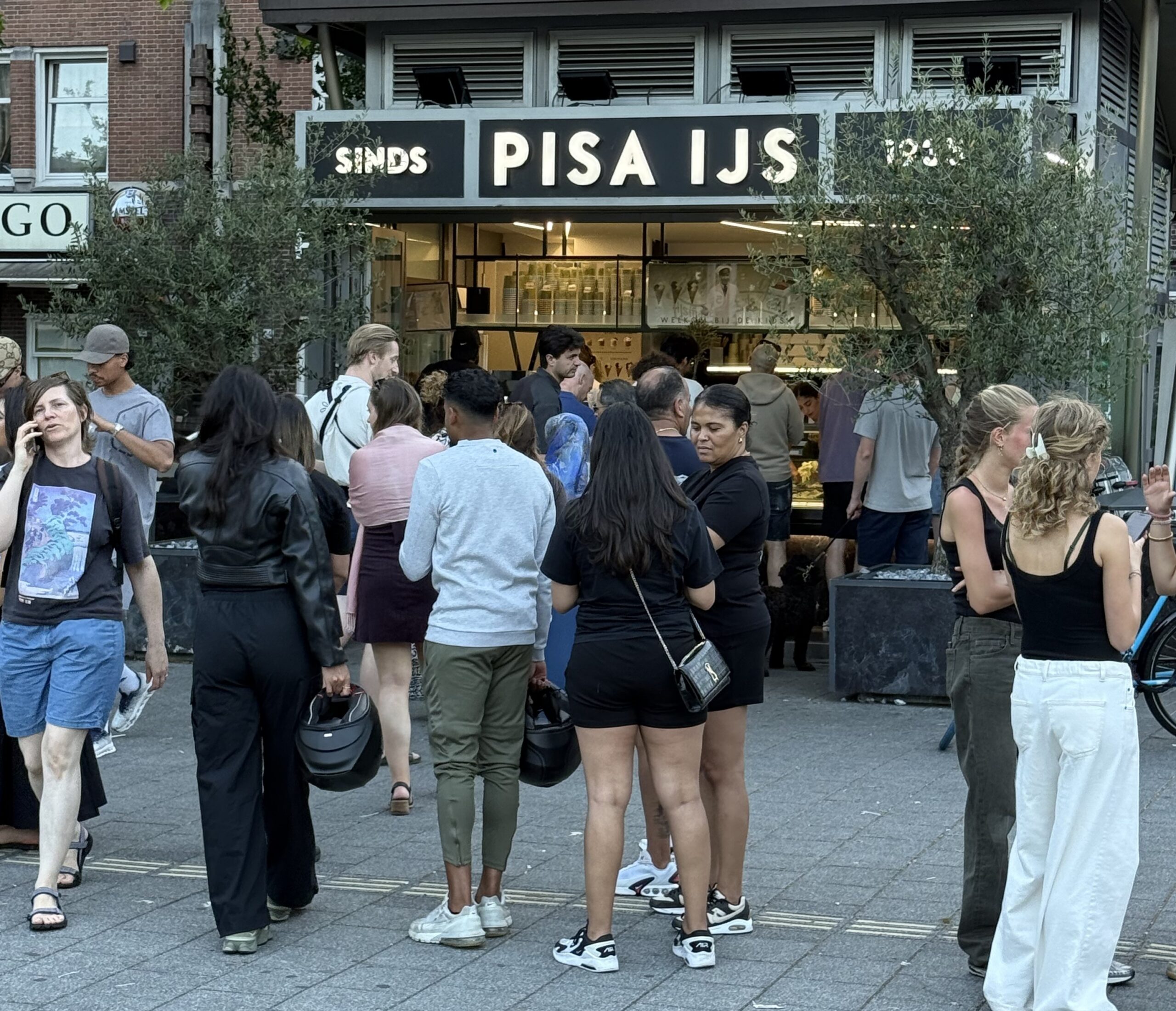
    But waiting in line for ice cream? Well that’s another story. Lines like this for Pisa Ijs on a warm Sunday evening in June are OK because… uh, why again? Oh, because it’s us in line and not ‘stupid tourists.’ You see, we’re smart and they’re dumb.

    And what about when we travel abroad? Are we then dumb there? No silly. Dutch people are wonderful travelers, who add to the flavor of their destination just by being there. Dutch travelers never contribute to over-tourism or ‘monoculture,’ whatever exactly that is. Dutch people are ‘visitors,’ but only other people are tourists.

    It makes perfect, consistent, non-hypocritical sense.

    Amsterdam’s official policy ranks the priorities for scarce public space. Pedestrians are officially most important, followed by bikes, public transportation, driving and parking in that order. Parking is

  • Let’s Stop Buying Trams with Doors on Both Sides!

    Let’s Stop Buying Trams with Doors on Both Sides!

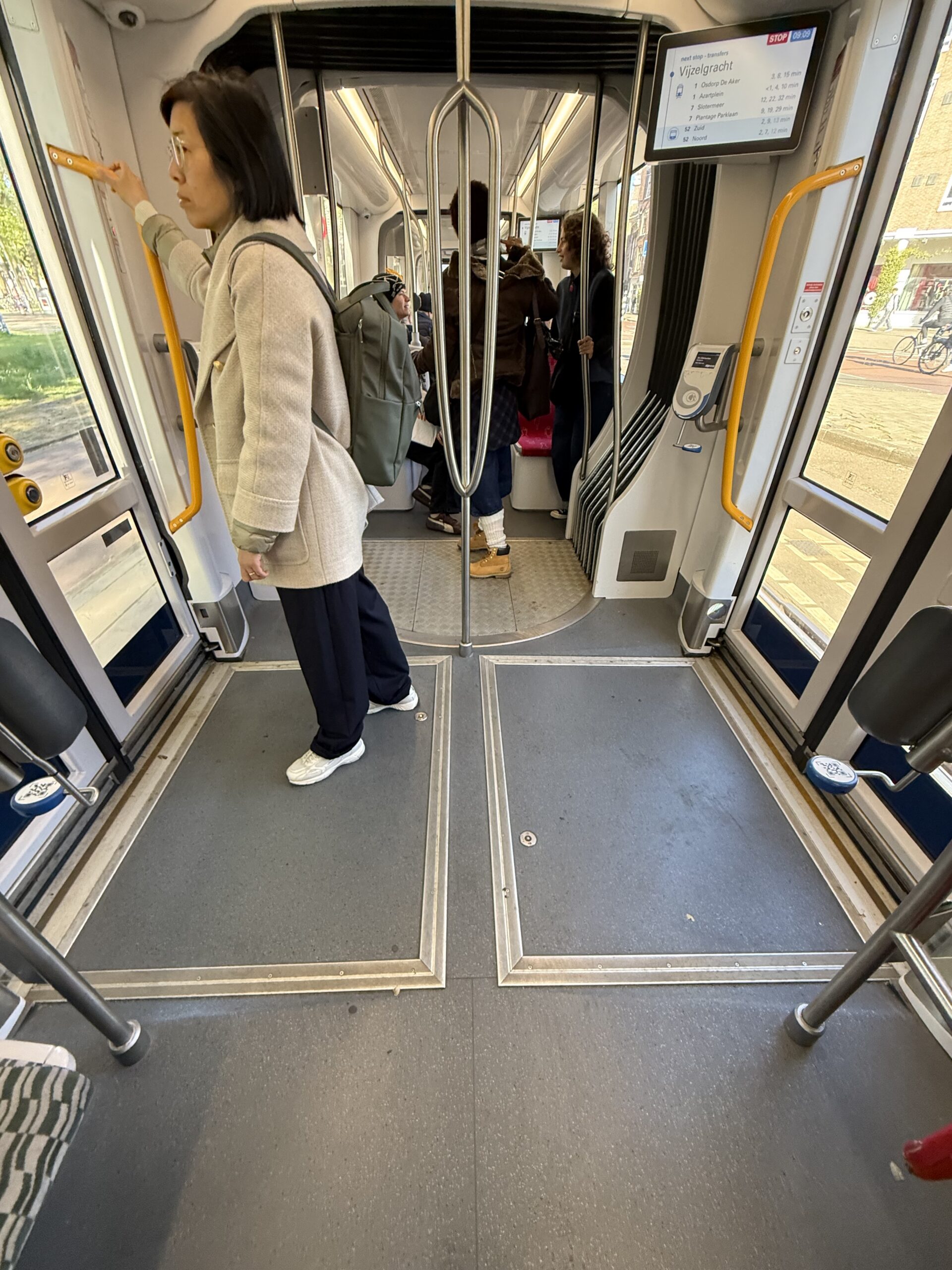
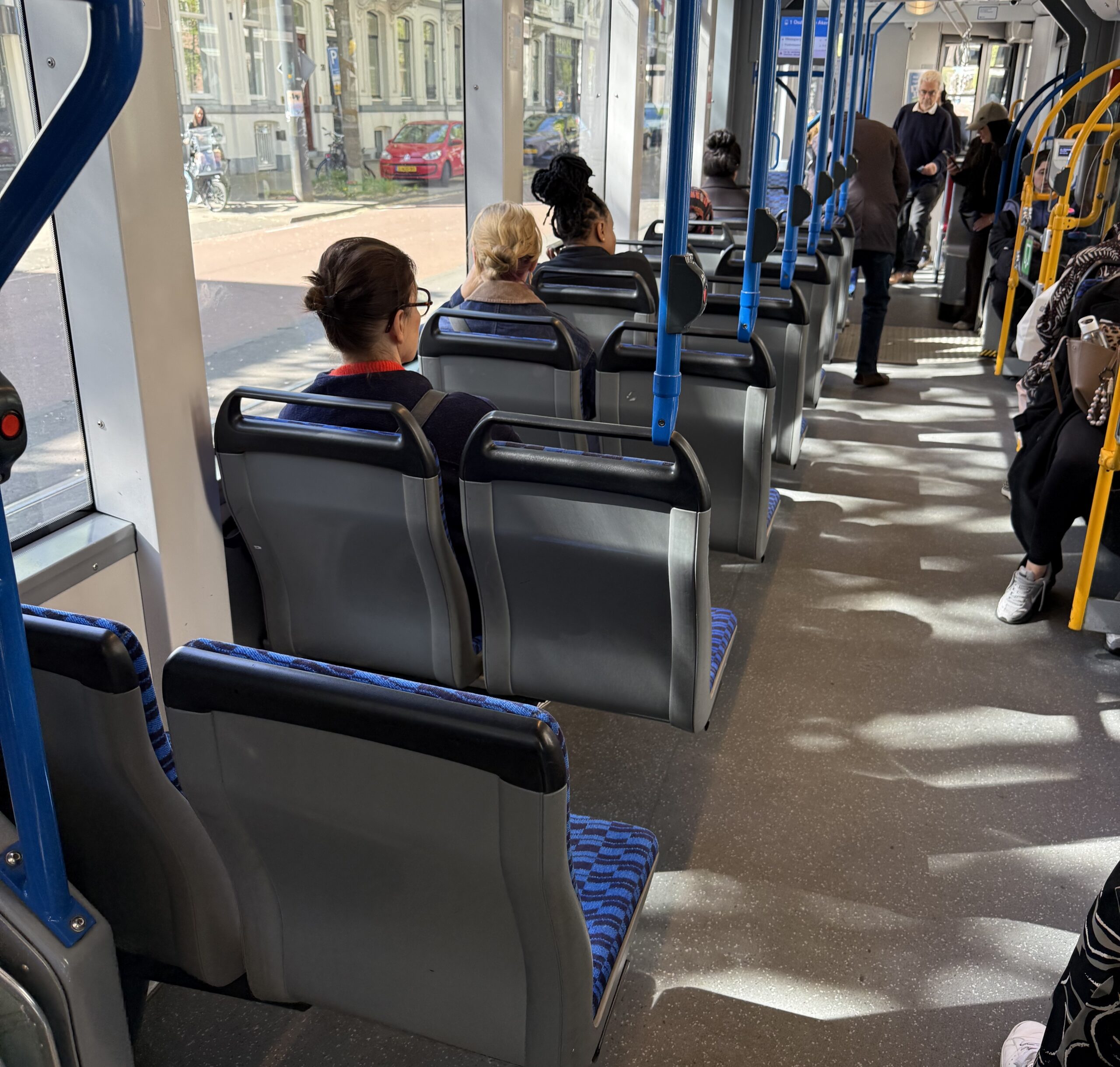
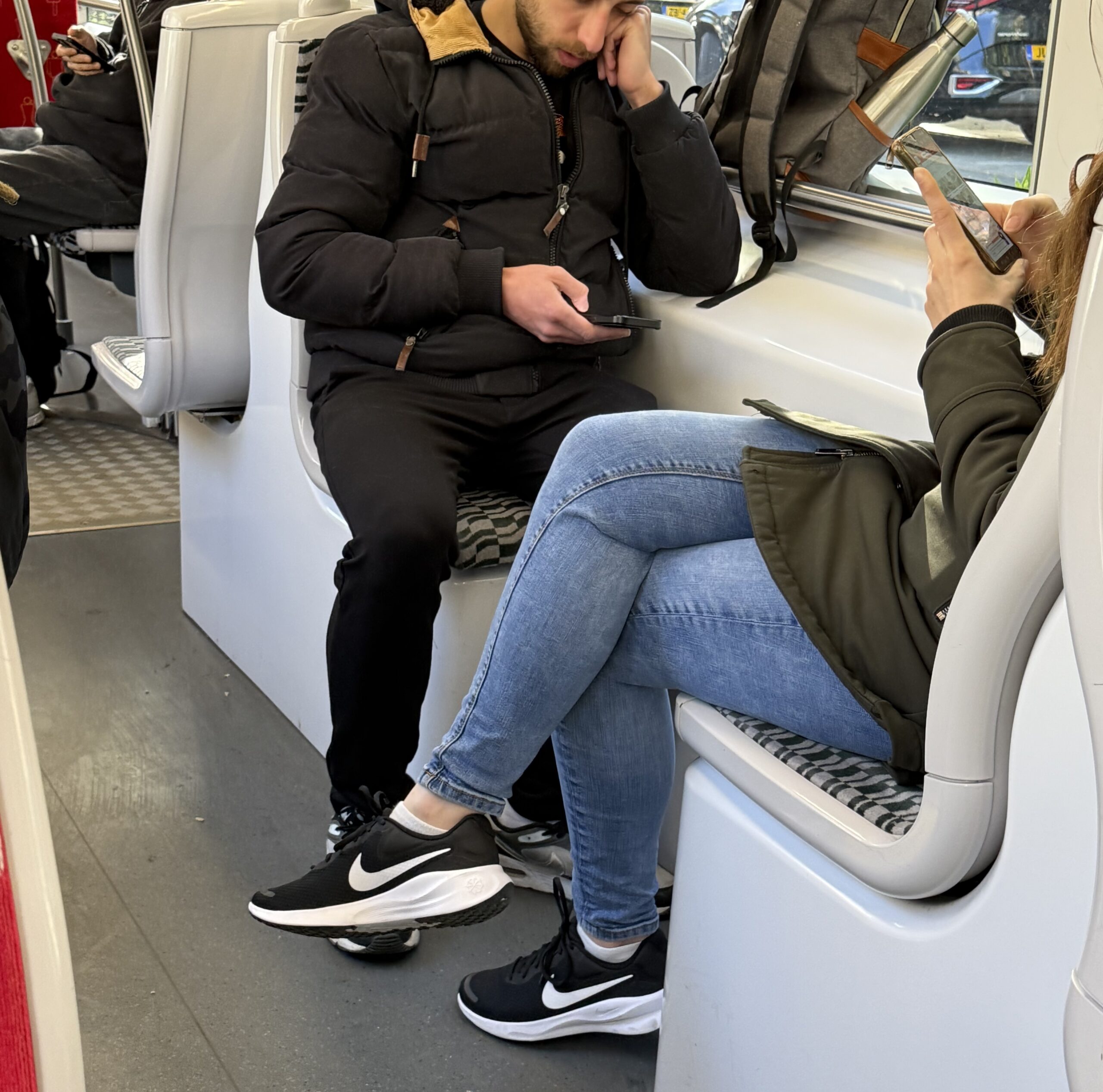
    Very few trams need doors on both sides. Most have a loop at each end which means the trams don’t need to run in both directions like a metro. So GVB, please stop buying trams with unnecessary doors that take up space needed for the best and most comfortable seats. 

    Good seats face forward or backward with a view out the window, and space for your feet under the seat in front of you. The worst seats are the ones over the wheels, with no legroom. Also poor are the ones facing the aisle where people walk, with your back to your window. Watching Amsterdam go by is one of the joys of riding the tram.

    For a combination of reasons, the new ‘CAF Urbos’ (the 15G series officially) barely have any good seats. The all low-floor design already means crappy seats with no legroom above the wheels (three sets per tram — ‘bogies’ for the nerds). Then you have not one but two luxurious places for wheelchairs and strollers that also eat into scarce space. And when you take away four seats for each set of wrong side doors, that leaves only eight good seats on each tram. Yes eight!  

    Currently, almost no one in a wheelchair rides a tram, but let’s assume some will in the future. And we need three bogies to put the wheels on, so what could we give up for more seats? The doors to nowhere! 

    Thanks for the air conditioning, but Amsterdam deserves comfortable trams and good seats!   

  • What is the best neighborhood in Amsterdam for expats to live in?

    What is the best neighborhood in Amsterdam for expats to live in?

    De Pijp, Amsterdam-Zuid, and the Jordaan are the neighborhoods where most expats in Amsterdam actually end up living. Each offers a distinct balance of English-friendly amenities, international community, and genuine Amsterdam character. The best choice depends on your budget, lifestyle, and whether you are moving alone, as a couple, or with children.

    Which Amsterdam neighborhoods do most expats actually end up in?

    Most expats in Amsterdam settle in De Pijp, Amsterdam-Zuid (particularly the Oud-Zuid area), the Jordaan, and increasingly the newer eastern neighborhoods like Oostelijk Havengebied and IJburg. These areas combine good English-language infrastructure, strong international communities, and enough local character to feel like you are actually living in Amsterdam rather than in a generic expat bubble.

    De Pijp is probably the most internationally mixed neighborhood in the city. It has a long history of absorbing waves of newcomers, and that openness is baked into its street culture. The Albert Cuyp market, the dense grid of bars and restaurants, and the relatively (for Amsterdam) manageable rents have made it a default landing zone for expats in their twenties and thirties.

    Amsterdam-Zuid, particularly the streets around Beethovenstraat and the Vondelpark, attracts a slightly different profile: expats working in finance, tech, or international organizations, often with families or higher budgets. The Jordaan draws people who want beauty and history and are willing to pay for it. Meanwhile, neighborhoods like Indische Buurt and Noord are increasingly popular among expats who want more space for less money and do not mind a slightly longer commute.

    What’s the difference between living in De Pijp and Amsterdam-Zuid?

    The key difference between De Pijp and Amsterdam-Zuid is energy versus comfort. De Pijp is lively, dense, and social, with a younger demographic and a neighborhood feel built around street life and casual dining. Amsterdam-Zuid is quieter, more spacious, and tends to attract expats who prioritize schools, green space, and proximity to international corporate offices.

    In practical terms, De Pijp means smaller apartments, more noise, and better access to nightlife and the city center. Amsterdam-Zuid means larger homes, wider streets, and a neighborhood that genuinely quiets down after 10pm. The Vondelpark is right there, which matters enormously if you have a dog or small children.

    There is also a social dynamic worth naming honestly. De Pijp has a more mixed, bohemian feel where locals and expats genuinely intermingle. Parts of Amsterdam-Zuid, particularly around the international schools, can feel like a self-contained expat ecosystem where you could theoretically go months without having a meaningful conversation with a Dutch person. Neither is wrong, but they are genuinely different experiences of living in Amsterdam.

    How much does it cost to rent in Amsterdam’s most popular expat neighborhoods?

    Renting in Amsterdam’s most popular expat neighborhoods is expensive by any European standard. In 2026, a two-bedroom apartment in De Pijp or Amsterdam-Zuid typically runs between €2,000 and €3,500 per month depending on size, condition, and whether the landlord has done a recent renovation and priced accordingly. The Jordaan sits at the higher end of that range, sometimes exceeding it for anything with canal views.

    For expats on tighter budgets, neighborhoods like Bos en Lommer, Indische Buurt, and Amsterdam-Noord offer meaningfully lower rents while still being well connected. A two-bedroom in Noord can be €500 to €800 cheaper per month than an equivalent apartment in De Pijp, which over a year is a significant difference.

    One important caveat: Amsterdam’s rental market is genuinely difficult to navigate. Demand consistently outstrips supply, and good apartments go fast. Many expats end up renting through corporate relocation services or paying a premium for furnished short-term lets while they search for something longer term. Budget for that transition period – it is rarely as quick as you hope.

    Which Amsterdam neighborhood is best for families with children?

    Amsterdam-Zuid is widely considered the best Amsterdam neighborhood for expat families with children, largely because of its concentration of international schools, green space, and quieter residential streets. The area around Apollolaan and Beethovenstraat puts families within easy reach of the British School of Amsterdam, the International School of Amsterdam (which is technically in Amstelveen but accessible), and several well-regarded Dutch primary schools with bilingual programs.

    That said, Amsterdam-Zuid is not the only option. Oud-West, particularly around the Hoofddorpplein area, has become popular with young families who want more space than De Pijp offers but a slightly more relaxed atmosphere than the more polished streets of Oud-Zuid. IJburg, the artificial island neighborhood to the east, is a genuine alternative for families who want modern apartments, water views, and a strong local community – though it requires accepting that you are not in the historic center.

    One thing long-term expat parents consistently mention: the Dutch school system is genuinely good, and integrating your children into a local Dutch school rather than an international school has real long-term benefits, both for language acquisition and for building actual roots in the city. It requires more from parents initially, but the payoff is a child who grows up genuinely bilingual and with Dutch friends rather than a rotating cast of expat kids who leave every two years.

    Should expats live in the city centre or the outer neighborhoods?

    Most expats who have lived in Amsterdam for more than a few years will tell you the same thing: the city centre looks great on Instagram but is a difficult place to actually build a life. The historic canal ring and the Jordaan are beautiful, but they are also expensive, loud in summer, and increasingly dominated by tourism infrastructure rather than the kind of local amenities that make a neighborhood livable long-term.

    The outer neighborhoods, by contrast, offer more space, better value, and a more authentic experience of how Amsterdam residents actually live. Neighborhoods like De Baarsjes, Bos en Lommer, Indische Buurt, and Noord have genuine local character, good public transport connections, and a growing food and culture scene that does not cater primarily to tourists.

    The honest answer is that the best neighborhood for an expat is usually not the one that looks most like a postcard. It is the one where you can afford a comfortable apartment, walk to a decent supermarket, and gradually build a social life that includes Dutch people. That is more likely to happen in a neighborhood where you are not competing with Airbnb guests for a table at the local cafe.

    What do long-term expats wish they’d known before choosing a neighborhood?

    Long-term expats in Amsterdam consistently identify a handful of things they wish someone had told them before signing a lease. The most common is this: do not choose a neighborhood based on how it feels on a sunny Saturday afternoon in May. Visit on a rainy Tuesday evening in November. That is the neighborhood you are actually choosing.

    • Proximity to a good supermarket matters more than you think. Amsterdam cycling distances feel short until it is raining sideways and you need to carry groceries.
    • Check the noise situation carefully. Many central apartments sit above bars or on tram routes, and Amsterdam’s old buildings offer very little sound insulation.
    • The neighborhood social scene changes after you have children. A neighborhood that was perfect at 28 may feel isolating at 35 with a toddler if it is built around bars rather than parks.
    • Dutch neighbors are not always welcoming to expats. This is not universal, but in some buildings and streets there is a real divide. Spending time in a neighborhood before committing gives you a feel for the social temperature.
    • Transport to your actual workplace matters. Amsterdam is a small city, but a commute involving a tram, a bike, and a bus every day adds up. Map it realistically before choosing.

    The deeper lesson most long-term expats share is that the best Amsterdam neighborhood is the one where you stop feeling like a visitor. That transition happens faster in some neighborhoods than others, and it has less to do with beauty or prestige than with whether the place has a genuine local life you can actually join.

    How Klagen Niet Klagen helps you find your place in Amsterdam

    Choosing where to live in Amsterdam is one of those decisions that benefits enormously from honest, insider perspective – the kind that no relocation agency brochure or tourism website will give you. That is exactly what Klagen Niet Klagen is built to provide.

    • Long-form essays on Amsterdam neighborhoods written from over three decades of lived experience in the city
    • Honest commentary on what Amsterdam life actually looks like, including the parts that expat guides quietly skip over
    • Cultural context that helps you understand not just where to live, but how Amsterdam works and what makes it genuinely worth living in
    • A perspective free from tourism-board influence or advertorial pressure – just a real point of view from someone who has built a life and a business here

    If you are navigating Amsterdam as an expat, curious visitor, or long-term resident trying to make sense of the city, the blog archive is a good place to keep reading.

    And while you are getting settled in Amsterdam, do yourself a favor and get to a Boom Chicago show. After more than thirty years, it remains one of the best nights out in the city – sharp, funny, and genuinely Amsterdam in a way that very few things still are. It is also one of the fastest ways to meet other internationals who have actually committed to life here, which, depending on your neighborhood choice, might be exactly what you need.

    Frequently Asked Questions

    How do I find a rental apartment in Amsterdam as an expat without getting scammed or priced out?

    Start with reputable platforms like Funda, Pararius, and Kamernet, and be extremely cautious of listings on Facebook Marketplace or private WhatsApp groups that ask for deposits before a viewing. Many expats work with a certified rental agent (makelaar) for their first apartment — it costs a fee, typically one month’s rent, but significantly reduces the risk of fraud and speeds up the search in a market where good apartments are gone within hours. Budget for a transition period of one to three months in a furnished short-term let while you search, and have all your documents ready in advance: proof of income, employer letter, passport, and BSN if you already have one.

    Is it possible to integrate into Dutch social life as an expat, or do most internationals end up in a separate bubble?

    Integration is absolutely possible, but it requires deliberate effort and the right neighborhood choice helps enormously. Expats who join local sports clubs, take Dutch language classes, or send their children to Dutch schools consistently report much stronger connections with local residents than those who rely solely on expat networks. The honest reality is that Dutch social culture can feel closed to outsiders at first — friendships tend to form slowly and are taken seriously — but once you are in, those relationships tend to be genuine and long-lasting rather than the transactional connections common in expat social circuits.

    What are the biggest mistakes expats make when choosing a neighborhood in Amsterdam?

    The most common mistake is choosing a neighborhood based on a single visit during good weather or proximity to one landmark, rather than testing it across different times of day and week. A close second is underestimating the importance of the commute — Amsterdam feels compact on a map, but a poorly planned route involving multiple transfers in winter rain is a daily quality-of-life issue. Many expats also overweight prestige (the Jordaan, the canal ring) and underweight practical liveability factors like supermarket access, noise levels, and whether the neighborhood has the kind of social infrastructure — parks, community spaces, local cafes — that supports the life stage they are actually in.

  • What day trips from Amsterdam can you do without a car?

    What day trips from Amsterdam can you do without a car?

    Amsterdam is one of the best-connected cities in Europe for car-free day trips. From Centraal Station, you can reach dozens of Dutch towns and cities by train in under an hour, and the national rail network makes spontaneous travel genuinely easy. This article covers the best destinations, travel times, seasonal picks, and the practical ticketing question that catches most visitors off guard.

    Which destinations are easiest to reach by train from Amsterdam?

    The easiest train destinations from Amsterdam are Haarlem, Utrecht, Leiden, Delft, and Zaanse Schans — all reachable in under 45 minutes with frequent direct services from Amsterdam Centraal. These cities offer a full day of culture, architecture, and food without the hassle of transfers or long travel times.

    Haarlem is the local favourite for good reason. It sits just 15 minutes from Centraal by intercity train, feels genuinely Dutch rather than tourist-packaged, and has a beautiful main square, excellent museums, and a compact old town that rewards slow walking. It is the kind of place that makes you wonder why you spent all your time in Amsterdam.

    Utrecht is the other standout. It is the fourth-largest city in the Netherlands, has one of the best-preserved medieval city centres in the country, and offers a completely different energy from Amsterdam. The famous wharf-level canal terraces are unique to Utrecht and worth the 30-minute journey alone.

    Leiden draws visitors with its university atmosphere, excellent museums (the Rijksmuseum van Oudheden is world-class and often overlooked), and the birthplace-of-Rembrandt angle. Delft is smaller and more manageable, famous for its blue-and-white ceramics and the Vermeer connection, and easy to pair with a half-day in The Hague if you want more.

    For something completely different, Zaanse Schans sits just north of Amsterdam and gives you the windmill-and-wooden-house imagery that most people associate with the Netherlands. It is genuinely touristy, but if you go early on a weekday, you can enjoy it before the crowds arrive.

    How long does it take to get to popular Dutch cities by public transport?

    Travel times from Amsterdam Centraal by direct train are roughly: Haarlem 15 minutes, Utrecht 30 minutes, Leiden 35 minutes, The Hague 50 minutes, Delft 55 minutes, Rotterdam 40 minutes, and Eindhoven 75 minutes. All of these are served by NS (Dutch Railways), with trains running at least every 15 to 30 minutes throughout the day.

    Rotterdam deserves special mention for day trippers. The journey takes around 40 minutes on a direct intercity train, and Rotterdam offers an experience that is almost the opposite of Amsterdam: bold, modern architecture, a working port atmosphere, and a food scene that has quietly become one of the best in the country. The Markthal alone is worth the trip.

    The Hague is the seat of Dutch government and home to the Mauritshuis, which houses Vermeer’s Girl with a Pearl Earring. At under an hour from Amsterdam, it is an easy and culturally rich day trip. Combine it with a tram ride to Scheveningen beach if the weather cooperates.

    One practical note: NS trains in the Netherlands are reliable but not always perfectly on time. Build in a buffer if you have a specific reservation or timed entry ticket at a museum. The NS Reisplanner app gives real-time journey planning and is worth downloading before you travel.

    What are the best day trips from Amsterdam for nature and countryside?

    The best nature day trips from Amsterdam without a car are the Keukenhof gardens (seasonal), the Hoge Veluwe National Park (accessible by bus and train), the dunes and beaches near Zandvoort, and the polders and windmills around Kinderdijk. Each offers a genuinely different natural landscape within two hours of Amsterdam by public transport.

    Beaches and dunes within an hour

    Zandvoort is the closest beach to Amsterdam and takes around 30 minutes by direct train. The beach is wide, the North Sea is bracing, and the town itself is unpretentious in a good way. Bloemendaal aan Zee, just north of Zandvoort, has a wilder stretch of dune landscape that feels genuinely remote. You can walk between the two along the beach.

    The dunes between Haarlem and the coast are part of the Zuid-Kennemerland National Park and make for excellent walking or cycling. Rent a bike in Haarlem, cycle through the dunes to the beach, and return via a different route. This is one of the genuinely underrated half-day options near Amsterdam.

    Farther afield for real countryside

    Hoge Veluwe National Park is the closest thing the Netherlands has to true wilderness. It takes roughly 90 minutes from Amsterdam by train and bus (travel to Arnhem or Apeldoorn, then bus to the park entrance), but the combination of forest, heathland, sand dunes, and the outstanding Kröller-Müller Museum makes it worth the journey. The park has free white bicycles you can use inside — one of those Dutch ideas that sounds too good to be true but actually works.

    Kinderdijk, near Rotterdam, is the most famous windmill site in the Netherlands and is accessible by water taxi from Rotterdam after your train journey. It is more tourist-oriented than Hoge Veluwe, but the landscape of 19 working windmills along the waterways is genuinely spectacular and feels like nothing else in Europe.

    Which day trips from Amsterdam work best for a half-day?

    Haarlem, Zaanse Schans, and Volendam are the best half-day trips from Amsterdam. Each takes under 30 minutes to reach, offers a compact and walkable centre, and can be fully enjoyed in three to four hours without feeling rushed. They work well as morning or afternoon excursions that leave time for Amsterdam in the other half of the day.

    Haarlem is the strongest option for a half-day. The historic centre is small enough to walk in a couple of hours, the Frans Hals Museum is world-class and rarely crowded, and the café and restaurant scene means you can end the morning with a long lunch before heading back. The train runs every 10 minutes, so there is no pressure around timing.

    Zaanse Schans works best as a morning trip before the tour groups arrive. Take the first or second train of the day, spend two or three hours among the windmills and historic houses, and be back in Amsterdam by early afternoon. Going late in the day is less rewarding.

    Volendam and Marken are reachable by bus from Amsterdam Noord (after taking the free ferry) and offer a look at traditional Dutch fishing village life. They are smaller and more tourist-facing than Haarlem, but if you want a quick dose of wooden houses, smoked eel, and flat Dutch light on the water, they deliver efficiently.

    Is an OV-chipkaart or a day ticket better for Amsterdam day trips?

    For day trips outside Amsterdam, an OV-chipkaart (the national public transport card) is almost always better value than a day ticket. Day tickets are designed for unlimited travel within Amsterdam’s GVB network of trams, buses, and metro — they do not cover NS intercity trains to cities like Haarlem, Utrecht, or Rotterdam.

    The OV-chipkaart works across all Dutch public transport: NS trains, GVB in Amsterdam, RET in Rotterdam, HTM in The Hague, and regional buses. You load credit onto the card and check in and out for every journey. It gives you the flexibility to travel spontaneously without buying a separate ticket for each leg.

    If you are visiting for a short time and only doing one or two day trips, buying individual NS tickets through the NS app or website is perfectly straightforward and avoids the card deposit fee. The NS app accepts international credit cards and lets you plan and buy in English.

    One important detail: always check in and out with your OV-chipkaart, including when transferring between trains. Forgetting to check out charges you the maximum fare for that journey, which is significantly more than the actual fare. It catches a surprising number of travellers who are used to single-zone systems.

    What day trips from Amsterdam are worth it in winter?

    The best winter day trips from Amsterdam are Utrecht, Rotterdam, Leiden, and The Hague. These cities offer strong indoor attractions — museums, covered markets, historic interiors, and excellent cafés and restaurants — that make them rewarding even in cold or grey weather. Winter also means smaller crowds and a more authentic, local atmosphere.

    Utrecht in winter is particularly atmospheric. The canal-side restaurants and cafés are warm and unhurried, the Dom Tower is less crowded, and the city’s student population keeps the energy alive year-round. The Centraal Museum and the Miffy Museum (yes, really, and it is genuinely charming) are both worth a winter visit.

    Rotterdam’s indoor highlights shine in winter. The Markthal is a spectacular covered food market that works in any weather. The Museum Boijmans Van Beuningen depot building, a publicly accessible art storage facility with an extraordinary design, is one of the most unusual museum experiences in Europe and entirely weather-proof.

    Leiden’s museums are exceptional and largely indoor. The Rijksmuseum van Oudheden (national antiquities), Naturalis Biodiversity Center, and the Leiden American Pilgrim Museum are all worth a winter afternoon. The city also has a strong café culture that makes sheltering from the rain feel like a feature rather than a compromise.

    Avoid Zaanse Schans and Kinderdijk as primary winter destinations unless you genuinely enjoy windswept open landscapes in the cold. They are outdoor experiences that lose a lot of their appeal in bad weather, and the reduced visitor numbers in winter mean fewer facilities are open.

    How Klagen Niet Klagen helps you get more from Amsterdam and beyond

    Day trips are one thing. But understanding what Amsterdam and the Netherlands are actually like — beyond the tourist trail — is something else entirely. That is what Klagen Niet Klagen is built for.

    • Honest, insider commentary on Amsterdam city life written by someone who has lived and worked here for over 30 years
    • No tourism-board angle, no sponsored content, no sanitised version of the city
    • Practical and cultural perspectives that help you understand the Netherlands, not just visit it
    • Long-form essays and opinion pieces that give context to what you are actually seeing when you travel around the country

    If you want to go deeper than a day trip itinerary, the blog archive is the place to start. There is a lot there for anyone who wants to understand Amsterdam from the inside.

    And if you find yourself back in Amsterdam on an evening when you are not on a train somewhere, consider spending it at Boom Chicago. It is the comedy theatre that Andrew Moskos co-founded in Amsterdam in 1993, and after more than three decades, it is still one of the best nights out in the city — sharp, funny, entirely in English, and rooted in the same honest Amsterdam perspective that runs through everything on this blog. Check the shows and agenda and see what is on.

    Frequently Asked Questions

    Can I do multiple day trips from Amsterdam in one day, or is it better to focus on one destination?

    It is almost always better to focus on one destination per day. Even though travel times are short, splitting a day between two cities means you end up rushing both and missing the slower, more rewarding parts of each place — a long lunch, an unplanned detour, or a second museum. The one exception worth considering is pairing Delft with The Hague, since they are just 15 minutes apart by train and complement each other well in terms of scale and pace.

    What is the best way to get from Amsterdam Centraal to destinations not directly on the main rail lines?

    For destinations not served by a direct NS train — such as Volendam, Kinderdijk, or the Hoge Veluwe park entrance — the best approach is to combine a train with a regional bus or water taxi. The NS Reisplanner app handles multi-modal journey planning and will show you the full route including bus connections and walking legs. Google Maps is also reliable for Dutch public transport and gives a useful second opinion on timings.

    Are day trips from Amsterdam suitable for travelling with young children?

    Several destinations work very well with children. Zaanse Schans has the visual drama of windmills and working craft demonstrations that hold kids’ attention well. Utrecht has the Miffy Museum, which is genuinely designed for young children and not just a gift shop with a museum attached. Zandvoort beach is an easy, low-stress option in warmer months — the train is direct, the beach is wide, and there is very little that can go wrong. Avoid destinations where the main draw is a single large museum with limited outdoor space.