
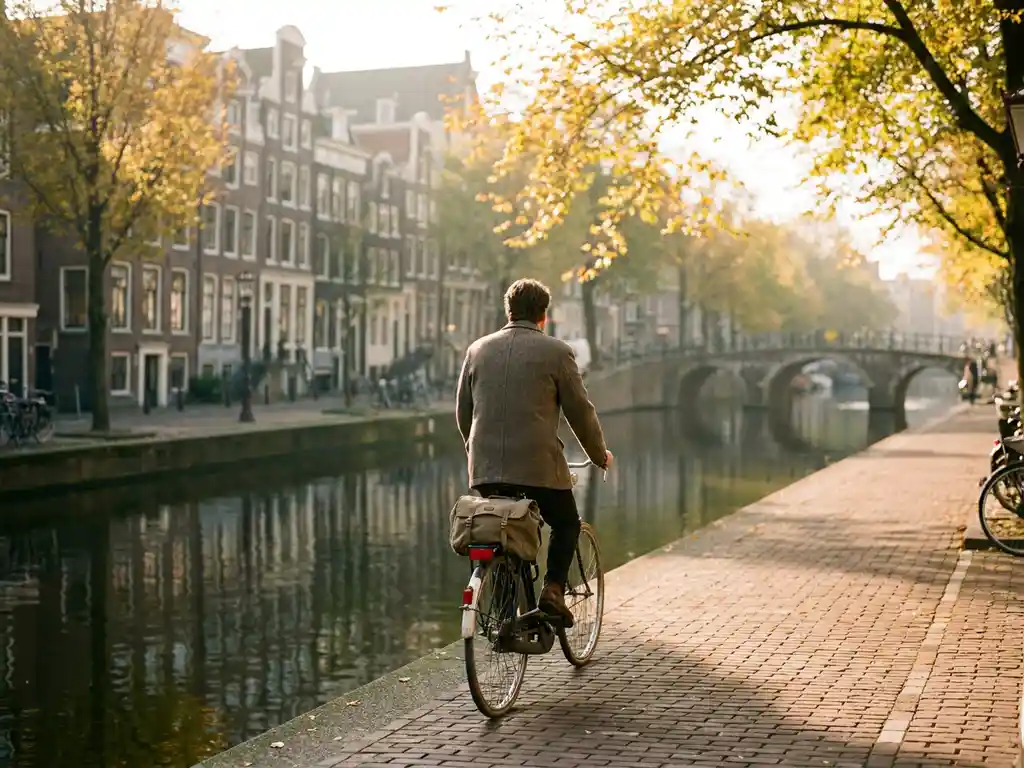
The best bike route along Amsterdam’s canals follows the four main canal ring roads — Prinsengracht, Keizersgracht, Herengracht, and the Jordaan side streets — in a roughly counterclockwise loop starting near Leidseplein. This route keeps you on quieter stretches, away from the worst tourist congestion, and gives you the full visual sweep of the canal ring that UNESCO put on its World Heritage list for good reason. The sections below answer every practical question you need before you clip into those pedals.
Which canals are actually worth cycling along?
The four canals genuinely worth your time are Prinsengracht, Keizersgracht, Herengracht, and Brouwersgracht. These form the historic canal ring and offer the combination of visual drama, architectural variety, and manageable cycling infrastructure that makes Amsterdam’s waterways famous. Skip Singel for cycling — it is narrow, busy with trams and delivery traffic, and the least rewarding of the inner canals.
Prinsengracht is the widest and the most atmospheric. It has the Anne Frank House, the Westerkerk tower as a constant landmark, and enough breathing room on the cycle path to actually look around without riding into a tourist. Keizersgracht is the grandest in terms of architecture — the canal of merchant wealth, lined with double-width canal houses that have barely changed since the seventeenth century. Herengracht is more formal and slightly less busy, particularly beautiful between Vijzelstraat and the Amstel where it widens into the so-called Golden Bend.
Brouwersgracht deserves special mention. It is short, connects the top of the canal ring, and is consistently voted the most beautiful canal in Amsterdam by people who actually live here. If you cycle it and feel nothing, check your pulse.
What is the best direction to cycle the canal ring?
Cycling counterclockwise — heading north on Prinsengracht from Leidseplein, crossing Brouwersgracht, then looping back south on Herengracht or Keizersgracht — puts the canals on your right side for most of the route. This matters because the best views, the houseboats, and the tree canopy are all more accessible when you are riding close to the water rather than on the inland side of the road.
There is also a practical reason. Amsterdam’s cycling infrastructure along the canal ring tends to flow more smoothly counterclockwise when you start from the Leidseplein area. You avoid the worst pinch points around Centraal Station and the Jordaan’s narrower cross streets, which become genuinely chaotic on summer afternoons. Going with the natural flow of local cyclists — rather than against it — is the difference between a pleasant ride and a stressful one.
How long does a canal bike ride through Amsterdam take?
A relaxed full loop of the main canal ring takes between 60 and 90 minutes of actual riding time. Add stops for photos, coffee, or a look inside a courtyard garden and you are comfortably looking at a half-day activity. A shorter version covering just Prinsengracht and Brouwersgracht can be done in 30 to 40 minutes.
Distance is not the issue — the full ring is only around 12 to 15 kilometres depending on your exact route. The variable is traffic. On a quiet Tuesday morning in March, you can ride it smoothly and efficiently. On a Saturday afternoon in July, the same route will have you stopping constantly for pedestrians stepping off pavements, confused rental cyclists braking without warning, and tour groups that have somehow spread across the entire road. Build in extra time in summer and on weekends.
Where should you start a canal cycling route in Amsterdam?
The best starting point for a canal cycling route in Amsterdam is Leidseplein or the stretch of Prinsengracht just south of it. This puts you at the southern edge of the canal ring with the entire loop ahead of you, clear navigation in both directions, and easy access to bike rental shops if you need one.
Leidseplein works as a starting point for several practical reasons. It is well-connected by tram and metro, so you can arrive without a bike and rent one nearby. It sits at a natural junction between the canal ring and the Jordaan neighbourhood, meaning you have options to extend or shorten your ride easily. And crucially, you avoid starting in the Centraal Station area, which is the single most chaotic cycling environment in the city and a genuinely bad introduction to Amsterdam by bike for anyone not already confident in dense urban traffic.
If you are staying in the east of the city, starting from the Amstel and heading north along Herengracht is a solid alternative that gives you the Golden Bend early and keeps you away from the western crowds until you have warmed up.
What are the biggest cycling mistakes tourists make on Amsterdam canals?
The biggest mistakes tourists make cycling Amsterdam’s canals are renting the wrong bike, riding on the wrong side of the path, stopping suddenly without warning, and underestimating how fast local cyclists move. These are not minor inconveniences — they cause real accidents and make the experience miserable for everyone, including the tourist.
- Renting a heavy city bike when you want a lighter one: Most rental shops push the standard black oma fiets. Fine for short trips, exhausting on a full canal loop. Ask specifically for a lighter option if you plan to cover real distance.
- Treating the cycle path like a pavement: Amsterdammers cycle fast and with purpose. Stopping in the middle of a cycle lane to check your phone or take a photo is the equivalent of braking suddenly on a motorway. Pull over to the side completely before stopping.
- Ignoring tram tracks: The canal ring has tram lines crossing it at several points. Riding parallel to the tracks and then turning across them at a shallow angle is how you fall off your bike. Cross tracks at a 90-degree angle, always.
- Cycling on the pavement: It is illegal, it annoys pedestrians, and it marks you out immediately as someone who has no idea what they are doing. The cycle infrastructure in Amsterdam is excellent — use it.
- Not locking the bike properly: Amsterdam has one of the highest bike theft rates in Europe. Lock through the frame and to a fixed object. Always.
When is the best time of day to cycle the Amsterdam canals?
The best time of day to cycle the Amsterdam canals is early morning, between 7 and 9 a.m., or in the early evening after 6 p.m. These windows give you the canal ring with a fraction of the daytime tourist traffic, better light for the visual experience, and the genuine feeling of cycling through a living city rather than a theme park.
Early morning in particular is transformative. The canal surfaces reflect the light cleanly, the houseboats are quiet, and the only other people on the road are locals heading to work. You see Amsterdam as Amsterdammers see it daily — functional, beautiful, and entirely unsentimental about its own charm. This is the version of the city that does not make it onto postcards, which is precisely what makes it worth seeing.
Midday in summer is the worst possible time. The canal ring between Leidseplein and Centraal Station becomes genuinely dangerous between noon and 5 p.m. in July and August — a combination of rental cyclists with no experience, pedestrians wandering into cycle lanes, and the sheer volume of people that the city’s infrastructure was never designed to handle at this scale. If midday is your only option, stick to the quieter stretches of Keizersgracht and avoid Prinsengracht between the Anne Frank House and Centraal entirely.
Spring and autumn are the best seasons overall. April and May give you the canal ring in full bloom without the summer crowds. September and October offer cooler air, lower tourist numbers, and a quality of light on the water that genuinely justifies every cliché ever written about Amsterdam.
How Klagen Niet Klagen helps you navigate Amsterdam like a local
A canal bike route is one of the best things to do in Amsterdam — but knowing which stretch to cycle, when to go, and what to avoid is the difference between a great experience and a frustrating one. That is exactly what this blog exists to provide: honest, insider commentary on Amsterdam from someone who has lived and worked here for over thirty years, with no tourism board agenda and no advertorial softening.
- Practical, experience-based guides to Amsterdam bike routes, neighbourhoods, and hidden gems — written for people who want the real city, not the brochure version
- Honest takes on what is genuinely worth your time and what is overhyped, from canal tours to restaurants to cultural experiences
- Long-form essays and opinion pieces that give you the cultural context to understand Amsterdam beyond the surface level
- An English-language perspective written from inside the city’s creative and entrepreneurial scene — not from a press trip
If this kind of commentary is what you are looking for, the full blog archive has plenty more. And if you want to know what the Klagen Niet Klagen framework is really about — the Dutch tension between complaining and counting your blessings — that is a good place to start.
And while you are planning your Amsterdam visit, do yourself a favour and put Boom Chicago on the list. After thirty-plus years of bringing sharp, improvised comedy to Amsterdam, it remains one of the most genuinely entertaining things you can do in the city — and unlike a canal bike ride, it works just as well in the rain. Check the current shows and agenda to see what is on, or get in touch if you have a group or event in mind. It is the kind of Amsterdam experience that people talk about for years.
Frequently Asked Questions
Can I cycle the Amsterdam canal ring on a rented e-bike, and is it worth it?
Yes, most rental shops in Amsterdam now offer e-bikes, and for the canal ring they are genuinely worth considering — especially if you plan to extend your ride beyond the main loop into areas like the Pijp or Plantage. The flat terrain means you will not need the motor much on the canal ring itself, but the assist makes a real difference if you are covering 20-plus kilometres or cycling with children. Just be aware that e-bikes move faster than standard rental bikes, which requires even more attention to tram tracks and pedestrian crossings than usual.
Are there any sections of the canal ring that are not suitable for less confident cyclists?
The stretch of Prinsengracht between the Anne Frank House and Centraal Station is the most challenging section for less confident riders — it narrows, tourist foot traffic spills onto the cycle path, and the volume of other rental cyclists braking unpredictably makes it genuinely stressful. If you are not comfortable in dense urban cycling environments, take the parallel route along Keizersgracht instead, which carries less pressure and gives you equally strong architecture. The Brouwersgracht and the southern stretches of Herengracht near the Golden Bend are consistently the most relaxed sections of the entire loop.
What should I do if it rains during my canal bike ride?
Carry on — Amsterdammers cycle in the rain without a second thought, and the canal ring is actually beautiful in wet weather, with the reflections on the water and the emptier streets. A lightweight rain jacket that fits over your regular clothes is all you need; dedicated cycling gear is not necessary for a leisure ride. If the rain turns heavy, duck into one of the covered markets or a brown café (bruine kroeg) along the route — there are several on Prinsengracht and in the Jordaan — and wait it out over a coffee before continuing.