
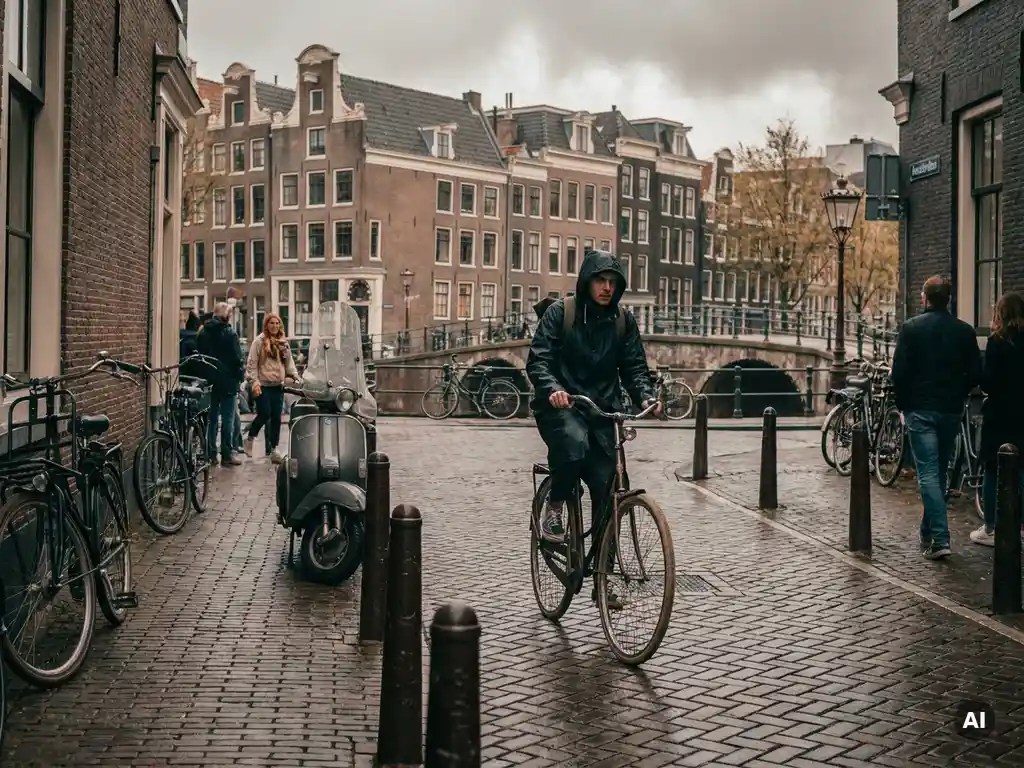
Amsterdam’s traffic policy in the city center affects bike and scooter riders in meaningfully different ways. Scooters have faced the most dramatic restrictions, with mopeds and speed pedelecs largely pushed off cycle paths in the city center and onto the main roadway. Cyclists, by contrast, have generally gained more protected space as a result. Below, the key questions get straight answers.
What has changed for scooter riders under Amsterdam’s traffic policy?
Under Amsterdam’s traffic policy, scooters (bromfietsen) are no longer permitted on most cycle paths in the city center. Instead, riders must use the main carriageway alongside cars and trams. This applies to both mopeds and speed pedelecs. The shift was introduced to reduce air pollution, lower noise levels, and make cycle paths safer and more pleasant for cyclists.
In practice, this means scooter riders must wear a helmet when using the main road, since that requirement kicks in the moment they leave the protected bike lane. The change was controversial when first introduced, but the reasoning behind it is straightforward: scooters travel significantly faster than bicycles, and their presence on narrow Amsterdam cycle paths had long been a source of near-misses and genuine danger. The policy essentially treats faster, motorized two-wheelers as motor vehicles, which, legally speaking, they are.
Speed pedelecs, which can reach up to 45 km/h, fall under the same rules as mopeds in the city center. Regular electric bikes, which are limited to 25 km/h with motor assistance, are treated as ordinary bicycles and remain welcome on cycle paths.
Are cyclists treated differently from scooter riders in Amsterdam?
Yes, cyclists are treated very differently from scooter riders under Amsterdam’s traffic policy. Standard bicycles, including regular electric bikes with a maximum assisted speed of 25 km/h, retain full access to cycle paths throughout the city center. Scooters and speed pedelecs do not. The dividing line is speed and motor classification, not whether the vehicle has two wheels.
This distinction matters enormously in daily life. A commuter on a regular e-bike can glide through the city on dedicated infrastructure, largely separated from car traffic. A scooter rider on the same route must now navigate tram rails, buses, and turning vehicles on the main road. It is a significant difference in both comfort and safety.
The policy reflects a broader philosophy in Amsterdam: cycle paths are for cyclists, not for anything that blurs the line between bicycle and motorbike. It is a clear hierarchy, and it has made cycle paths noticeably calmer.
Which streets and zones do the new traffic rules apply to?
The scooter restrictions under Amsterdam’s traffic policy apply primarily to the city center and surrounding ring areas, which together cover the busiest and most densely used cycling infrastructure in the city. The city center (Centrum) was the first area where mopeds were banned from cycle paths, and the zone has expanded over time to include major routes in neighboring districts.
Specific streets and zones are designated with signage, and the rules do not apply uniformly across the entire city. In outer neighbourhoods and on routes where cycle paths are wide or traffic volumes are lower, the restrictions may be less stringent. However, the general direction of travel, politically and practically, has been toward expanding the restricted zones rather than reducing them.
If you ride a scooter regularly in Amsterdam, the safest assumption is that any cycle path in or near the center is off-limits unless signage explicitly indicates otherwise. Checking the municipality’s official map of restricted zones before planning a regular commute is worth the five minutes it takes.
What happens if you break Amsterdam’s bike or scooter traffic rules?
Breaking Amsterdam’s traffic rules for bikes and scooters results in a fine issued by enforcement officers or police. Scooter riders caught using a cycle path in a restricted zone face a fixed penalty. Cyclists who violate rules, such as running a red light, using a phone while riding, or cycling the wrong way on a one-way street, are also subject to fines, which have increased in recent years.
Enforcement in Amsterdam is active, particularly in the city center. Officers patrol on foot and by bike, and fines are issued on the spot. Repeat violations do not automatically lead to escalating penalties in the same way that driving offenses might, but the fines are set at a level designed to be genuinely discouraging rather than merely symbolic.
For scooter riders, the additional risk of being on the main road without proper equipment, specifically without a helmet, compounds the problem. Riding a moped on the carriageway without a helmet is itself a separate infraction. The practical advice is simple: know which category your vehicle falls into, know where the restricted zones are, and ride accordingly.
How Klagen Niet Klagen helps you navigate Amsterdam city life
Traffic rules are just one layer of the city that takes time to fully understand. Klagen Niet Klagen exists precisely for moments like this, when you want a straight answer written by someone who has actually lived here for over thirty years, not a tourism board press release or a recycled expat forum thread.
- Honest, insider commentary on Amsterdam policies and how they affect daily life
- Long-form essays that go beyond headlines and actually explain the reasoning behind city decisions
- A perspective shaped by decades of living, working, and building something real in Amsterdam
- Content written in English, for people who engage with the city on their own terms
If you want more of this, the blog archive is the place to start. And if you have a question, a topic you think deserves the treatment, or just want to get in touch, the contact page is right there.
And while you are navigating Amsterdam, there is one more thing worth knowing: Boom Chicago has been making people laugh in this city since 1993. If you have never been to a show, or if it has been a while, the shows and agenda page is worth a look. Live comedy in Amsterdam, done properly. That is very much a Niet Klagen situation.
Frequently Asked Questions
How do I know whether my electric bike counts as a regular bicycle or a speed pedelec under Amsterdam's rules?
The key factor is the maximum speed at which the motor provides assistance. If your e-bike’s motor cuts out at 25 km/h, it is classified as a regular bicycle (rijwiel) and you are free to use cycle paths as normal. If the motor continues to assist up to 45 km/h, it is classified as a speed pedelec (snorfiets or bromfiets depending on type), and in Amsterdam’s city center it must use the main carriageway. When in doubt, check your bike’s technical documentation or the registration certificate — the classification should be clearly stated there.
What should a scooter rider actually do to stay safe now that they have to use the main road in Amsterdam?
The most important step is wearing a helmet, which is both legally required and genuinely necessary given the speed and density of Amsterdam’s city-center traffic. Beyond that, scooter riders should stay alert to tram rails, which are a real hazard for narrow wheels, and position themselves clearly in the lane rather than hugging the kerb where drivers may not expect them. Riding predictably and avoiding gaps between buses and trams will reduce the risk significantly — the main road is more demanding than a cycle path, but manageable if you treat it with the same seriousness as driving a car.
Are rental scooters and shared e-scooters subject to the same city-center restrictions as privately owned ones?
Yes, the restrictions apply based on vehicle classification, not ownership. Shared scooters and mopeds available through rental platforms fall under the same rules as privately owned equivalents — if the vehicle is classified as a bromfiets or snorfiets, it cannot use cycle paths in restricted zones regardless of who owns it. Some shared e-scooter schemes operate vehicles classified as step scooters (steps) with lower speed limits, which may be treated differently, so it is worth checking the specific classification of the rental vehicle before you ride.
Related Articles
- Why is it so hard to get a terrace permit in Amsterdam?
- Are Amsterdam's city beaches good alternatives to the canals?
- How has outdoor recreation changed in Amsterdam post-covid?
- What are the best English-language shows in Amsterdam this year?
- What are the hidden costs of visiting Amsterdam tourists ignore?