
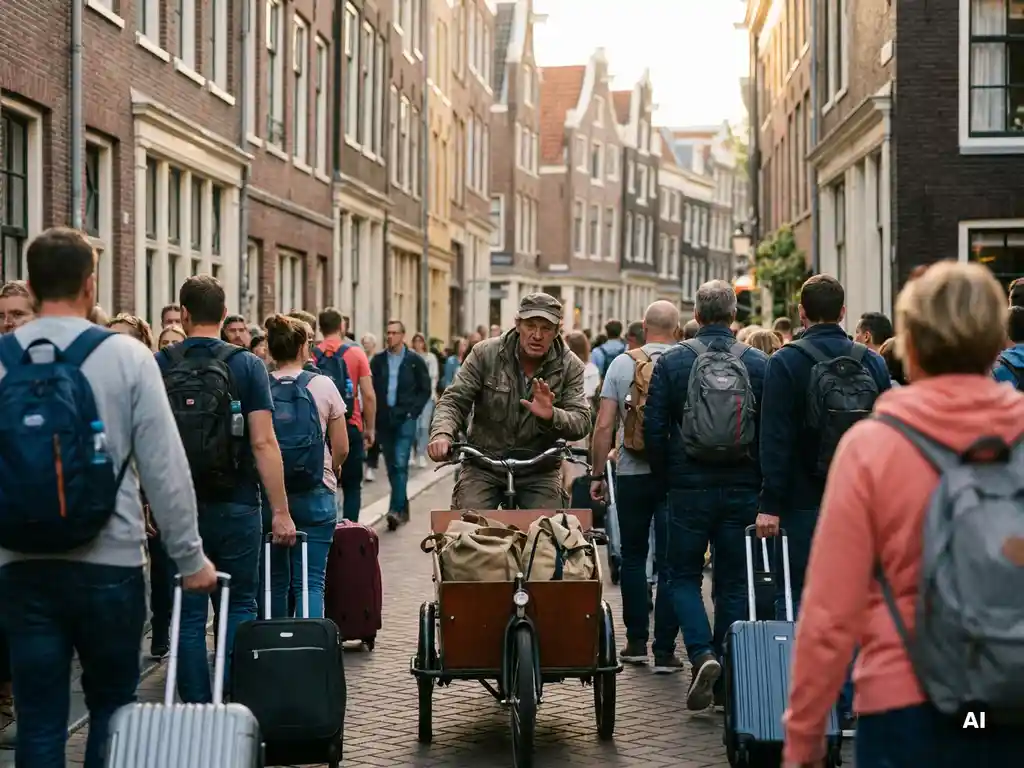
Overtourism has fundamentally disrupted daily life for Amsterdam residents by turning ordinary routines into obstacle courses. Streets that locals once used for grocery runs are now clogged with selfie sticks and stag parties. Neighbourhoods built for living have been hollowed out by short-term rentals. The tension between tourists and residents has moved from background noise to a defining feature of city life, and it is getting harder to ignore. Here is how that tension plays out across housing, neighbourhood identity, and city policy.
What parts of Amsterdam life have been most disrupted by overtourism?
The most disrupted parts of Amsterdam life are the mundane ones: shopping for groceries, cycling through your own street, finding a quiet café, or simply getting from A to B without navigating a slow-moving crowd. The tension between tourists and residents shows up most sharply in the city centre and the Jordaan, where basic daily infrastructure has been repurposed around visitor needs rather than resident ones.
Supermarkets in tourist-heavy areas have been replaced by souvenir shops and overpriced restaurants. Pharmacies, hardware stores, and dry cleaners have vanished. The businesses that make a neighbourhood liveable for actual residents have been pushed out by higher rents driven by tourist foot traffic. What remains is a kind of theme park economy that serves visitors well and locals poorly.
Public transport is another flashpoint. Trams and metro lines that residents depend on for commuting are routinely overwhelmed by tourists who are unfamiliar with the system and slow to board. Cycling, Amsterdam’s most essential form of daily transport, has become an exercise in patience as rental bike riders drift unpredictably across lanes. These are small irritations individually, but experienced daily, they accumulate into something that genuinely erodes quality of life.
Why has Amsterdam’s housing crisis gotten worse because of tourism?
Amsterdam’s housing crisis has worsened because of tourism primarily through the explosive growth of short-term rental platforms, which removed thousands of properties from the long-term housing market. Every apartment listed as a holiday rental is one fewer home available to residents. In a city already facing a severe shortage of affordable housing, that loss compounds an already critical situation.
The city has responded by tightening Airbnb-style regulations significantly, including caps on the number of nights a property can be rented short-term and outright bans in certain areas. But enforcement has been inconsistent, and the financial incentive to rent to tourists rather than long-term tenants remains strong in many parts of the city.
Beyond short-term rentals, tourism drives up property values and commercial rents across entire neighbourhoods. Landlords who might otherwise rent to families or young professionals see greater returns converting residential space into tourist accommodation or selling to investors who will. The result is a city where residents are priced out not just by the housing market in the abstract, but by the specific economic logic that tourism creates.
How has the character of Amsterdam’s neighbourhoods changed?
Amsterdam’s neighbourhoods have changed by losing the mix of residents, independent businesses, and local culture that gave them their distinct identity. Areas like the Jordaan and De Pijp, once genuinely lived-in working-class and creative neighbourhoods, have been progressively smoothed into versions of themselves designed for consumption rather than habitation.
The independent bookshop, the neighbourhood brown café, the family-run Indonesian restaurant that has been there for thirty years: these are the businesses that define a neighbourhood’s character, and they are precisely the ones that cannot compete with the rents that tourist-facing businesses can absorb. What moves in instead is generic: cocktail bars, souvenir shops, and the same rotating cast of international chains.
Long-term residents follow. When your neighbourhood no longer serves your daily needs, when the noise and crowds make ordinary life uncomfortable, you leave if you can. The people who built the social fabric of these places, the ones who knew their neighbours, organised street festivals, and kept the community alive, are replaced by short-term visitors and transient renters. The neighbourhood still looks like Amsterdam on the outside. Inside, something essential has gone quiet.
What is the city of Amsterdam actually doing about overtourism?
Amsterdam has taken some of the most aggressive anti-overtourism measures of any European city, including banning new hotels in the city centre, restricting short-term rentals, prohibiting cannabis sales in tourist-heavy areas, and actively discouraging certain categories of visitor through campaigns that tell rowdy stag parties they are not welcome. These are real policy moves, not just press releases.
The city has also invested in spreading tourist flows beyond the historic centre, promoting neighbourhoods like Noord and Nieuw-West to visitors who might otherwise never leave the canal ring. Whether this genuinely relieves pressure on the centre or simply expands the footprint of tourism into areas that were previously spared is a legitimate debate among residents and planners.
What Amsterdam has not yet solved is the underlying economic logic. As long as tourism remains enormously profitable for property owners, hotel operators, and large parts of the retail sector, the incentives that drive overtourism remain in place. Regulation can push back against the worst excesses, but it cannot fully counter a market that rewards visitor-facing businesses over resident-serving ones. The tension between tourists and residents is not going to be resolved by a single policy shift. It is a structural problem that the city is managing, not solving.
How Klagen Niet Klagen covers Amsterdam’s overtourism debate
Klagen Niet Klagen exists precisely for moments like this one, when the gap between the official Amsterdam narrative and the lived reality of residents is too wide to ignore. This blog offers something that tourism boards and mainstream media rarely do: an honest, insider perspective from someone who has lived and built in Amsterdam for over thirty years.
- Long-form essays that go beyond headlines and explore the real contradictions of Amsterdam city life
- A perspective rooted in genuine local experience, not journalistic distance or commercial interest
- Commentary that names the tensions honestly, including the uncomfortable ones
- Content written in English for the globally minded audience that mainstream Dutch media leaves out
If you want commentary on Amsterdam that respects your intelligence and does not flinch from the difficult questions, read more about the blog and explore what else is being written here. And if you have a question, a tip, or just want to push back on something, get in touch.
Of course, Amsterdam is not only frustrations and policy debates. It is also one of the most creative, funny, and genuinely surprising cities in the world, and nowhere is that more alive than at Boom Chicago, the comedy theatre that has been making Amsterdam laugh since 1993. If you have never been, or if it has been a while, check out what is on. A night at Boom Chicago is the kind of Amsterdam experience that does not show up in any tourism brochure, and that is exactly the point.
Frequently Asked Questions
Is overtourism in Amsterdam getting better or worse, and are the city's measures actually working?
The honest answer is: it is complicated. Some specific measures have had measurable effects — short-term rental listings have dropped following stricter enforcement, and the hotel ban in the centre has slowed new accommodation supply. But overall visitor numbers remain high, and the structural economic incentives that drive overtourism have not fundamentally changed. Progress is real but partial, and residents living in the most affected neighbourhoods are unlikely to feel a dramatic difference yet.
Which Amsterdam neighbourhoods are still relatively unaffected by overtourism, and for how long?
Areas like Nieuw-West, Bos en Lommer, and parts of Noord still retain much of their resident-first character, with functioning local infrastructure and less tourist foot traffic. However, the city’s own strategy of redirecting tourists to these neighbourhoods means that buffer may not last indefinitely. If you are considering where to live or spend time as a local, these areas offer the most genuine Amsterdam experience right now — but it is worth watching how quickly that changes as promotion efforts intensify.
What can individual Amsterdam residents actually do when they feel the impact of overtourism in their street or building?
Residents have more formal channels than many realise. Illegal short-term rentals can be reported directly to the municipality via the city’s dedicated hotline and online reporting tool, and Amsterdam takes these reports seriously as part of its enforcement strategy. Beyond that, neighbourhood associations (buurtcomités) are an effective way to collectively raise concerns with local district councils (stadsdelen), which have real authority over local planning and licensing decisions. Individual frustration becomes policy pressure when it is organised.