
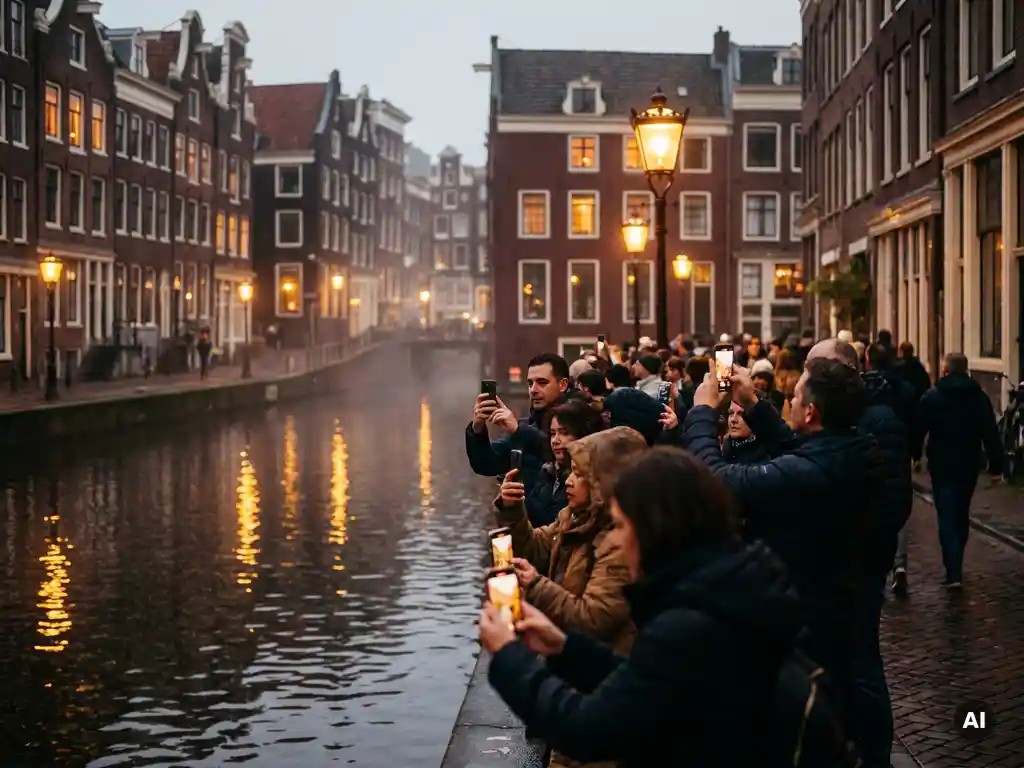
So many tourists crowd the Red Light District because it offers something genuinely unlike anything else in Europe: legal prostitution, open cannabis sales, and centuries of transgressive history packed into a handful of medieval streets. It is simultaneously a functioning neighbourhood, a living museum, and a permission slip to behave in ways that feel impossible back home. The questions below unpack exactly how De Wallen got here, whether it is still worth your time, and why Amsterdam keeps struggling to manage the chaos it created.
What actually draws so many people to De Wallen?
De Wallen attracts enormous crowds because it combines novelty, spectacle, and legal transgression in a way that no other neighbourhood in the world quite replicates. The red-lit windows, the coffee shops, the canal reflections at night: it is visually arresting and socially disorienting in equal measure. For most visitors, it represents a kind of freedom that feels genuinely exotic, regardless of whether they actually participate in anything on offer.
But the draw runs deeper than shock value. De Wallen is also one of the oldest parts of Amsterdam, with architecture dating back to the 14th century. The neighbourhood sits at the intersection of the city’s maritime trading past and its famously liberal present. That combination of historical weight and contemporary permissiveness creates a tension that is genuinely fascinating, even for visitors who arrive with no interest in the sex industry or cannabis culture.
There is also a powerful social dimension. Visiting the Red Light District has become a rite of passage for stag parties, school trips, and first-time Amsterdam visitors alike. The crowds generate their own gravity. People come partly because other people come, and because not going feels like missing something essential about Amsterdam. That herd logic is one of the most underestimated forces driving crowds in Amsterdam city centre.
How did De Wallen become Amsterdam’s most visited neighbourhood?
De Wallen became Amsterdam’s most visited neighbourhood through a combination of genuine historical distinctiveness, deliberate liberal policy, and decades of word-of-mouth amplification that no marketing budget could have manufactured. The area has been associated with Amsterdam’s port trade and its accompanying vices since the Middle Ages, but it was the policy decisions of the late 20th century that turned it into a global tourist magnet.
The Netherlands decriminalised brothels in 2000, formalising what had been a tolerated reality for generations. Coffee shops had already been operating under the gedoogbeleid, the famous Dutch policy of deliberate non-enforcement, since the 1970s. These legal frameworks gave De Wallen a legitimacy and openness that similar districts in other cities could never claim. Tourists were not just visiting something illicit: they were visiting something officially permitted, which made it feel both safer and more remarkable.
International travel growth through the 1990s and 2000s brought the neighbourhood to a global audience, and budget airlines made Amsterdam one of Europe’s most accessible weekend destinations. By the time social media arrived, De Wallen was already deeply embedded in the cultural imagination as the place you simply had to see. The crowds in Amsterdam’s city centre that now feel overwhelming were decades in the making.
Is the Red Light District still worth visiting in 2026?
The Red Light District is still worth visiting in 2026, but only if you arrive with the right expectations. The neighbourhood has changed significantly under sustained pressure from the city government, which has been actively trying to reduce its most exploitative and chaotic elements. Several windows have been permanently closed, new hotels are restricted, and guided tours through the area have faced increasing regulation.
What remains is still genuinely interesting, but the experience depends heavily on when and how you visit. During the day, De Wallen is a surprisingly liveable neighbourhood with good restaurants, independent shops, and some of Amsterdam’s most beautiful canal architecture. The Oude Kerk, the oldest building in the city, sits at its heart and is worth visiting on its own terms. At night, particularly on weekends, the crowds become so dense that any sense of atmosphere is crushed under the weight of people filming on their phones.
The honest answer is that the neighbourhood rewards curiosity and punishes passive tourism. If you walk through it as part of a stag party at midnight on a Saturday, you will likely see very little of what makes De Wallen genuinely remarkable. If you visit on a weekday morning and take the time to look at the architecture, read the history, and engage with the neighbourhood as a place rather than a spectacle, it still has real things to offer.
Why does Amsterdam struggle to manage Red Light District tourism?
Amsterdam struggles to manage Red Light District tourism because the neighbourhood’s appeal is structurally resistant to conventional crowd management. The very things that make De Wallen attractive to millions of visitors, its openness, its legal permissiveness, its concentrated spectacle, are the same things that make it almost impossible to regulate without fundamentally changing what it is.
The city has tried a range of interventions over the years. Guided tours have been restricted. Alcohol consumption on the streets has been regulated. The municipality has bought back properties from sex workers and landlords as part of its Project 1012 urban renewal programme, reducing the number of window brothels substantially. None of these measures have meaningfully reduced the flow of visitors, because the underlying demand has not changed.
There is also a genuine political tension at the heart of Amsterdam’s tourism problem. The city benefits economically from the millions of visitors who pass through De Wallen each year, even as residents and policymakers complain loudly about the quality of that tourism. Closing the Red Light District entirely, or radically transforming it, would require a level of political will and financial sacrifice that successive city governments have not been willing to commit to. The result is a perpetual cycle of half-measures, public debate, and continued overcrowding that defines the experience of Amsterdam city centre crowds for residents and visitors alike.
The deeper issue is that Amsterdam has marketed itself on the basis of its liberalism for decades, and De Wallen is the most visible expression of that brand. Dismantling it means dismantling a significant part of what the city has told the world it stands for. That is a much harder problem than installing a few crowd barriers on a Saturday night.
How Klagen Niet Klagen helps you understand Amsterdam beyond the obvious
De Wallen is the most written-about neighbourhood in Amsterdam and also one of the least understood. Most of what you read about it is either promotional tourism content or breathless moral outrage, neither of which actually helps you make sense of the place or the city around it. Klagen Niet Klagen exists to fill exactly that gap.
- Honest, long-form commentary on Amsterdam city life written from over three decades of lived experience inside the city
- No tourism board influence, no advertorial pressure, just a genuine point of view on what makes Amsterdam work, fail, and fascinate
- Coverage of the contradictions that define the city: liberalism versus pragmatism, openness versus overcrowding, pride versus exasperation
- A perspective that treats readers as intelligent adults who want nuance, not a checklist
If you want to go deeper on Amsterdam, its neighbourhoods, its culture, its unspoken rules, the blog archive is a good place to start. And if you have questions or want to get in touch, the contact page is always open.
One more thing worth knowing: the same mind behind this blog co-founded Boom Chicago, Amsterdam’s legendary comedy theatre, back in 1993. If you want to experience the city’s humour, energy, and contradictions live on stage rather than on a screen, the shows and agenda are worth a look. It is genuinely one of the best things Amsterdam has to offer, and unlike De Wallen on a Saturday night, the crowds there are actually part of the fun.
Frequently Asked Questions
What's the best time of day to visit De Wallen if I want to actually appreciate it?
Weekday mornings between 9am and noon are by far the best window. The streets are calm enough to walk without being jostled, the architecture is visible without a wall of selfie sticks in front of it, and the neighbourhood functions like an actual neighbourhood rather than a theme park. If a daytime visit isn’t possible, early weekday evenings before 8pm are your next best option — the atmosphere picks up without yet tipping into chaos.
Is it disrespectful to visit De Wallen purely as a sightseer with no intention of using any of its services?
Not at all — the vast majority of people who pass through De Wallen are sightseers, and the neighbourhood has always accommodated that. The more meaningful question is how you behave while you’re there. Photographing sex workers in the windows is widely considered disrespectful and is actively discouraged by the city; beyond that, treating the area with the same basic consideration you’d extend to any residential neighbourhood goes a long way. Residents do actually live there, and that’s easy to forget when the crowds are thick.
Are there any lesser-known parts of Amsterdam's old city centre that offer a similar historical atmosphere without the overwhelming crowds?
The Jordaan district, immediately to the west of De Wallen, offers comparable canal architecture and a genuine sense of Amsterdam’s layered history at a fraction of the foot traffic. The Begijnhof — a hidden medieval courtyard just off the Spui — is one of the city’s most atmospheric spots and consistently undervisited relative to its quality. For a more local experience of old Amsterdam without the spectacle economy, these are the places worth prioritising.