
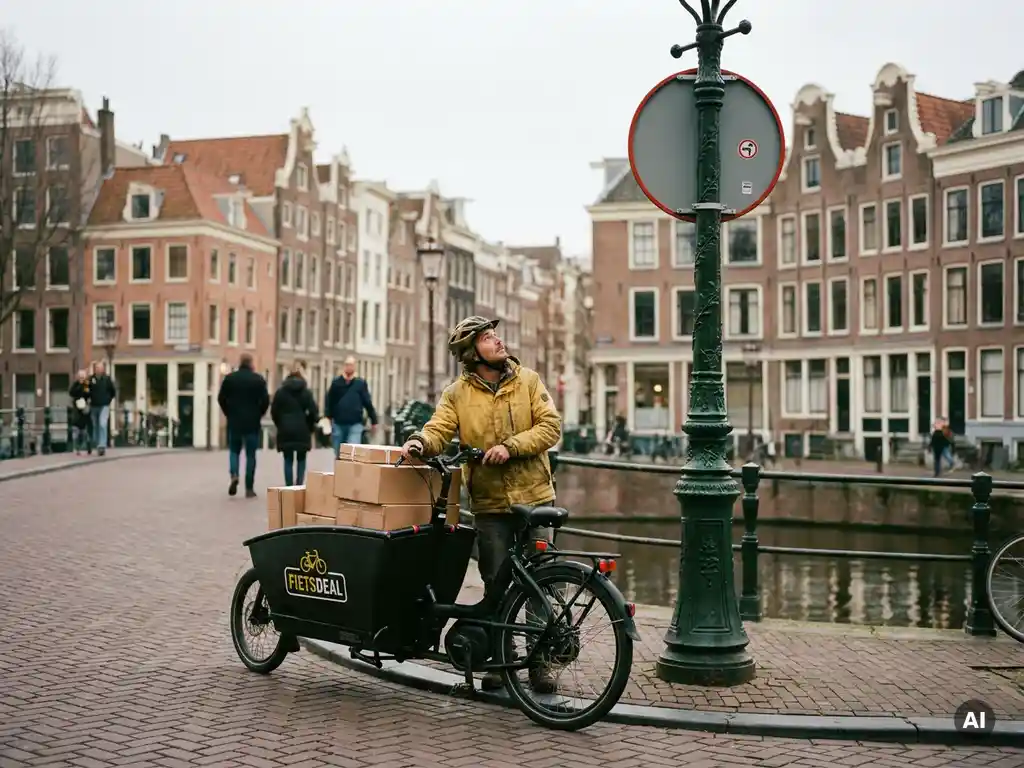
Amsterdam’s new traffic policy will significantly restrict which vehicles can enter the city center, when they can do so, and what happens if they don’t comply. For anyone relying on deliveries, whether you’re a business owner, a courier company, or someone waiting for a package, the rules have changed in ways that matter. Here’s a clear breakdown of what the policy means in practice.
Which delivery vehicles are still allowed in Amsterdam’s center?
Under Amsterdam’s updated traffic policy for the city center, only zero-emission delivery vehicles are permitted to operate within the designated low-emission zone. This means electric vans, cargo bikes, and other emission-free freight vehicles can still access central streets. Diesel and petrol delivery vehicles are no longer welcome inside the zone, regardless of their Euro emission rating.
The city has been moving in this direction for years, and 2026 marks a firm enforcement point rather than a gentle suggestion. Practically speaking, this affects a wide range of operators: courier companies, food delivery services, wholesale suppliers, and independent tradespeople who use a van to get around. If your vehicle runs on fossil fuels, it needs to stay outside the ring or be replaced.
Cargo bikes have become an increasingly visible part of the solution, and several logistics companies have already invested heavily in electric freight cycles capable of carrying substantial loads through Amsterdam’s narrow streets. For smaller deliveries, they are genuinely practical. For larger shipments, electric vans remain the primary permitted option.
What are the new delivery time windows in Amsterdam’s center?
Amsterdam’s center now operates with defined delivery time windows designed to reduce congestion during peak hours. Deliveries are generally permitted during early morning hours before the city fills with pedestrians, cyclists, and tourists. Outside these windows, even compliant zero-emission vehicles may be restricted from stopping or unloading on certain streets.
The specific windows vary by street category and neighborhood within the center, so there is no single universal rule that applies everywhere. High-traffic corridors near major shopping areas and tourist zones tend to have the tightest restrictions, while quieter residential streets within the center may allow slightly broader access. Delivery operators are expected to consult the city’s official zone maps to understand exactly which rules apply to each route.
For businesses receiving goods, this creates a practical coordination challenge. If your supplier’s driver arrives outside the permitted window, they cannot legally unload, which means either early-morning scheduling or finding a consolidation point outside the center and transferring goods from there.
How will the policy affect same-day and last-mile delivery services?
Same-day and last-mile delivery services face the sharpest operational pressure from Amsterdam’s new traffic policy for the city center. These services depend on speed and flexibility, and both are constrained by time windows and vehicle restrictions. Companies that have not yet transitioned to electric fleets will simply be unable to fulfill same-day orders within the center.
Last-mile logistics providers have been adapting in different ways. Some are investing in electric cargo bikes for the final stretch, using larger electric vans to bring goods to the edge of the zone and then switching to bikes for the last leg. Others are partnering with local consolidation hubs, where shipments from multiple senders are bundled and delivered together in a single compliant vehicle.
For consumers in the center, the honest reality is that same-day delivery may become less reliable or more expensive as logistics companies absorb the cost of fleet upgrades and route restructuring. Retailers and restaurants that depend on frequent, flexible restocking will feel this most acutely, particularly smaller independent businesses without the negotiating power to secure priority delivery slots.
What happens if a delivery vehicle violates the new rules?
If a delivery vehicle violates Amsterdam’s city center traffic policy, the consequences are financial and increasingly automated. The city uses a combination of camera enforcement and number-plate recognition to identify non-compliant vehicles entering the zone or unloading outside permitted windows. Fines are issued automatically, without requiring a physical enforcement officer to be present.
The fine amounts are set to be genuinely deterrent rather than a manageable cost of doing business. Repeat violations attract higher penalties, and persistent offenders can face additional measures, including temporary access bans. For delivery companies operating at scale, the cumulative cost of non-compliance can quickly outweigh the investment in switching to a compliant fleet.
Drivers themselves can also be held liable in some circumstances, not just the company operating the vehicle. This has shifted internal accountability within logistics firms, with many now implementing route compliance checks and driver briefings as standard procedure. If you are a business owner receiving deliveries, it is worth confirming with your suppliers that their vehicles and scheduling are compliant, since a failed delivery due to a fine or access refusal ultimately affects you too.
How Klagen Niet Klagen helps you navigate Amsterdam’s city rules
Amsterdam’s traffic and delivery policies are a perfect example of the kind of city-level change that sounds simple in a press release and turns out to be genuinely complicated in practice. At Klagen Niet Klagen, this is exactly the territory the blog was built to cover: honest, clear, insider commentary on how Amsterdam actually works, written for people who live here or do business here rather than for tourists passing through.
- Practical breakdowns of Amsterdam city policies that affect daily life and business operations
- An honest perspective that does not soften inconvenient realities or repeat official talking points uncritically
- Long-form commentary written from over three decades of lived Amsterdam experience
- Content aimed at expats, internationally minded locals, and engaged visitors who want substance over surface
If this kind of commentary is useful to you, explore more articles on the blog. And if you want to get in touch directly, the contact page is the place to start.
On a completely different note: if Amsterdam’s logistics headaches have you needing a laugh, Boom Chicago has been making Amsterdammers and visitors crack up since 1993. Sharp, live, improvised comedy in the heart of the city. Check the shows and agenda and come see what the fuss is about.
Frequently Asked Questions
How can a small business in Amsterdam's center get started with compliant deliveries if switching to electric vehicles isn't immediately affordable?
The most practical first step is to contact your existing suppliers and logistics partners to confirm whether their fleets are already compliant, since many larger courier companies have already made the switch. If your regular provider cannot deliver compliantly, look into urban consolidation hubs operating on the edge of the center, where goods can be transferred to compliant vehicles for the final leg. Amsterdam’s municipality also offers subsidy schemes and support programs for small businesses transitioning to zero-emission logistics, so checking the city’s official business portal is worth the time before assuming the cost falls entirely on you.
What are the most common mistakes businesses make when trying to adapt to Amsterdam's new delivery rules?
The most frequent mistake is assuming that a single compliant vehicle or a single early-morning delivery slot solves the problem without reviewing the specific rules for each street or neighborhood within the zone. Delivery windows and access rules vary by location, so a schedule that works for one part of the center may be entirely wrong for another. A second common error is failing to confirm compliance with suppliers proactively, leaving businesses blindsided when a delivery fails at the last moment because the driver’s vehicle or timing was non-compliant.
Is there any flexibility in the rules for urgent or emergency deliveries, such as medical supplies or critical business restocking?
Amsterdam’s policy does include provisions for certain categories of essential services, but these exemptions are narrowly defined and require prior registration or permits rather than being granted on the spot. Medical and emergency service vehicles generally fall outside the standard enforcement framework, but commercial deliveries, even urgent ones, are not automatically exempt simply because the goods are time-sensitive. If your business regularly handles genuinely critical deliveries, the correct route is to apply for the relevant permit through the city’s traffic and transport authority well in advance, rather than hoping for leniency at the point of enforcement.