
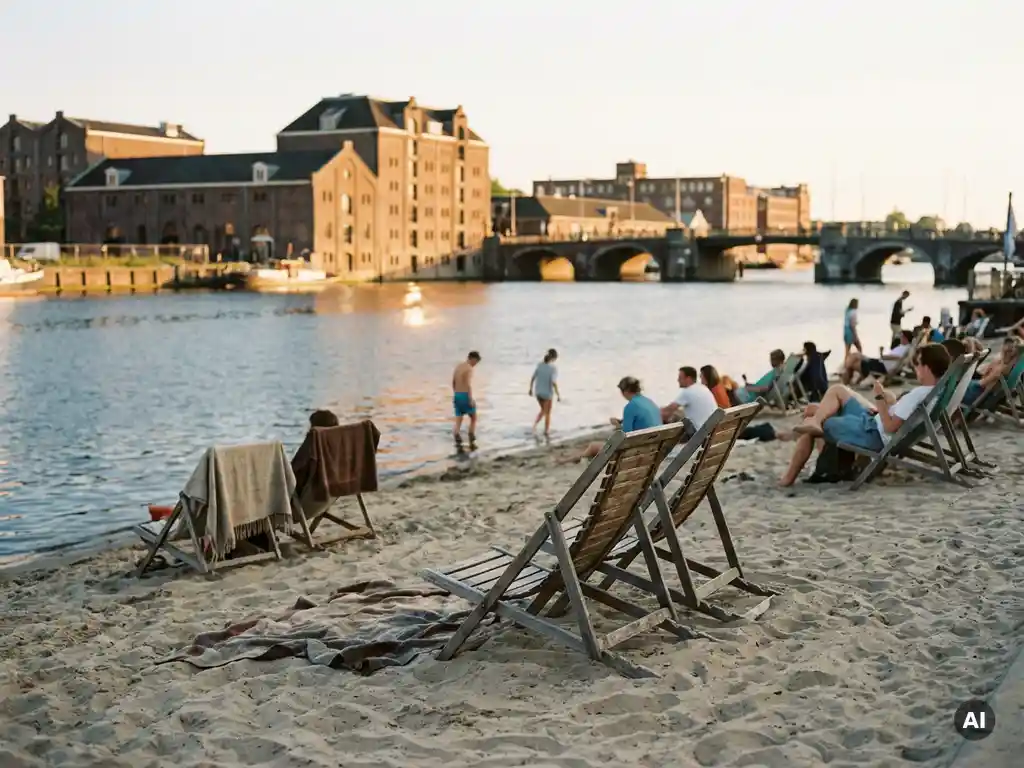
Amsterdam’s urban beaches are a genuinely distinctive summer phenomenon: purpose-built sandy spots along the city’s rivers, canals, and harbour edges that bring a beach atmosphere directly into the urban fabric. Unlike traditional coastal beaches, they are compact, social, and deeply woven into everyday Amsterdam life rather than being a destination you have to travel to reach. Below, the key questions about these spots get honest, direct answers.
Where are Amsterdam’s urban beaches actually located?
Amsterdam’s city beaches are scattered across the IJ waterfront, the Amstel River, and various canal-side locations throughout the city. The most prominent cluster sits along the northern IJ banks, particularly around the NDSM wharf and Amsterdam-Noord, where former industrial terrain has been reimagined as waterfront leisure space. Roest, on the eastern IJ bank, is another well-known spot combining a sandy beach with a bar and cultural programming.
Beyond the IJ, smaller beach bars and sandy terraces pop up along the Amstel and in Westerpark each summer. The Sloterplas recreational lake in the west of the city also offers a more traditional lido-style beach experience, with grass and sand alongside open water. What is striking is how spread out these spots are: there is no single “beach district” in Amsterdam. Instead, the city beach scene is decentralised, which means locals tend to have a favourite neighbourhood spot rather than everyone converging on one place.
What makes Amsterdam’s city beaches different from regular seaside beaches?
Amsterdam’s urban beaches are fundamentally social spaces first and swimming spots second. Unlike a seaside beach defined by waves, tides, and sunbathing in rows, a city beach Amsterdam summer experience is built around bars, music, food trucks, and the particular pleasure of sitting on sand in the middle of a metropolis. The contrast between industrial harbour architecture and a beach chair is part of the appeal.
The scale is also entirely different. These are intimate, curated environments rather than open stretches of coastline. Roest, for example, fits a few hundred people comfortably; on a hot July afternoon it feels like a festival rather than a beach. That density creates a social energy that a vast North Sea beach simply cannot replicate. You are close to your neighbours, conversation happens easily, and the atmosphere is more like an outdoor living room than a natural landscape.
There is also a distinctly Amsterdam cultural layer: these spots tend to attract a creative, international crowd. You will hear as much English and Spanish as Dutch. The programming often includes live music, art installations, and film screenings after dark, which makes them function as cultural venues that happen to have sand underfoot.
Can you actually swim at Amsterdam’s urban beaches?
Swimming is possible at some Amsterdam urban beach locations but not all of them, and the quality of the water varies significantly by spot. The Sloterplas lake is the most reliably safe option for swimming, with regular water quality monitoring and a proper designated swim area. Several IJ-side locations technically allow swimming, but the IJ is a working harbour with boat traffic, currents, and variable water quality that demands caution.
The honest answer is that most people who visit Amsterdam’s city beaches are not there primarily to swim. They are there to sit in the sun with a beer, enjoy the waterfront view, and feel the particular pleasure of escaping the city’s stone and brick without actually leaving it. If swimming is your priority, the Sloterplas or the beaches along the Amstel offer calmer, cleaner conditions than the busy IJ waterfront.
It is always worth checking current water quality reports before swimming anywhere in the city. Amsterdam’s municipal water authority publishes seasonal updates, and conditions can change after heavy rainfall due to urban runoff.
What is the local culture like at Amsterdam’s beach spots?
The culture at Amsterdam’s urban beaches is relaxed, unpretentious, and noticeably international. These are not tourist traps: they are places where Amsterdammers genuinely spend their summer evenings. The crowd tends to be young to middle-aged, creative, and mixed in background, which reflects the broader demographic of the city’s inner and near-inner neighbourhoods.
The Dutch approach to leisure applies here in full: no fuss, no dress code, no expectation of being waited on hand and foot. You order at the bar, you find your own spot, and you settle in. Bringing your own food is common and completely accepted. Dogs are usually welcome. The vibe is closer to a neighbourhood barbecue than a resort beach experience, which is precisely why locals love it.
One thing worth understanding is the weather dependency. Amsterdam summers are genuinely uncertain, and a city beach can go from packed to empty in an hour when a cloud rolls in from the North Sea. Locals have made peace with this. There is a particular Amsterdam pleasure in seizing a sunny afternoon the moment it appears, knowing it might not last, and that shared acceptance of meteorological impermanence gives these spots a slightly festive, carpe diem quality that seaside resorts with guaranteed sunshine simply do not have.
How Klagen Niet Klagen helps you understand Amsterdam’s summer scene
If you want to go beyond the obvious and actually understand what makes Amsterdam worth experiencing in summer, Klagen Niet Klagen offers exactly that kind of honest, insider commentary. This is not a tourism board telling you everything is wonderful. It is a real perspective from someone who has lived and worked in Amsterdam for over three decades, and who is equally happy to tell you when something is overrated.
- Long-form essays on Amsterdam city life written from genuine insider experience
- Honest takes on what works, what does not, and why Amsterdam is worth understanding rather than just visiting
- Cultural commentary that goes beyond the surface, covering the city’s contradictions as well as its pleasures
- An English-language platform written for expats, international visitors, and curious locals alike
If you want more of this kind of commentary, find out more about the blog and explore what else is in the archive. And if you have a question or a topic you think deserves an honest answer, get in touch directly.
One more thing: if you find yourself on a city beach in Amsterdam on a warm summer evening wondering what to do next, the answer is straightforward. Boom Chicago has been running shows in Amsterdam since 1993, and an evening of sharp, funny, English-language comedy is one of the best ways to end a summer day in the city. Check the shows and agenda and see what is on.
Frequently Asked Questions
What is the best time of day to visit Amsterdam's urban beaches?
Late afternoon into early evening is widely considered the sweet spot — the heat of the day has softened, the after-work crowd arrives, and the atmosphere picks up noticeably. Spots like Roest tend to come alive around 5–7pm on weekdays, while weekends can get busy from midday onward. If you prefer a quieter experience with a good chance of finding a seat, arriving before noon on a weekday is your best bet.
Do I need to book in advance, or can I just show up?
For most Amsterdam city beaches, simply showing up is perfectly fine — that spontaneous, drop-in quality is part of what makes them feel local rather than touristy. However, some spots with ticketed events, live music nights, or film screenings (Roest being a good example) do sell out, so it is worth checking their social media or website if you have a specific evening in mind. For a regular sunny afternoon with a drink, no reservation is needed.
Are Amsterdam's urban beaches suitable for families with young children?
Some spots are more family-friendly than others. The Sloterplas is generally the best choice for families, offering supervised swim areas, more open space, and a calmer environment than the bar-heavy IJ waterfront locations. Spots like Roest are primarily geared toward an adult crowd, especially in the evenings when music and bar culture dominate. If you are visiting with young children, aim for the lido-style locations rather than the harbour-edge beach bars.