
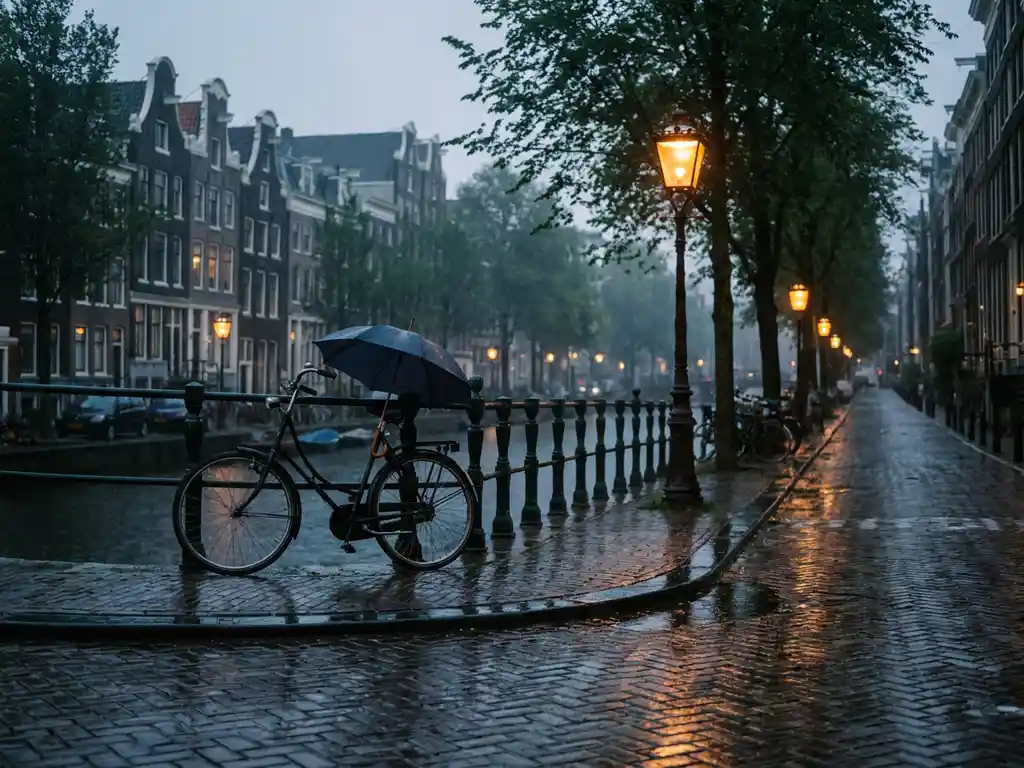
November is the rainiest month in Amsterdam. On average, November brings more precipitation than any other month of the year, with October and December close behind. If you are planning a trip or simply trying to understand the city’s notoriously grey skies, knowing which months pile on the most rain makes a real difference to how you dress, plan, and mentally prepare.
Amsterdam’s climate is classified as temperate maritime, which means the North Sea keeps temperatures mild year-round but also keeps the clouds coming. Rain is never truly off the table, whatever the calendar says. The sections below break down the specific numbers, seasonal patterns, and practical takeaways that belong in any honest Amsterdam weather guide.
Which month actually gets the most rain in Amsterdam?
November is Amsterdam’s wettest month. It typically receives around 90 to 100 millimetres of rainfall and sees rain on roughly 20 days out of 30. October and December are almost as wet, making the entire autumn-to-early-winter stretch a reliably damp affair. If you want to avoid the worst of it, November is the month to think twice about.
What makes November particularly unpleasant is not just the volume of rain but the combination of factors that come with it. The days are short, the light is flat, and the wind off the North Sea gives the rain a horizontal quality that no umbrella fully defeats. Amsterdammers have a word for this kind of weather, but the expression on their faces when they arrive at work soaked through says it just as well.
That said, November rain in Amsterdam is rarely dramatic. There are no monsoons, no biblical downpours that last for days. It is more of a persistent, grey, drizzly presence that settles in and refuses to leave. Think of it as the weather equivalent of an uninvited guest who is perfectly polite but simply will not go home.
How many rainy days does Amsterdam get per year?
Amsterdam experiences rain on approximately 130 to 150 days per year, depending on how you define a rainy day. That works out to roughly one in every three days. Even so, total annual precipitation sits at around 800 to 850 millimetres, which is actually less than cities like London or Brussels receive on average.
The distinction matters. Amsterdam does not necessarily get more rain than comparable European cities. It just gets rain more frequently, spread across more days, often as light drizzle rather than heavy showers. You are less likely to get caught in a sudden downpour and more likely to walk around in a low-level mist that you barely notice until you realise your jacket is completely soaked.
For residents, this is simply the texture of Amsterdam life. You carry a compact umbrella the way you carry your phone. You stop being surprised. For visitors, the mental adjustment takes a little longer, especially if you arrive expecting the bright, postcard version of the city and find instead a moody, atmospheric one. Honestly, the moody version has its own appeal.
What’s the difference between Amsterdam’s wettest and driest months?
The difference between Amsterdam’s wettest and driest months is real but not dramatic. November averages around 90 to 100 millimetres of rain, while April and May are the driest months, typically receiving around 40 to 50 millimetres each. That is roughly a two-to-one ratio, which is noticeable but far from the extreme seasonal swings you see in Mediterranean or tropical climates.
In practical terms, this means Amsterdam never has a truly dry season. Even in April and May, you will encounter rain. The difference is that spring showers tend to be shorter, brighter, and interspersed with genuinely lovely sunny spells. You are more likely to have a full dry day in May than in November, but you should never assume the sun will hold.
This relatively narrow range is a direct consequence of the maritime climate. The North Sea acts as a temperature and moisture buffer, smoothing out extremes in both directions. Amsterdam does not bake in summer or freeze in winter, and it does not have a monsoon season or a bone-dry summer. What it has instead is a kind of persistent, mild dampness with occasional bursts of beauty. That is Amsterdam’s meteorological deal, and after a few years here, you stop negotiating with it.
Does Amsterdam rain more in summer or winter?
Amsterdam actually receives slightly more rain in summer than in winter, which surprises most people. July and August can see frequent short, sharp showers, while winter months bring more persistent drizzle and overcast skies. However, winter feels wetter because the rain is colder, the days are shorter, and there is far less sunshine between showers to dry things out.
Summer rainfall in Amsterdam tends to arrive as convective showers, the kind that build quickly in the afternoon heat, dump water for twenty minutes, and then clear. These are annoying but manageable. Winter rainfall is more of a constant companion, a grey background hum that lasts for days without a break.
The other key difference is daylight. In July, even a rainy day has sixteen hours of light, and the city still feels alive and energetic. In December, a rainy day means darkness by four in the afternoon and a canal-side atmosphere that is either deeply romantic or quietly depressing, depending on your mood and your company. Both are authentically Amsterdam.
What month should you avoid Amsterdam for bad weather?
If you want to avoid Amsterdam’s worst weather, November is the month to sidestep. It combines the highest rainfall, frequent overcast skies, short days, and biting North Sea winds into one reliably grim package. December is a close second, though the Christmas markets and festive lights do a lot of heavy lifting to offset the gloom.
That said, “avoid” is a strong word. Amsterdam in November has real appeal if you are the kind of traveller who prefers museums over canal boat tours and does not mind wrapping up. The crowds thin out significantly after the summer peak, prices drop, and the city has a quieter, more local feel. You can actually get a table at a good restaurant without a reservation made three weeks in advance.
The months that offer the best balance of reasonable weather and manageable crowds are May, early June, and September. May in particular tends to deliver the most pleasant combination of mild temperatures, lower rainfall, and long evenings. It is not guaranteed sunshine, because this is Amsterdam and nothing is guaranteed, but it is your best statistical bet for a trip that does not require waterproof trousers.
How Klagen Niet Klagen helps you understand Amsterdam weather (and everything else)
Weather in Amsterdam is one of those topics that every guidebook covers superficially and nobody covers honestly. The tourist-board version tells you to pack a light jacket. The reality involves rain gear, wind-resistant umbrellas, and a philosophical acceptance that the sky will do what it wants. Klagen Niet Klagen exists precisely for that gap between the polished version and the lived one.
- Honest, experience-based commentary on what Amsterdam is actually like to live in and visit, written without tourism-board influence
- Long-form essays and practical guides that go beyond surface-level advice and reflect over thirty years of Amsterdam life
- A clear-eyed perspective on the city’s contradictions, including the weather, the housing market, the cycling culture, and everything in between
- Content written in English for a globally minded audience that wants real insight, not a sponsored city guide
If you want more of this kind of honest Amsterdam perspective, the blog archive is a good place to start. There is plenty more where this came from.
And if you find yourself in Amsterdam in November, staring at the rain from a warm window and wondering what to do with your evening, the answer is simple: go see a show at Boom Chicago. Thirty-plus years of sharp, Amsterdam-rooted comedy, performed live in English. The weather outside will still be terrible when you leave, but you will feel considerably better about it. That is basically the Boom Chicago guarantee.
Frequently Asked Questions
What should I pack for a trip to Amsterdam in November?
Beyond the standard advice of a light jacket, November in Amsterdam demands a genuinely waterproof outer layer, a wind-resistant compact umbrella (a standard canopy umbrella will lose the battle against North Sea gusts), and waterproof footwear. Layering is key since temperatures hover between 5–10°C, and the combination of wind and damp makes it feel colder than the thermometer suggests. Think of packing for persistent grey drizzle rather than dramatic downpours, and you will be well prepared.
Is there anything I can do in Amsterdam on a rainy day that is actually worth the trip?
Absolutely — Amsterdam’s indoor culture is arguably its strongest suit. The Rijksmuseum, the Van Gogh Museum, the Anne Frank House, and the lesser-known Moco Museum all reward a few unhurried hours, and rainy days mean slightly shorter queues than peak summer. Beyond the big institutions, Amsterdam’s neighbourhood brown cafés (bruine kroegen) are made for exactly this kind of weather — a warm corner, a local beer, and no particular urgency to be anywhere else. November is also prime season for live performances, with Boom Chicago and the Concertgebouw both offering excellent evening programmes.
Does Amsterdam's rain affect cycling, and should visitors still rent a bike in wet weather?
Amsterdammers cycle in virtually all weather, rain included, and the city’s infrastructure is built around it — but visitors should be honest with themselves about their comfort level. Light drizzle is entirely manageable on a bike, especially on the flat, well-maintained cycle paths. Heavy rain combined with wind, however, makes cycling genuinely unpleasant and slightly more hazardous, particularly near canal edges. If you are visiting in November, a waterproof jacket and a willingness to arrive at your destination slightly damp is the realistic expectation; if that does not appeal, Amsterdam’s tram network is excellent and covers most of the city efficiently.