
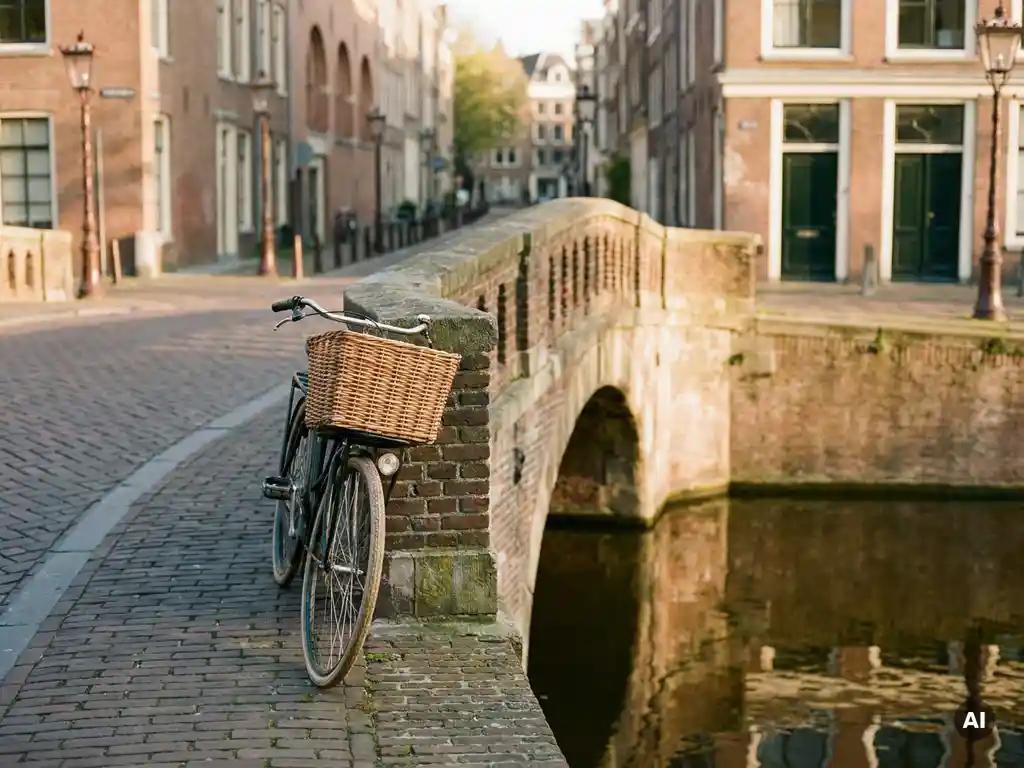
Amsterdam is restricting cars in the city center as part of a long-term strategy to reclaim public space, reduce pollution, and make the city more liveable for residents. The plan involves removing thousands of parking spots, closing streets to through traffic, and prioritising pedestrians, cyclists, and public transport. Below, we unpack the key questions around Amsterdam’s traffic policy in the city center.
What is Amsterdam’s plan to remove cars from the city center?
Amsterdam’s plan to remove cars from the city center involves systematically eliminating on-street parking spaces, restricting access for private vehicles, and redesigning streets to favour walking and cycling. The city has set ambitious targets to remove tens of thousands of parking spots from the center over the coming years, freeing up significant amounts of public space in the process.
The approach is not a single dramatic ban but a gradual, neighbourhood-by-neighbourhood transformation. Streets that once served as car corridors are being redesigned as public squares, wider cycling lanes, and green spaces. Paid parking zones have expanded, and permit systems have been tightened to make keeping a car in the center increasingly inconvenient and expensive.
The policy also targets delivery vehicles and tourist coaches, which contribute heavily to congestion without serving residents. Designated loading zones and time restrictions are being introduced to manage commercial traffic without eliminating it entirely. The overall vision is a city center where the car is the exception rather than the rule.
Why is Amsterdam restricting cars now and not earlier?
Amsterdam is restricting cars now because decades of accumulated pressure from residents, environmental advocates, and urban planners finally reached a political tipping point. The combination of worsening air quality, chronic congestion, housing pressure, and the growing recognition that car-dominated streets actively harm quality of life made the status quo politically unsustainable.
The honest answer is that Amsterdam has been talking about this for a long time. The city has had progressive cycling infrastructure since the 1970s, largely as a response to the 1973 oil crisis and early environmental activism. But the political will to take on car culture in a meaningful, structural way only solidified in the 2010s and accelerated into the 2020s.
Several factors converged to make action possible now rather than earlier. Climate commitments at the European level created external pressure. Resident surveys consistently showed that Amsterdammers wanted fewer cars and more space. And the success of similar schemes in cities like Oslo and Barcelona demonstrated that removing cars does not kill urban economies, which neutralised one of the most persistent counterarguments from business owners and retailers.
How does Amsterdam’s car policy compare to other European cities?
Amsterdam’s car policy is ambitious by most standards but not the most radical in Europe. Cities like Oslo have gone further by removing nearly all on-street parking from their center, while Paris has dramatically reduced car lanes along the Seine and introduced aggressive low-emission zones. Amsterdam sits in the progressive middle: bolder than most, but more incremental than the frontrunners.
What distinguishes Amsterdam is the combination of cycling infrastructure and car restriction working together. In many cities, removing cars creates a vacuum. In Amsterdam, the bicycle already fills that vacuum with remarkable efficiency. The city’s flat terrain, dense layout, and deeply embedded cycling culture mean that alternatives to the car are genuinely practical for most journeys, which makes the political case for restriction far easier to make.
London’s congestion charge and Madrid’s central emission zone take a different approach, using pricing rather than physical removal to reduce car use. Amsterdam uses both: financial disincentives through parking costs and permits, and physical redesign that simply makes driving through the center less possible. The result is a more comprehensive transformation of the streetscape rather than just a reduction in traffic volume.
What does Amsterdam’s car crackdown mean for residents and visitors?
For residents, Amsterdam’s car restrictions mean less noise, cleaner air, and more usable public space, but also real inconvenience if you own a car. Permit waiting lists in central neighbourhoods are long, parking costs have risen sharply, and the practical case for keeping a car in the city has weakened considerably. For visitors, the message is straightforward: arrive by train, rent a bike, and do not expect to drive to your hotel door.
The impact on daily life depends heavily on where you live and how you move. For the majority of Amsterdammers who cycle or use public transport, the changes are largely positive. Streets feel calmer, children can play more safely, and the city is measurably quieter in areas where parking has been removed. For the minority who rely on cars, whether due to disability, profession, or personal preference, the restrictions create genuine friction that the city has not always managed well.
Visitors should plan accordingly. Amsterdam Centraal connects to the national rail network and international routes, making car-free arrival straightforward from most of Europe. Within the city, trams, the metro, and the GVB ferry network cover the main areas. And of course, cycling remains the fastest and most enjoyable way to navigate the center, with rental options available throughout the city.
How Klagen Niet Klagen helps you make sense of Amsterdam
Amsterdam’s traffic policy is a perfect example of what makes this city fascinating and occasionally maddening at the same time. The ambition is real, the results are visible, but so are the contradictions and the compromises. That is exactly the kind of story Klagen Niet Klagen exists to tell.
- Honest, insider commentary on Amsterdam city policy, culture, and everyday life, written in English for people who actually live here or want to understand the city beyond the tourist surface
- A clear editorial framework: what is genuinely good about Amsterdam (niet klagen) and what deserves an honest critique (klagen), without the diplomatic softening of mainstream media
- Long-form essays and opinion pieces from someone who has spent over three decades building something real in this city and has earned the right to an opinion about it
- Content written for expats, international visitors, and curious Amsterdammers who want more than a listicle
If this kind of honest Amsterdam perspective appeals to you, find out more about the blog and explore what else is worth reading.
And if you want to experience Amsterdam’s sharpest, most irreverent take on city life in person, Boom Chicago has been doing exactly that since 1993. The comedy, the improv, the commentary on Dutch culture and Amsterdam absurdity: it is all there on stage, and it is a very good night out. Worth knowing about.
Frequently Asked Questions
If I'm visiting Amsterdam, what's the best way to get around without a car?
The most practical options are cycling, trams, and the metro. Bike rentals are widely available across the city and are genuinely the fastest way to navigate the center for most journeys. If cycling isn’t for you, the GVB tram and metro network covers the main districts well, and Amsterdam Centraal serves as an excellent hub for arriving from elsewhere in Europe by train.
Are there any exceptions to Amsterdam's car restrictions for people with disabilities or essential needs?
Yes, Amsterdam does make provisions for residents with mobility impairments, including special parking permits that allow access to restricted areas. However, critics have pointed out that the system is not always straightforward to navigate, and the city has faced some pressure to improve how it handles these edge cases. If you have specific accessibility needs, it’s worth checking directly with the Gemeente Amsterdam (City of Amsterdam) for the most current exemption criteria and application process.
Has removing parking and restricting cars actually hurt local businesses in Amsterdam?
The evidence from Amsterdam and comparable cities like Oslo and Barcelona suggests that fears of economic damage are largely overstated. Studies have consistently shown that pedestrians and cyclists spend more per month at local shops than car drivers do, partly because they visit more frequently. While some individual businesses have raised concerns during transition periods, the broader economic picture in car-restricted city centers has generally remained stable or improved.
What happens to the space left behind when parking spots are removed?
Reclaimed parking space is typically converted into wider cycling lanes, pedestrian areas, green planting, seating, or small public squares depending on the neighbourhood’s needs. The city uses a participatory process in some districts, allowing residents to have input on how the freed-up space is redesigned. This is one of the more tangible and popular outcomes of the policy, as the transformation from asphalt to usable public space is immediately visible to local residents.
Is Amsterdam's approach something other cities can realistically copy, or is it unique to Amsterdam?
Amsterdam’s success is partly built on conditions that not every city shares, particularly its flat terrain, compact layout, and a cycling culture that has been embedded for decades. However, the core policy toolkit — parking removal, permit restrictions, street redesign, and financial disincentives — has been applied successfully in cities with very different profiles, including Oslo, Ghent, and Pontevedra in Spain. The lesson other cities tend to draw is that political will and a credible alternative to the car matter more than geography.