
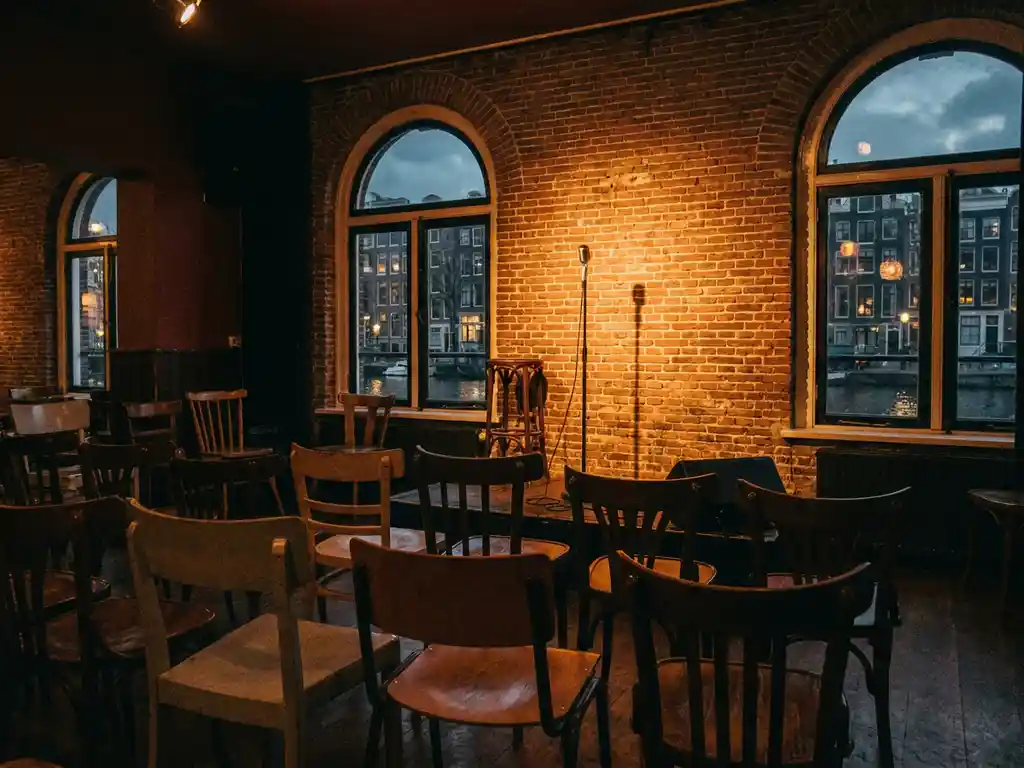
Amsterdam’s comedy scene is different from anywhere else because it grew up bilingual, multicultural, and radically honest from the start. Unlike London or New York, where comedy scenes evolved within a single dominant culture and language, Amsterdam built its comedic identity at the crossroads of dozens of nationalities, a deeply ironic Dutch sensibility, and the practical necessity of performing in English. The result is a comedy culture that is sharper, stranger, and more self-aware than most cities its size. Below, we unpack exactly what makes it tick.
Why does Amsterdam produce such a distinctive style of comedy?
Amsterdam produces a distinctive style of comedy because the city itself is a pressure cooker of contradictions: liberal but rule-bound, tolerant but blunt, internationally minded but fiercely local. Dutch culture has a deeply embedded tradition of directness and self-deprecation, and when you layer decades of international immigration and a thriving expat scene on top of that, you get comedy that cuts to the bone without apology.
The Dutch word nuchterheid roughly translates as sober-mindedness or no-nonsense practicality, and it shapes Dutch humour profoundly. There is very little reverence for status, very little patience for pretension, and a strong cultural permission to say the uncomfortable thing out loud. For comedians, that is an extraordinary environment to work in. Audiences are not easily offended, but they are also not easily impressed. You have to earn the laugh with something real.
Add to that the sheer density of perspectives living within a city of fewer than a million people, and you have a comedy scene that is constantly stress-tested by an audience that has seen and heard almost everything.
How did improv theatre take root in Amsterdam?
Improv theatre took root in Amsterdam in 1993 when Boom Chicago opened its doors, bringing the Chicago-style long-form improv tradition to a city that had no existing framework for it. Before that, improvisation as a theatrical form was almost entirely unknown in the Netherlands. Within a few years, it had become a fixture of Amsterdam’s cultural life and a genuine influence on Dutch performance culture more broadly.
The timing mattered. Amsterdam in the early 1990s was in the middle of a creative and economic reinvention. The city was becoming more international, more entrepreneurial, and more open to cultural imports, particularly from the United States. A comedy theatre that performed entirely in English, used audience suggestions to build scenes from scratch, and refused to take itself too seriously landed in exactly the right place at exactly the right moment.
What made the roots go deep rather than shallow was the local talent that grew around the form. Dutch performers, writers, and directors engaged with improv and made it their own. Today, improv workshops, corporate training programmes rooted in improv principles, and a generation of Dutch performers who grew up watching and doing it have made the form genuinely native to Amsterdam rather than a permanent American import.
What role does the English language play in Amsterdam’s comedy?
English plays a central and structurally unique role in Amsterdam’s comedy scene. Because so much of the city’s population either speaks English as a first language or as a strong second language, English-language comedy has a genuine, large, and permanent audience here in a way that simply does not exist in most non-Anglophone cities.
In most European cities, performing comedy in English is a niche act aimed at tourists passing through. In Amsterdam, English-language comedy reaches residents: expats who have lived here for decades, Dutch people who consume English-language media as naturally as Dutch, and international students and professionals who make up a significant share of the city’s population. That changes the dynamic entirely. Comedians can build a real following, develop long-running shows, and grow artistically rather than just cycling through tourist-friendly material.
There is also something genuinely funny about the collision of languages in Amsterdam. Dutch is a language full of sounds and constructions that strike English speakers as inherently comic, and the Dutch relationship with English, enthusiastic, confident, and occasionally spectacular in its errors, gives local comedians rich material that performers in London or New York simply do not have access to.
How does Amsterdam’s comedy scene compare to London and New York?
Amsterdam’s comedy scene is smaller than London or New York but punches well above its weight in terms of originality and intimacy. London and New York have massive, competitive comedy ecosystems with hundreds of venues, thousands of performers, and highly stratified hierarchies from open mic nights to arena tours. Amsterdam operates on a different scale, which creates both limitations and genuine advantages.
What Amsterdam lacks compared to London and New York
The sheer volume of comedy output in London and New York means those cities generate more raw talent, more stylistic diversity, and more commercial infrastructure. There are more agents, more broadcasters commissioning comedy, and more pathways from unknown performer to recognisable name. Amsterdam cannot compete with that pipeline.
What Amsterdam does better
What Amsterdam offers instead is proximity and creative freedom. Shows happen in small venues where the audience is close enough to feel the room shift in real time. There is far less of the grinding open-mic circuit culture that can make London and New York feel brutal and transactional. Performers in Amsterdam often develop their craft in longer-form, more collaborative environments, which tends to produce comedians who are strong on character, story, and ensemble work rather than purely on punchline delivery.
Amsterdam also benefits from its multicultural audience in a way that is different from London or New York. Those cities have diverse audiences too, but their comedy scenes still have dominant cultural centres of gravity. Amsterdam’s comedy scene, particularly its English-language wing, has always been genuinely multinational at its core, which pushes performers toward universality and away from the kind of hyper-local references that can make comedy land brilliantly at home and die completely everywhere else.
What makes Amsterdam audiences different from other comedy crowds?
Amsterdam audiences are unusually direct, unusually international, and unusually hard to fool. Dutch cultural norms around honesty mean that audiences will not politely laugh at something they do not find funny, which sounds brutal but is actually a gift for comedians who want real feedback. If a joke lands in Amsterdam, it genuinely landed.
The international mix in the room also creates a particular dynamic. On any given night at an Amsterdam comedy show, the audience might include Dutch locals, British expats, American students, French professionals, and visitors from a dozen other countries. That forces comedians to find material that travels across cultural references rather than leaning on shared national shorthand. The jokes that work in that room tend to be about human behaviour, power, absurdity, and the specific comedy of Amsterdam itself, rather than topical references that only land for one demographic.
There is also a sophistication that comes from years of exposure. Amsterdam audiences, particularly those who have been attending English-language comedy for a decade or more, know the form well. They recognise lazy callbacks, they spot when a performer is recycling material, and they reward genuine risk-taking in a way that keeps the scene honest.
Where can you actually experience Amsterdam’s comedy scene?
The best place to experience Amsterdam’s comedy scene, and the venue most central to its history, is Boom Chicago, which has been running English-language improv and sketch comedy in the city since 1993. Shows run regularly throughout the year, ranging from long-form improv nights to fully produced sketch shows, and the venue itself, currently located in the Rozentheater, is part of the experience.
Beyond Boom Chicago, Amsterdam has a growing number of comedy nights scattered across the city’s smaller venues, bars, and cultural centres. English-language stand-up nights pop up regularly, particularly in areas like the Jordaan and De Pijp. The comedy scene here is less formalised than in London, which means you sometimes have to look for it, but the reward is stumbling into something genuinely surprising in an intimate setting.
For visitors looking for best English shows Amsterdam has to offer, the combination of a ticketed Boom Chicago show and one of the smaller neighbourhood comedy nights gives you both the polished end of the spectrum and the raw, unpredictable end. That contrast is, in many ways, the Amsterdam comedy experience in miniature.
How Klagen Niet Klagen helps you find the best of Amsterdam’s comedy scene
Finding your way into Amsterdam’s comedy scene, past the tourist-facing surface and into the stuff that locals actually care about, takes the kind of insider knowledge that no travel guide provides. That is exactly what Klagen Niet Klagen exists to offer. Written from over three decades of lived Amsterdam experience, the blog gives you honest, opinionated, and genuinely useful guidance on the city’s cultural life, including its comedy scene.
- Long-form essays on Amsterdam’s cultural identity, written by someone who has been part of shaping it
- Honest takes on what is worth your time and what is not, free from tourism-board influence or advertorial pressure
- An insider perspective on the city’s creative and comedy scene that goes well beyond surface-level recommendations
- Content that works whether you live here, visit regularly, or are planning your first serious trip to Amsterdam
If you want to understand Amsterdam rather than just visit it, the Klagen Niet Klagen blog archive is the place to start. Read it before you book your tickets, and you will arrive knowing what you are actually looking for.
And speaking of tickets: if this article has made you curious about what Amsterdam’s comedy scene actually feels like from the inside, the most direct answer is to come and see a show at Boom Chicago. After more than thirty years, it remains the heartbeat of English-language comedy in this city, and no amount of reading quite prepares you for the experience of watching a genuinely great improv ensemble build something hilarious from nothing, live, in a room full of people from everywhere. Check the current shows and agenda, or get in touch if you have questions. You will not regret it.
Frequently Asked Questions
I'm visiting Amsterdam for just a few days — is it worth planning my itinerary around a comedy show?
Absolutely, and it’s worth prioritising over many of the more obvious tourist attractions. A night at Boom Chicago, for example, gives you a genuine window into Amsterdam’s cultural identity — the humour, the directness, the multinational energy — in a way that a canal cruise or a museum visit simply cannot. Book tickets in advance, particularly for weekend shows, as they sell out regularly. Pair it with a drink at a neighbourhood bar in the Jordaan or De Pijp beforehand and you have an evening that feels authentically Amsterdam rather than tourist-packaged.
Are there comedy shows in Amsterdam that are suitable for non-native English speakers?
Yes, and this is one of the things that makes Amsterdam’s comedy scene genuinely unusual. Because the scene has always catered to a multinational audience — including Dutch locals who speak English as a strong second language — performers are skilled at avoiding hyper-idiomatic language and overly culture-specific references. Improv shows in particular tend to be very accessible because so much of the comedy is physical, situational, and built in real time from audience suggestions. If your English is conversational, you will follow and enjoy the vast majority of what’s on offer.
What's the best way to stay up to date with what's happening in Amsterdam's comedy scene?
The most reliable approach is a combination of checking venue websites directly — Boom Chicago publishes its full schedule at boomchicago.nl — and following local cultural blogs like Klagen Niet Klagen, which covers Amsterdam’s comedy and cultural scene with the kind of editorial depth and honesty that event listing sites don’t provide. Amsterdam’s smaller comedy nights are less formally advertised, so local knowledge genuinely matters here; a well-curated blog or a trusted local contact will surface things that a Google search simply won’t.