
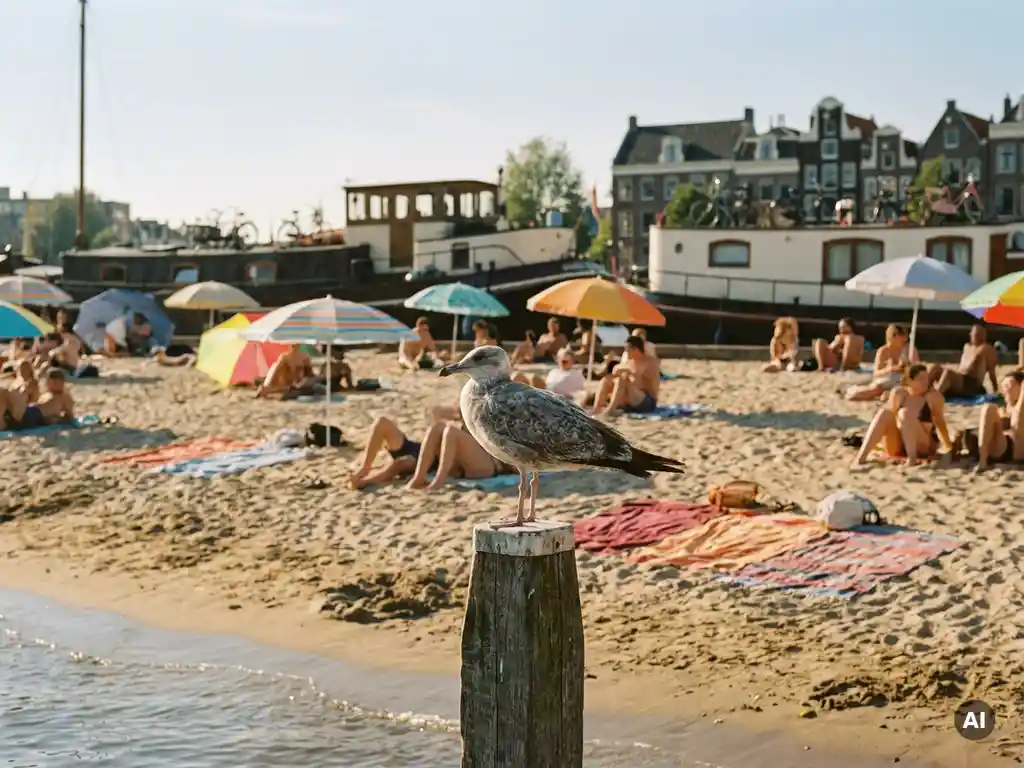
Amsterdam’s city beaches do attract tourists, but they are far less overwhelmed than the city centre. Most of the people you will find cooling off at spots like Blijburg or Sloterplas are locals — families, students, and regulars who treat these beaches as neighbourhood escapes rather than sightseeing destinations. That distinction matters enormously when you are trying to find a genuine slice of Amsterdam life in summer. Below, this article unpacks which beaches get busy, who actually shows up, when to go, and how the beach scene stacks up against Amsterdam’s more notorious tourist magnets.
Which city beaches in Amsterdam actually get crowded?
The city beach in Amsterdam that draws the biggest crowds is Blijburg aan Zee on the eastern IJburg island. On a hot summer weekend it fills up fast, though “crowded” here means a lively local scene rather than shoulder-to-shoulder tourism. Sloterplas in the west and the Gaasperplas in the southeast stay noticeably quieter, even on the hottest days of the year.
Blijburg has the most going for it in terms of atmosphere: a beach bar, regular events, and a genuinely creative, laid-back crowd. That combination pulls people in. But even at its busiest, the vibe is more neighbourhood festival than tourist trap. The beaches further from the city centre simply require more effort to reach, which filters out anyone who is not genuinely motivated to be there.
Sloterplas is the city’s largest recreational lake and has proper sandy stretches, but it sits in a residential area that most visitors never think to explore. The Gaasperplas, tucked into Amsterdam Zuidoost near Amstel Park, is even more off the radar. Both are worth knowing about if your priority is space and calm over atmosphere.
Are Amsterdam’s city beaches full of tourists or mostly locals?
Amsterdam’s city beaches are overwhelmingly populated by locals. Unlike the Rijksmuseum, the Anne Frank House, or the Red Light District, these spots are not on the standard tourist itinerary. The people you encounter at a city beach on an Amsterdam summer afternoon are mostly residents who live nearby, cycling over with a bag and a towel rather than consulting a guidebook.
This is one of the genuinely pleasant surprises Amsterdam offers once you get past the tourist infrastructure. The city beaches function as real community spaces. You will hear Dutch spoken, see families with children, groups of friends who clearly know each other, and regulars who have claimed the same patch of sand for years. Tourists who do find their way to Blijburg tend to be the curious, independent type who have already spent a few days in Amsterdam and want something more authentic.
That local-to-tourist ratio is part of what makes these spots worth visiting. You are not paying to experience a curated version of Amsterdam life. You are simply showing up to where Amsterdammers actually go when the sun comes out.
When is the best time to visit Amsterdam’s city beaches without the crowds?
The best time to visit a city beach in Amsterdam without crowds is on a weekday morning, ideally before noon. Summer weekends in July and August fill up quickly once the temperature climbs above 25 degrees. Arriving early on a Saturday is manageable, but Sunday afternoons at Blijburg in particular can feel genuinely packed by local standards.
Weekday afternoons during the school summer holidays are a middle ground. Families are present, but the working crowd has not yet arrived, and the atmosphere stays relaxed. If you are visiting in June or early September, you get the benefit of warm-enough weather with significantly fewer people at every Amsterdam city beach.
Late afternoon on any day tends to bring a second wave of visitors after work, especially at Blijburg where the beach bar draws an after-office crowd. If you want the water and the sun without the social noise, aim for 9 am to noon on any weekday. That window reliably delivers the quietest experience across all of Amsterdam’s city beaches.
How do Amsterdam’s city beaches compare to other Amsterdam tourist hotspots?
Amsterdam’s city beaches are dramatically less crowded than the city’s main tourist hotspots. The Rijksmuseum, the Van Gogh Museum, and the Anne Frank House each draw millions of visitors per year and require advance booking. The city beaches require nothing — no ticket, no queue, no reservation. They operate on an entirely different scale and with an entirely different energy.
The contrast in atmosphere is just as significant as the contrast in crowd levels. The tourist hotspots of central Amsterdam are transactional spaces: you arrive, you experience the attraction, you leave. A city beach is the opposite. People stay for hours, bring their own food, swim, read, and talk. Time moves differently there.
For anyone spending more than a couple of days in Amsterdam during summer, the city beaches offer something the museum circuit cannot: the feeling of actually being inside the city rather than observing it. They are not a substitute for the cultural landmarks, but they are a genuinely worthwhile addition to any visit. And unlike almost everything else worth doing in Amsterdam in summer, they are free.
How Klagen Niet Klagen helps you find the real Amsterdam
Finding the honest, local version of Amsterdam takes more than a quick Google search. That is exactly what Klagen Niet Klagen exists for. Written by Andrew Moskos, co-founder of Boom Chicago, this blog delivers the kind of insider perspective on Amsterdam city life that no tourism board would ever publish.
- Honest takes on where locals actually go versus where tourists are directed
- Long-form essays on Amsterdam culture, contradictions, and seasonal rhythms
- Commentary written from over three decades of living and building something real in this city
- No advertorial pressure, no sponsored content, no polished PR spin
If you want to keep reading about the Amsterdam that Amsterdammers actually experience, find out more about the blog or browse more articles. And if you have a question or want to get in touch directly, the contact page is right there.
While you are in Amsterdam this summer, do yourself a favour and check what is on at Boom Chicago. After a day at the beach, an evening of sharp, funny, live comedy is about as good as Amsterdam gets. The shows are in English, the crowd is always a brilliant mix of locals and internationals, and the energy in the room is something a city beach cannot quite replicate. Have a look at the shows and agenda and see what is coming up.
Frequently Asked Questions
Can you swim safely in Amsterdam's city beach lakes, and are there lifeguards on duty?
Yes, swimming is generally safe at Amsterdam’s designated city beaches — Blijburg, Sloterplas, and Gaasperplas all have monitored swimming zones during summer. Water quality is regularly tested by the municipality and results are publicly available, though after heavy rainfall it is worth checking before you go. Lifeguards are present at the busiest spots during peak season, but coverage varies by location and time of day, so it is always wise to swim within the designated areas.
Do I need to bring everything myself, or are there facilities and food options at the beaches?
It depends on which beach you visit. Blijburg is the best-equipped, with a proper beach bar serving food and drinks, sun lounger rentals, and toilet facilities on site — you can arrive with nothing and still have a full day. Sloterplas and Gaasperplas are more self-sufficient affairs, with basic facilities but limited food options, so bringing your own picnic is the smarter move. Packing a bag with snacks, sunscreen, and a towel is standard practice for locals regardless of which beach they head to.
How do I actually get to Blijburg and the other city beaches without a car?
Blijburg is the easiest to reach by public transport — tram line 26 from Amsterdam Centraal takes you directly to IJburg in around 20 minutes, and the beach is a short walk from the stop. Sloterplas is accessible by tram and metro from the city centre in roughly the same time, while Gaasperplas is best reached via metro line 54 to Gaasperplas station. Cycling is also a perfectly realistic option for all three, and very much the local way to do it — the routes are flat, well-signed, and take 30 to 45 minutes from most central neighbourhoods.