
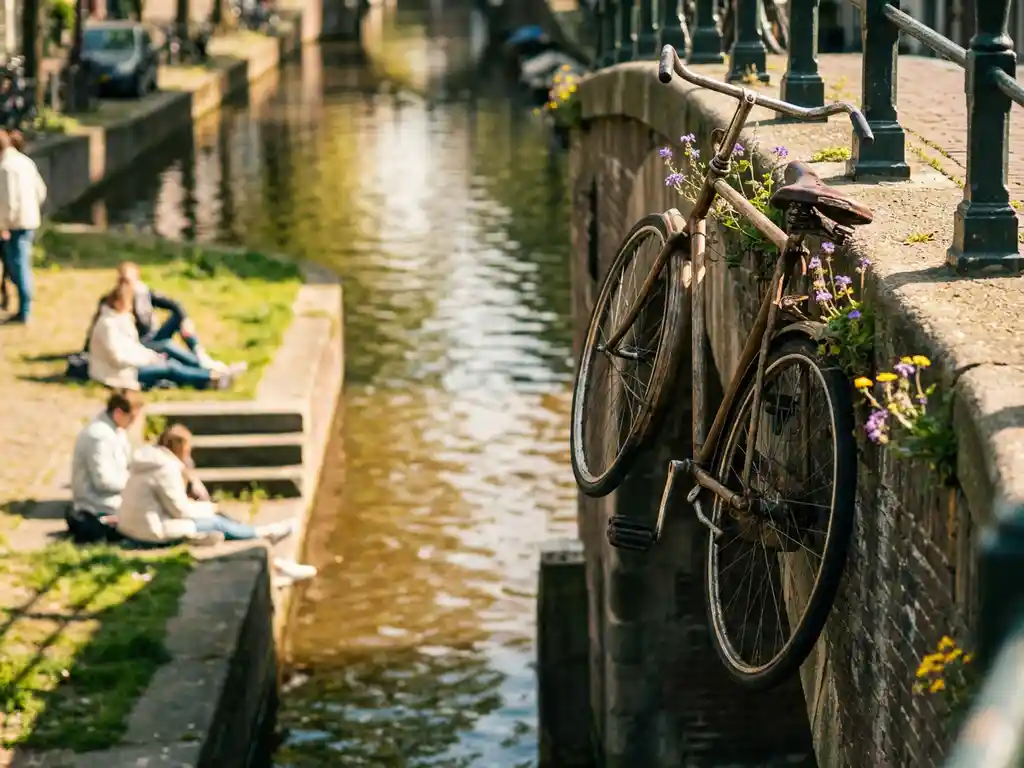
Amsterdam is genuinely one of the most generous cities in Europe when it comes to free experiences. You can fill an entire weekend without spending a cent on entry fees — from world-class art to canal-side wandering, neighbourhood markets to open-air concerts. The key is knowing where to look and when to show up. Below, every question a first-timer or long-term resident might ask gets a straight answer.
Which Amsterdam neighbourhoods are worth exploring for free?
The Jordaan, De Pijp, and the Plantage are the three neighbourhoods that reward aimless wandering most generously. Each has its own visual character, its own rhythm, and its own collection of free discoveries — from hidden courtyards to street art to canal views that no postcard fully captures.
The Jordaan is the obvious starting point. Its 17th-century canal houses, narrow alleyways, and small brown cafes make it one of the most photogenic neighbourhoods in any European city. Walk the Prinsengracht on a Saturday morning and you will pass antique dealers, flower sellers, and at least one accordion player who takes the whole thing completely seriously. The neighbourhood also contains the Begijnhof, a medieval courtyard that is free to enter and genuinely peaceful despite being minutes from the tourist centre.
De Pijp has a different energy — younger, more international, more caffeinated. The Albert Cuyp Market runs Monday through Saturday and is free to browse. It is one of the longest outdoor markets in Europe and sells everything from stroopwafels to fabric to questionable vintage electronics. Even if you buy nothing, walking its length gives you a reliable cross-section of who actually lives in Amsterdam.
The Plantage neighbourhood around Artis Zoo and the Hortus Botanicus is often overlooked by visitors. The streets are quieter, the architecture is grander, and the Wertheimpark — a small, leafy square with a striking Holocaust memorial — is one of the most moving free spaces in the city.
What free museums and galleries can you visit in Amsterdam?
Several excellent museums and galleries in Amsterdam are either permanently free or free on specific days. The Stedelijk Museum offers free entry to its permanent collection on certain evenings, and the Amsterdam Museum Noord has free admission. The Moco Museum is not free, but the Foam Photography Museum occasionally hosts free open evenings worth checking in advance.
The best consistently free cultural space in Amsterdam is the Rijksmuseum Gardens. The gardens surrounding the main building are open to the public at no charge and contain sculptures, fountains, and one of the most satisfying views of the museum’s rear facade. It is also a reliable shortcut between the Museumplein and the Vondelpark, which makes it easy to combine with a longer walk.
The EYE Film Museum in Amsterdam Noord is free to enter the building itself — the permanent exhibition and cinema programmes cost money, but the ground floor lounge, the terrace, and the view across the IJ waterway are all available without a ticket. Taking the free ferry from behind Centraal Station and arriving at EYE on foot is one of the better free experiences the city offers.
Smaller commercial galleries in the Jordaan and on Keizersgracht regularly host free openings and exhibitions. These are not curated tourist experiences — they are actual gallery shows, and the quality varies enormously. That unpredictability is part of the appeal.
Where can you find free events in Amsterdam this weekend?
The best sources for free Amsterdam events are the I Amsterdam events calendar, the Uitkrant (a free monthly culture magazine available in libraries and community centres), and local neighbourhood Facebook groups and WhatsApp communities. In 2026, a number of recurring free events have become reliable fixtures on the Amsterdam weekend calendar.
Vondelpark Open Air Theatre runs from spring through early autumn and hosts free concerts, theatre performances, and children’s shows on weekends. The programme changes each season but the principle stays the same: show up, find a spot on the grass, and watch a live performance without paying anything. Arrive early on sunny weekends — the good spots go quickly and the Dutch take their picnic blankets seriously.
The Waterlooplein flea market runs Tuesday through Saturday and is free to browse. It is not as curated as the Albert Cuyp, but it has more character — secondhand books, vinyl records, old Dutch ceramics, and occasional genuine surprises. The Noordermarkt on Saturday mornings combines a farmers market with an antique and secondhand clothing market, and both are free to walk through.
Many of Amsterdam’s cultural institutions also host free lectures, film screenings, and community events that never make it onto the major tourism platforms. The Tolhuistuin in Noord, the OBA (public library) on Oosterdok, and various community centres in the Bijlmer and Bos en Lommer run regular free programming that reflects the city’s actual cultural life rather than its curated tourist face.
Are Amsterdam’s parks actually worth visiting on a weekend?
Yes — Amsterdam’s parks are genuinely excellent weekend destinations, not just pleasant green spaces to pass through. The Vondelpark, Amsterdamse Bos, and Westerpark each offer a distinct experience, and all three are free. On a good weekend, they function as the city’s living room: social, active, and surprisingly well used by actual Amsterdammers.
The Vondelpark is the most central and the most visited, which means it can feel crowded on warm Saturdays. It is still worth it. The park has a strong social atmosphere — inline skaters, dog walkers, families, and groups of friends spread across the lawns in a way that feels genuinely communal rather than performative. The rose garden near the main entrance is one of those Amsterdam details that rewards slowing down.
The Amsterdamse Bos is the better choice if you want space. It covers roughly 1,000 hectares south of the city and contains forests, meadows, a rowing lake, and a goat farm that is free to visit. It takes about 20 minutes by bike from the Rijksmuseum and feels nothing like the urban centre. Cycling through it on a Sunday morning, with almost no one else around, is one of those Amsterdam experiences that long-term residents mention when they explain why they still live here.
Westerpark is smaller and more neighbourhood-focused, but it sits next to the Westergasfabriek cultural complex and regularly hosts free outdoor events, food markets, and film screenings. It is also one of the better parks for watching Amsterdam’s creative class in its natural habitat.
What free waterfront and harbour experiences does Amsterdam offer?
Amsterdam’s waterfront is one of its most underused free assets. The IJ waterway, the Eastern Docklands, and the NDSM Wharf in Noord all offer compelling free experiences — from industrial architecture to street art to some of the best views of the city skyline available without paying for a boat tour.
The free GVB ferries that run from behind Centraal Station to Amsterdam Noord are worth taking purely as a waterfront experience. The crossing takes around five minutes and gives you a direct view of the city from the water. The ferry to NDSM Wharf takes slightly longer and drops you at one of Amsterdam’s most interesting free destinations: a former shipyard turned creative hub with large-scale street art, independent studios, and a flea market on weekend mornings.
The Eastern Docklands neighbourhood — Java Island, KNSM Island, and Borneo Island — is a free architecture walk that most visitors never take. These artificial islands were developed in the 1990s and contain some of the most ambitious residential architecture in the Netherlands. Walking between them takes about an hour and passes buildings that were genuinely experimental for their time. The waterfront views back towards the city centre are excellent.
The Scheepvaartmuseum (Maritime Museum) has a free outdoor area with historic vessels moored alongside it. You do not need to pay for the museum to walk the waterfront, read the information panels, and get a sense of Amsterdam’s relationship with the sea that shaped everything about it.
How do you avoid the crowds when doing free things in Amsterdam?
The single most effective strategy for avoiding Amsterdam’s weekend crowds is timing: go early or go late. Most tourists operate on a late-morning to mid-afternoon schedule. If you are at the Jordaan by 8:30am or at the Albert Cuyp Market in its final hour, you will experience a version of Amsterdam that feels nothing like the midday rush.
Neighbourhood choice matters as much as timing. The areas that attract the most foot traffic — the Nine Streets, the Leidseplein, the Museumplein on sunny days — are genuinely crowded on weekends. Moving one or two neighbourhoods away from the tourist centre changes the experience dramatically. Oud-West, the Staatsliedenbuurt, or the streets around the Dappermarkt in Oost are all within cycling distance of the centre and operate at a completely different pace.
Cycling is also a crowd-avoidance tool in itself. Amsterdam’s bike routes let you move through the city at a speed that makes the tourist clusters feel brief and navigable rather than overwhelming. Renting a bike and following the canal ring outward from the centre — rather than moving along it — takes you into residential Amsterdam quickly. The further you get from the canal belt, the more the city starts to feel like it belongs to the people who actually live in it.
Finally, weekday mornings are the real answer if your schedule allows. Amsterdam’s free spaces — the parks, the markets, the waterfront, the neighbourhood streets — are at their best between Tuesday and Thursday before noon. The city has not yet filled up, the light is often better, and you are far more likely to have a genuine encounter with the place rather than a managed experience of it.
How Klagen Niet Klagen helps you get more from Amsterdam for free
Finding genuinely good free things to do in Amsterdam is harder than it sounds. The tourist platforms are full of the same recycled suggestions, the Dutch-language press is inaccessible to most international visitors and expats, and the gap between what Amsterdam offers and what most people actually find is surprisingly wide. Klagen Niet Klagen exists to close that gap.
- Honest, insider commentary on Amsterdam neighbourhoods, events, and experiences — written by someone who has lived and worked here for over three decades
- No tourism-board influence, no advertorial pressure, no polished promotional content — just a real point of view on what is worth your time
- Long-form essays and guides that go beyond surface-level suggestions and explain the cultural and social context that makes Amsterdam actually interesting
- A consistent editorial voice that treats readers as intelligent adults who want nuance, not a listicle
If you want to keep finding Amsterdam experiences that feel genuinely worth your time, the full blog archive is the best place to start. And if you want the short version of what this city is actually like, the Klagen Niet Klagen homepage gives you a clear picture of what the blog is and why it exists.
Of course, not everything worth doing in Amsterdam is free. Some of the best evenings this city produces happen at Boom Chicago — the comedy and improv theatre that has been making Amsterdam laugh since 1993. If you have never been, or if it has been a while, check the current shows and agenda. It is the kind of night out that reminds you why Amsterdam is one of the most creatively alive cities in the world — and that some things are absolutely worth paying for.
Frequently Asked Questions
Is it worth getting an I Amsterdam City Card if I'm mainly interested in free activities?
If your itinerary is built primarily around free experiences — parks, markets, neighbourhoods, and the waterfront — the I Amsterdam City Card is unlikely to pay for itself. It makes more financial sense for visitors who plan to visit several paid museums in quick succession. A better approach is to use the free ferry, the Rijksmuseum Gardens, and the open cultural spaces described in this post as your backbone, then selectively pay for one or two standout paid experiences like Boom Chicago that genuinely justify the cost.
What's the best way to get around Amsterdam when doing free things on a budget?
Renting a bike is the single best transport decision you can make for a budget-focused Amsterdam visit. Day rentals typically cost €10–€15 and give you the freedom to move between neighbourhoods, parks, and waterfronts at your own pace — without paying for trams or taxis between stops. The free GVB ferries from behind Centraal Station are the only exception worth noting: they are genuinely free, run frequently, and open up Amsterdam Noord, NDSM Wharf, and the EYE Film Museum without any additional cost.
Are there any common mistakes first-time visitors make when trying to experience Amsterdam for free?
The most common mistake is staying too close to the tourist centre and assuming that what you see there represents the full city. The Leidseplein and Damrak areas are heavily commercialised, and the free experiences within them are thin. A second mistake is visiting on Sunday afternoon, which is when Amsterdam’s parks and markets are at their most crowded. Arriving early, cycling outward from the canal belt, and checking neighbourhood-specific sources like the Uitkrant rather than generic tourism platforms will consistently produce better results.