
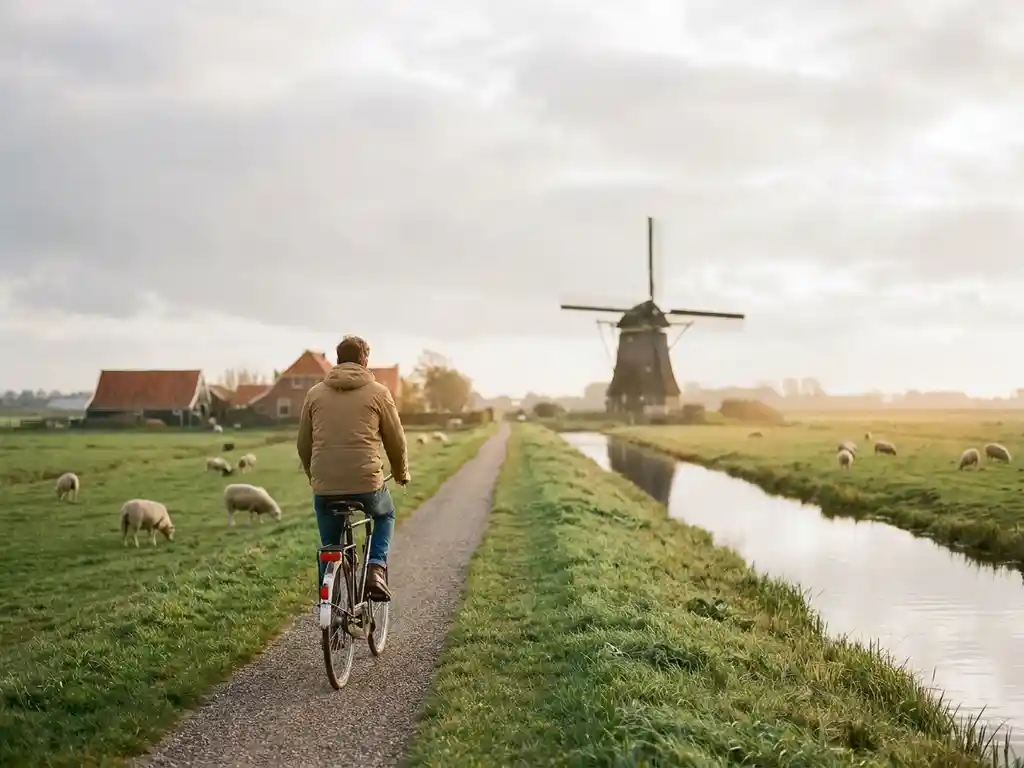
The best Amsterdam bike routes outside the city center take you into the polders, along the Amstel River, through the Waterland region to the north, and out toward the flower fields and windmills of the Haarlemmermeer. These routes start within minutes of leaving the ring road and deliver an almost instant shift from urban density to open Dutch countryside. This article answers the most common questions about cycling beyond Amsterdam’s crowded center.
Which Amsterdam neighborhoods make the best starting points for rides?
The best neighborhoods to start a ride out of Amsterdam are Amsterdam-Noord, De Pijp, and the eastern harbor district. Noord gives you immediate access to the Waterland region via the free ferry from Centraal Station. De Pijp puts you on the Amstel within ten minutes. The eastern docks connect directly to the IJmeer and the quieter IJburg routes heading east.
Noord is arguably the strongest choice for escaping the city quickly. Once you roll off the Buiksloterweg ferry, the tourist density drops almost immediately. Within five minutes of cycling, you are passing community gardens and small industrial workshops rather than souvenir shops. The roads north toward Durgerdam and Ransdorp are flat, well-surfaced, and almost entirely free of cars.
If you live in or near De Pijp, the Amstel route is your natural corridor. The river path heading south through Amstelveen and beyond is one of the most underused cycling routes in the greater Amsterdam area. It is scenic, logical, and easy to navigate without a map. Starting from the eastern harbor district, the IJmeer coastal path heading toward Muiden offers a different kind of Dutch landscape: wide water, open sky, and the occasional medieval fortress appearing on the horizon.
What are the most scenic cycling routes just outside Amsterdam?
The most scenic cycling routes just outside Amsterdam are the Waterland route to the north, the Amstel River route to the south, and the coastal IJmeer path heading east toward Muiden. Each offers a distinctly different Dutch landscape within thirty minutes of the city center, ranging from polder villages and wooden churches to open riverbanks and medieval fortifications.
The Waterland route is the classic choice, and it earns that reputation. The villages of Durgerdam, Ransdorp, Holysloot, and Zunderdorp sit in a landscape that looks almost unchanged from seventeenth-century Dutch paintings. The roads are narrow, the houses are wooden, and the horizon is enormous. It is genuinely one of the most beautiful short cycling routes in the Netherlands, and it begins less than two kilometers from Amsterdam Centraal.
The Amstel route heading south is slower to reveal itself but deeply satisfying. The river widens as you leave the city, and the banks become more rural with every kilometer. Ouderkerk aan de Amstel, about twelve kilometers from De Pijp, is a natural stopping point with a historic character that feels entirely removed from the city. The path continues further south through open polder country if you want to keep going.
The IJmeer coastal route east is less well-known among visitors but genuinely worth the detour. The path hugs the shoreline, passes through IJburg, and eventually reaches Muiden, where the sixteenth-century Muiderslot castle sits at the mouth of the Vecht River. It is one of the better-preserved medieval castles in the Netherlands and makes for an excellent cycling destination.
How far do you need to ride to escape Amsterdam’s tourist crowds?
You need to ride roughly five to ten kilometers from Amsterdam’s historic center to leave the tourist crowds behind. In most directions, that is between fifteen and thirty minutes of easy cycling. The density of visitors drops sharply once you cross the ring road, and in some directions, particularly north into Waterland, the shift happens even faster.
The tourist footprint in Amsterdam is heavily concentrated in a relatively small area: the canal ring, the museum quarter, and the main market streets. That concentration works in the cyclist’s favor. You do not need to travel far to find roads where the only other people are locals going about their day.
Heading north via the ferry is the fastest escape. Within ten minutes of leaving the Buiksloterweg ferry terminal, you are in a landscape that most Amsterdam visitors never see at all. Heading south along the Amstel, the crowds thin out around Amstelveen. Heading east along the IJmeer, the tourist trail effectively ends at IJburg. In all three directions, a half-hour ride is more than enough to put genuine distance between yourself and the Heineken Experience.
What’s the difference between cycling in the polders versus along the Amstel?
Cycling in the polders means riding through open, flat agricultural land that sits below sea level, often with long straight paths, wide skies, and almost no shelter from the wind. Cycling along the Amstel means following a river corridor with more visual variety, riverside cafes, and a more gradual transition from urban to rural. The polder experience is more elemental; the Amstel route is more sociable.
Cycling in the polders
The polder landscape north of Amsterdam, particularly in the Waterland region, is one of the most distinctively Dutch environments you can cycle through. The land is reclaimed from water, the roads run along the tops of dikes, and the views extend to the horizon in every direction. It is beautiful, but it is also exposed. On a windy day, polder cycling can be genuinely hard work in one direction and effortlessly fast in the other. The villages are small, services are limited, and the experience rewards those who enjoy solitude and landscape over convenience.
Cycling along the Amstel
The Amstel route offers a more varied experience. The river path winds rather than runs straight, and the landscape changes more gradually. You pass houseboats, rowing clubs, riverside restaurants, and the occasional working farm. The wind is less of a factor because the river corridor provides some natural shelter. It is a more forgiving route for casual riders and a better choice if you want to stop frequently or ride with mixed-ability company. The trade-off is that it feels less wild and more managed than the open polder country to the north.
Where can you stop for food and drink on rides outside the center?
The best stopping points for food and drink on rides outside Amsterdam are Ouderkerk aan de Amstel on the southern Amstel route, the village of Durgerdam on the Waterland route, and the harbor area of Muiden on the eastern IJmeer path. Each offers at least one genuinely good cafe or restaurant within easy reach of the cycling path, without requiring a significant detour.
Ouderkerk aan de Amstel is the most reliably rewarding stop. The village has a small cluster of cafes and restaurants along the river, a historic Jewish cemetery worth visiting, and the kind of quiet, unhurried atmosphere that makes a cycling lunch feel earned rather than rushed. It sits about twelve kilometers from the city center, which makes it a natural halfway point for a longer ride.
Durgerdam, on the northern Waterland route, is smaller and quieter. The village has a handful of options, and the setting on the IJmeer is genuinely beautiful. It is not a destination for a long lunch, but it is a perfect place to stop for coffee and a view before continuing further into the polder landscape.
Muiden, at the eastern end of the IJmeer route, has several good options near the castle and the harbor. It is a slightly longer ride from the city center, around twenty-five to thirty kilometers depending on your starting point, which makes it better suited to a full-day excursion than a quick spin.
Should you rent a bike or use your own for longer Amsterdam rides?
For longer rides outside Amsterdam’s center, using your own bike is almost always better than renting. Rental bikes in Amsterdam are built for short urban trips: heavy, upright, and limited to a handful of gears. They work well for navigating the canals but become tiring quickly on routes of fifteen kilometers or more. If you have access to your own bike, bring it.
That said, if you are visiting Amsterdam without a bike, renting is perfectly viable for the shorter routes. The Waterland loop, for example, is entirely manageable on a standard Dutch rental bike because the terrain is flat and the distances are moderate. The key is managing your expectations: a rental bike will get you there, but it will not make the ride effortless.
If you want a longer or more ambitious route and do not have your own bike, look at specialist rental shops rather than the large tourist-facing rental companies near Centraal Station. Several shops in Amsterdam rent better-quality city bikes and hybrid bikes that are more suited to half-day and full-day excursions. Electric bikes are also worth considering if you plan to cover significant distance or are riding into a headwind across open polder country.
One practical note: whatever bike you use, bring a good lock. Bike theft is a genuine reality in Amsterdam, and leaving a rental bike unlocked outside a polder village cafe is not a risk worth taking.
How Klagen Niet Klagen helps you discover Amsterdam beyond the obvious
Amsterdam’s best cycling routes are just one layer of a city that rewards the curious and frustrates the passive. Klagen Niet Klagen exists precisely for people who want to go deeper: past the tourist trails, past the polished travel guides, and into the honest, sometimes contradictory, always interesting reality of what Amsterdam actually is.
- Long-form essays on Amsterdam neighborhoods, culture, and city life written from three decades of lived experience
- Honest opinions on what is genuinely worth your time in Amsterdam and what is overrated
- An insider perspective on Dutch culture, social dynamics, and the unspoken rules that visitors and expats rarely find explained in plain English
- Regular new content covering the full range of Amsterdam experiences, from cycling routes to cultural commentary
If you found this useful, there is plenty more where it came from. Browse the full blog archive for more Amsterdam guides and essays, or head to the Klagen Niet Klagen homepage to get a sense of what the blog is about.
And if you are spending time in Amsterdam, do yourself a favour and add Boom Chicago to your itinerary. The comedy shows are sharp, fast, and genuinely funny in a way that has nothing to do with tourist-friendly entertainment. Boom Chicago has been making Amsterdam audiences laugh since 1993, and the shows reward exactly the kind of curious, engaged visitor who ends up cycling to Ouderkerk on a Tuesday morning. Check the current shows and agenda to see what is on, or get in touch if you have questions.
Frequently Asked Questions
Can I combine multiple routes into a single day ride from Amsterdam?
Yes, and it is one of the best ways to experience the variety of landscapes around the city. A popular combination is taking the ferry to Noord, riding the Waterland loop through Durgerdam and Ransdorp, then looping back via the IJmeer coastal path toward Muiden before returning to the city. Depending on your pace and how long you linger at stops, this kind of combined route typically runs between 50 and 70 kilometers and suits riders who are comfortable on a bike for four to six hours. Plan your stopping points in advance, since services in the polder sections are sparse.
What are the most common mistakes cyclists make when riding outside Amsterdam for the first time?
The most common mistake is underestimating the wind. The open polder landscape offers almost no shelter, and a headwind that feels manageable for the first few kilometers becomes genuinely exhausting over a longer ride. Check the wind direction before you leave and plan your route so that you ride into the wind on the outward leg and have it at your back on the return. A second common mistake is not bringing enough water and snacks, since the gaps between villages and cafes in the Waterland region can be longer than they appear on a map.
Are the cycling routes outside Amsterdam suitable for children or riders who are not very experienced?
Most of the routes described are well-suited to children and less experienced riders because the terrain is almost entirely flat and the dedicated cycling infrastructure is excellent. The Waterland route and the Amstel path both follow well-marked, low-traffic roads that are forgiving for mixed-ability groups. The main consideration is distance: keep the total ride to under 20 kilometers for younger children or beginners, and build in proper rest stops. The IJmeer coastal route to Muiden is longer and better suited to riders who are comfortable sustaining a steady pace for two or more hours.