
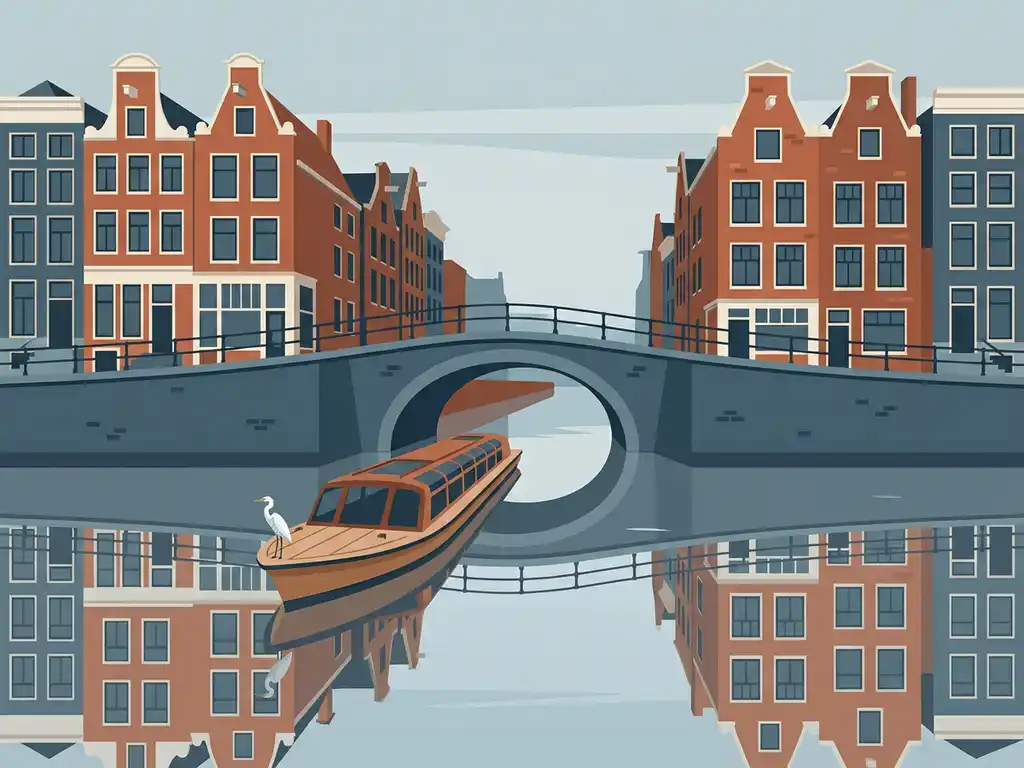
Which type of canal boat gives you the best Amsterdam experience?
For most visitors, a small open boat or electric canal boat gives the best Amsterdam experience. These smaller vessels get closer to the canal walls, fit under low bridges, and move at a pace that lets you actually look around. Large glass-topped tour boats are efficient, but they can feel like a moving waiting room — comfortable, but disconnected from the city around you.
The main categories worth knowing are:
- Large guided tour boats: Comfortable, informative, and efficient. Good for first-time visitors who want context. Less intimate, and the recorded commentary can feel generic.
- Small electric boats (rented yourself): The most freedom. You set the route, the pace, and the mood. No license required for boats under a certain size. Genuinely fun, and a local favourite.
- Private charter boats: More expensive, but worth it for groups or special occasions. A skipper handles navigation while you handle the wine.
- Kayaks and canoes: For the adventurous. Slow, physical, and surprisingly intimate — you see Amsterdam from water level in a way no motorboat allows.
If you want the best balance of ease and authenticity, renting a small electric boat with a few friends is hard to beat. It is one of those things to do in Amsterdam that genuinely delivers on its promise.
What’s the difference between a guided tour and a self-guided canal boat?
The key difference is control versus convenience. A guided canal tour gives you a fixed route, a skipper or recorded commentary, and zero logistical stress. A self-guided rental puts you in charge of where you go, how long you stay, and how much noise you make. Both are valid — they just suit different kinds of travellers.
Guided tours work well if you are new to Amsterdam and want someone to explain what you are looking at. The commentary on most reputable tours covers the Golden Age architecture, the history of the canal ring, and the stories behind specific bridges and houses. Some tours include drinks; some are entirely silent except for the audio guide in your ears.
Self-guided rentals require a little more effort — booking in advance, understanding basic right-of-way rules on the water, and navigating with a phone or paper map. But the payoff is real. You can pull up alongside a houseboat, linger under a bridge, or drift through a quieter neighbourhood canal that no tour boat bothers with. For anyone who has already done the standard tourist circuit, this is the more rewarding option.
Which canal route covers the most iconic Amsterdam sights?
The route through the UNESCO-listed canal ring — covering the Herengracht, Keizersgracht, and Prinsengracht — passes the highest concentration of iconic Amsterdam sights. Add the Amstel River, the Skinny Bridge, and a pass by the Anne Frank House, and you have covered the essential geography of historic Amsterdam in a single loop.
Most standard guided tours follow a version of this route, which takes roughly an hour. If you are renting your own boat, a practical starting point is the Jordaan or the area near Leidseplein, from where you can access all three main canals within minutes.
A few sights worth prioritising on any canal route:
- The Magere Brug (Skinny Bridge) on the Amstel — one of Amsterdam’s most photographed spots, and genuinely beautiful at any time of day
- The bend in the Herengracht known as the Golden Bend, lined with the grandest merchant houses in the city
- The Westerkerk tower, visible from the Prinsengracht and a useful landmark for orientation
- The smaller cross-canals connecting the main three — quieter, prettier, and often overlooked
When is the best time of day — and year — to take a canal ride?
The best time of day for a canal ride in Amsterdam is early morning or early evening. In the morning, the canals are calm, the light is soft, and the tourist crowds have not yet arrived. In the evening, the reflections on the water are extraordinary, and in summer the long Dutch twilight stretches the golden hour well past nine o’clock.
Midday in summer is the worst time — busy, loud, and hot. The canals become a traffic jam of tour boats, pedal boats, and rental kayaks. If you are visiting in July or August and want any sense of tranquillity on the water, an early start is not optional.
As for the best time of year, that depends on what you are after:
- Spring (April to May): The classic choice. Mild weather, longer days, and the tulip season running in parallel. Busy, but for good reason.
- Summer (June to August): Warm and lively, but the canals are at their most crowded. Go early or go late.
- Autumn (September to October): Underrated. The crowds thin, the light turns amber, and the canal-side trees are spectacular.
- Winter (November to February): Cold and quiet. If the canals freeze — which happens rarely — it becomes something else entirely. The Amsterdam Light Festival, typically running from late November into January, turns an evening canal ride into one of the most striking things to do in Amsterdam all year.
How much does a canal boat tour in Amsterdam cost?
A standard one-hour guided canal tour in Amsterdam costs roughly 15 to 25 euros per adult, depending on the operator and whether drinks are included. Renting a small electric boat for two to four hours typically runs between 70 and 120 euros for the whole boat, making it cost-competitive with guided tours once you split the price across a group.
Private charters are significantly more expensive, often starting at 200 to 300 euros for a two-hour trip, but they include a skipper and usually allow you to bring your own food and drink. Kayak rentals sit at the lower end of the price range, typically around 15 to 20 euros per hour per boat.
A few things that affect the price:
- Time of year — summer rates are higher across all categories
- Time of day — evening and sunset slots often carry a premium
- Whether food, drinks, or a live guide are included
- Advance booking versus walk-up — booking ahead is almost always cheaper and avoids disappointment in peak season
Are there canal rides worth taking that tourists mostly miss?
Yes. The eastern harbour area — the Oostelijke Eilanden, including Java Island, KNSM Island, and Borneo Island — offers a completely different canal experience from the historic centre. These former industrial docklands are now home to striking contemporary architecture, working houseboats, and almost no tour boats. It feels like a different city, and it is genuinely worth seeking out.
The Jordaan’s smaller side canals are another underrated option. The Bloemgracht and Egelantiersgracht in particular are quieter than the main ring canals, lined with some of the most beautiful 17th-century houses in Amsterdam, and rarely crowded even in peak summer.
Further out, the canals of Amsterdam Noord — accessible by crossing the IJ — offer a semi-rural, almost village-like experience that surprises most visitors. Combine a canal ride there with a visit to the neighbourhood’s creative spaces and you have a full afternoon that has nothing to do with the standard tourist trail.
The honest insider tip: the best canal rides in Amsterdam are often the ones where you stop treating the water as a sightseeing conveyor belt and start treating it as a place to actually be for a while.
How Klagen Niet Klagen helps you get more out of Amsterdam
Finding honest, experience-based advice about things to do in Amsterdam is harder than it should be. Most content is written for tourists who will visit once, not for people who want to understand what the city is actually like. Klagen Niet Klagen exists to fill that gap — with commentary written from over three decades of living, working, and building something real in Amsterdam.
- Long-form essays and opinion pieces on Amsterdam city life, written by someone with genuine skin in the game
- Honest takes on what is worth your time and what is overrated — no tourism board influence, no advertorial pressure
- Cultural context that helps you understand Amsterdam beyond the surface, whether you are visiting, living here, or just curious
- A consistent editorial voice you can actually trust
If you want more of this, the full blog archive is the place to start. Pull up a chair, or better yet, pull up a canal-side terrace.
And while you are planning your time on the water, consider spending an evening off it — at Boom Chicago, Amsterdam’s long-running English-language comedy theatre. Founded in 1993, Boom Chicago has been making Amsterdam audiences laugh for over thirty years, with sharp improvisation and sketch comedy that captures the city’s contradictions better than any canal tour commentary ever could. Check the current shows and agenda and make a night of it.
Frequently Asked Questions
Do I need any experience or a license to rent a self-drive electric canal boat in Amsterdam?
No license is required to rent a small electric canal boat in Amsterdam — most rental companies allow anyone to take the helm after a brief on-the-spot orientation from staff. That said, it helps to be comfortable with basic spatial awareness and to read up on Dutch waterway right-of-way rules before you set off, as the canals can get busy and larger vessels always have priority. Most reputable rental companies provide a simple briefing and a map, so even complete beginners manage just fine.
What's the biggest mistake first-time visitors make when booking a canal ride?
The most common mistake is leaving it until the day of the visit, especially in summer — popular rental companies and guided tours can be fully booked days in advance, and walk-up availability during peak season is unreliable. A close second is booking the midday slot out of convenience, which is exactly when the canals are at their most congested. Book early in the day or for the evening, and secure your spot at least a few days ahead to avoid disappointment.
Can I bring food and drinks on a canal boat in Amsterdam?
For self-rented electric boats and private charters, bringing your own food and drinks is not only allowed but actively encouraged — a canal picnic with cheese, bread, and a cold drink is a quintessentially Amsterdam experience. Guided tour boats vary by operator: some include drinks as part of the ticket price, others allow you to bring your own, and a few have onboard bars. Always check the specific policy when booking, particularly if you are planning around a special occasion.