
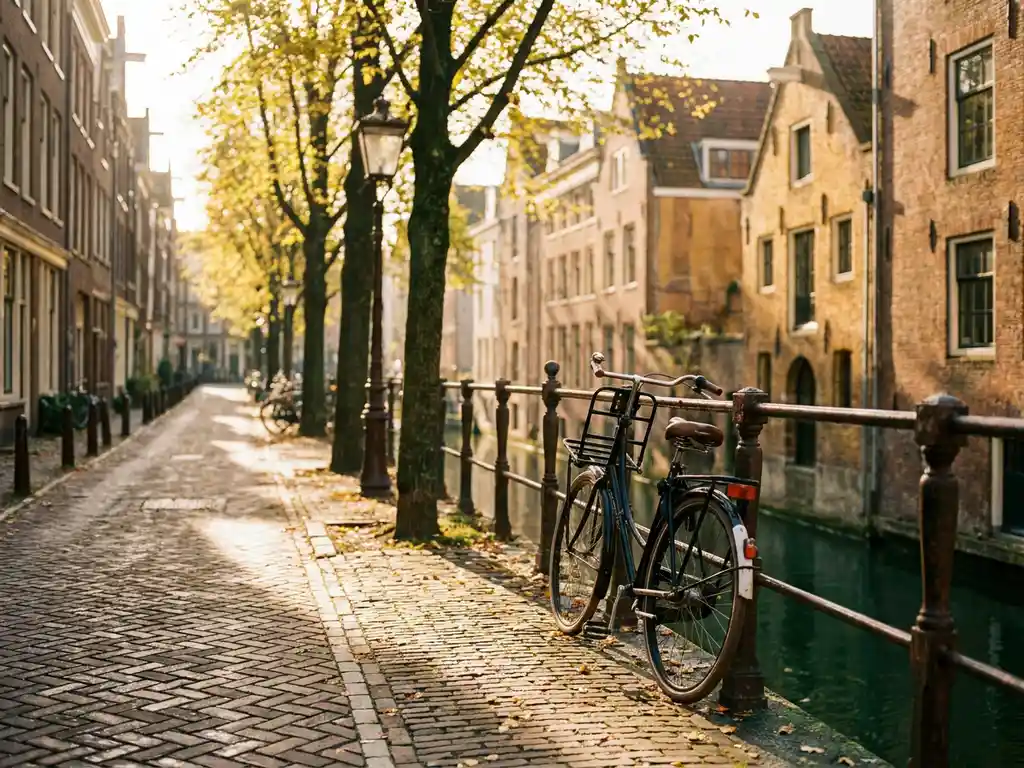
Which Amsterdam neighborhoods have the fewest tourists?
Amsterdam-Noord consistently has the fewest tourists of any central-adjacent neighborhood. De Pijp, Bos en Lommer, and the Indische Buurt also see dramatically lower visitor numbers than the canal ring. The further you get from the Centraal Station-to-Leidseplein corridor, the more the city opens up and starts to feel like a place where people actually live.
The tourist footprint in Amsterdam is surprisingly concentrated. Most visitors stick to a narrow band running from Centraal Station through the Negen Straatjes, past the Anne Frank House, and down to Museumplein. Step outside that corridor and the city changes completely. In Bos en Lommer, you can walk for twenty minutes without passing a single souvenir shop. In the Indische Buurt, a diverse and underrated neighborhood in Amsterdam-Oost, the streets are full of locals going about their day with zero interest in posing for Instagram photos in front of a canal.
Noord is the most dramatic shift. Cross the IJ by free ferry and you land in a neighborhood that feels like a different city entirely. That is partly its charm and partly its design: Noord developed independently from the old city center, and the tourist infrastructure simply never followed.
What makes a neighborhood genuinely pleasant to walk around in Amsterdam?
A genuinely walkable Amsterdam neighborhood has wide enough pavements to move comfortably, a mix of local shops and cafes rather than tourist-facing businesses, and streets where cyclists and pedestrians coexist without chaos. The presence of locals going about their daily lives is the single clearest indicator that a neighborhood is worth your time on foot.
Amsterdam’s best walking neighborhoods share a few common traits. First, they have variety at street level: a bakery next to a bookshop next to a brown cafe next to a hardware store. That mix signals a neighborhood serving residents, not visitors. Second, they have human-scale streets. Amsterdam’s canal ring streets are technically beautiful but often too narrow and too crowded to enjoy at a walking pace. Wider, calmer streets in Noord or De Pijp let you actually look around without being nudged into a bike lane.
Third, and this matters more than people admit, a good walking neighborhood has somewhere to sit down. Amsterdam’s terrace culture is one of its genuine pleasures, but in the tourist center you spend half your time competing for a table. In De Pijp or Oud-West, you can usually find a spot at a cafe within five minutes without a reservation or a twenty-minute wait.
Is the Jordaan still worth walking around, or is it too crowded?
The Jordaan is still worth walking around, but only if you go at the right time and know which streets to avoid. On a Saturday afternoon in summer, the main routes through the Jordaan are genuinely unpleasant. On a Tuesday morning in November, the same streets are among the most beautiful in the city. The neighborhood itself has not changed; crowd management around it has simply failed.
The Jordaan’s problem is that it became famous for being charming, which attracted crowds, which eroded the charm, which somehow did not reduce the crowds. The Negen Straatjes shopping streets that border the Jordaan are the worst offenders. They are now essentially an outdoor shopping mall with canal views.
The parts of the Jordaan worth seeking out are the quieter northern streets around the Lindengracht and the Westerpark edge, and the smaller cross-streets that don’t appear in travel guides. The Jordaan still has genuine neighborhood life tucked into it. You just have to be willing to leave the main route and accept that you might not find anything Instagram-worthy. That is, honestly, the point.
What are the best streets in Amsterdam-Noord for walking?
The best streets in Amsterdam-Noord for walking are the NDSM Wharf area along the waterfront, the Buiksloterweg strip near the ferry terminal, and the quieter residential streets around Nieuwendam and Schellingwoude. Each offers something different: post-industrial cool, local cafe culture, and genuine old Amsterdam village character respectively.
Noord rewards explorers. The NDSM Wharf is a former shipyard turned creative hub, and walking through it feels nothing like the rest of Amsterdam. The scale is enormous, the art is everywhere, and on weekends there are often markets and events that attract a genuinely local crowd rather than a tourist one.
Further east, Nieuwendam and Schellingwoude are two of Amsterdam’s best-kept secrets. These are actual old villages that were absorbed into the city, and they still look like it. Wooden houses, small bridges, and a pace of life that feels closer to rural North Holland than to a European capital. Most visitors to Amsterdam never make it here. That is their loss and your gain.
The ferry crossing itself is also worth noting. The free IJ ferries that run from behind Centraal Station to Noord are one of the best Amsterdam experiences that cost absolutely nothing. The five-minute crossing gives you a view of the city skyline that most visitors never see.
When is the best time of day to walk Amsterdam’s city centre freely?
The best time to walk Amsterdam’s city centre freely is between 7am and 9am on any day, or after 8pm in the evening. Early morning is by far the superior option: the light is extraordinary, the streets are clean, the canals are quiet, and you will have whole stretches of the historic center almost entirely to yourself.
This is not a minor difference. Amsterdam’s city center at 8am on a weekday feels like a completely different city from Amsterdam’s city center at noon on a Saturday. The same streets that are shoulder-to-shoulder chaos at midday are genuinely peaceful two hours after sunrise. The cafes are not yet open, which is either a drawback or a feature depending on your priorities.
Evening walking has different qualities. After 8pm, the day-trippers have largely left, the light turns golden and then blue, and the canal reflections become genuinely spectacular. The trade-off is that you are sharing the streets with people heading to bars and restaurants, which creates its own kind of energy. It is still far more pleasant than peak afternoon hours.
If you are visiting in summer and want to walk the canal ring without feeling like you are in a theme park queue, set your alarm. There is no other reliable solution.
Which Amsterdam neighborhood should you walk if you only have a few hours?
If you only have a few hours to walk in Amsterdam, go to De Pijp. It combines the canal-city aesthetic with genuine neighborhood life, has excellent cafes and food options at every price point, and is compact enough to explore thoroughly in two to three hours without feeling rushed. It is the best single neighborhood for getting a true sense of how Amsterdam actually lives.
De Pijp has a few things going for it that other neighborhoods do not. The Albert Cuyp Market, which runs along the main street, is one of the largest and most authentic street markets in the Netherlands. It is not a tourist market. It is a real market where locals buy vegetables, fish, fabric, and cheap household goods. Walking through it on a weekday morning is one of the more honest Amsterdam experiences available to visitors.
The neighborhood also has a density of good cafes and restaurants that rewards wandering. You do not need a reservation or a plan. You can simply walk until something looks good and sit down. That kind of spontaneity is increasingly hard to find in Amsterdam’s tourist center, where most decent places require booking days in advance.
For those with slightly more time, combining De Pijp with a ferry crossing to Noord makes for a near-perfect Amsterdam walking day. Two neighborhoods, completely different characters, both genuinely worth your time.
How Klagen Niet Klagen helps you find the real Amsterdam on foot
Finding the parts of Amsterdam that are actually worth your time requires the kind of local knowledge that no tourism website is going to give you. That is exactly what Klagen Niet Klagen is here for. Written by someone who has lived and worked in Amsterdam since 1993, the blog cuts through the polished tourism content and tells you what the city is actually like.
- Honest, opinionated neighborhood guides written from genuine long-term local experience
- No tourism board influence, no advertorial pressure, no sanitised “top 10 hidden gems” content
- English-language commentary on Amsterdam life that treats readers as intelligent adults
- Regular essays on the city’s contradictions, charms, and frustrations that no mainstream outlet covers
If you want more of this, the full blog archive has plenty more where this came from. Subscribe, bookmark it, or just come back when you need an honest answer about Amsterdam.
And while you are exploring the city on foot, consider spending an evening at Boom Chicago. After thirty years of performing, writing, and making Amsterdam audiences laugh, it remains one of the most genuinely entertaining nights out the city offers. The shows are in English, the comedy is sharp, and the crowd is always a good mix of locals and internationals who all end up laughing at the same things. Check the current shows and agenda and book a seat while you are planning your Amsterdam walking itinerary.
Frequently Asked Questions
How do I get to Amsterdam-Noord from the city centre, and is it easy to navigate on foot once I'm there?
Getting to Amsterdam-Noord is straightforward: take one of the free IJ ferries that depart from the docks directly behind Centraal Station. The crossing takes around five minutes and runs frequently throughout the day and night. Once you arrive, Noord is very easy to navigate on foot — the areas near the ferry terminal are flat, well-signed, and compact enough that you can explore the NDSM Wharf, Buiksloterweg, and surrounding streets without a detailed map or a plan.
What are the most common mistakes tourists make when trying to explore Amsterdam beyond the tourist centre?
The most common mistake is underestimating how quickly the character of Amsterdam changes once you leave the main corridor — people often turn back too soon, assuming the interesting parts are behind them. A second mistake is visiting off-the-beaten-path neighborhoods on weekends, when even quieter areas like De Pijp get noticeably busier. Go on a weekday, commit to walking at least fifteen minutes past the point where the souvenir shops stop, and you will find a completely different city.
Are there any practical tips for walking Amsterdam in winter, when the weather is less predictable?
Winter is actually one of the best times to walk Amsterdam, precisely because the tourist crowds thin out dramatically and the city takes on a quieter, more atmospheric quality. The practical essentials are waterproof footwear — Amsterdam’s pavements and cobblestones get slippery when wet — and layers rather than a single heavy coat, since you will be moving between outdoor streets and warm cafes regularly. The upside is that in winter you can walk the Jordaan on a Saturday morning and actually enjoy it, which is genuinely not possible in July.