
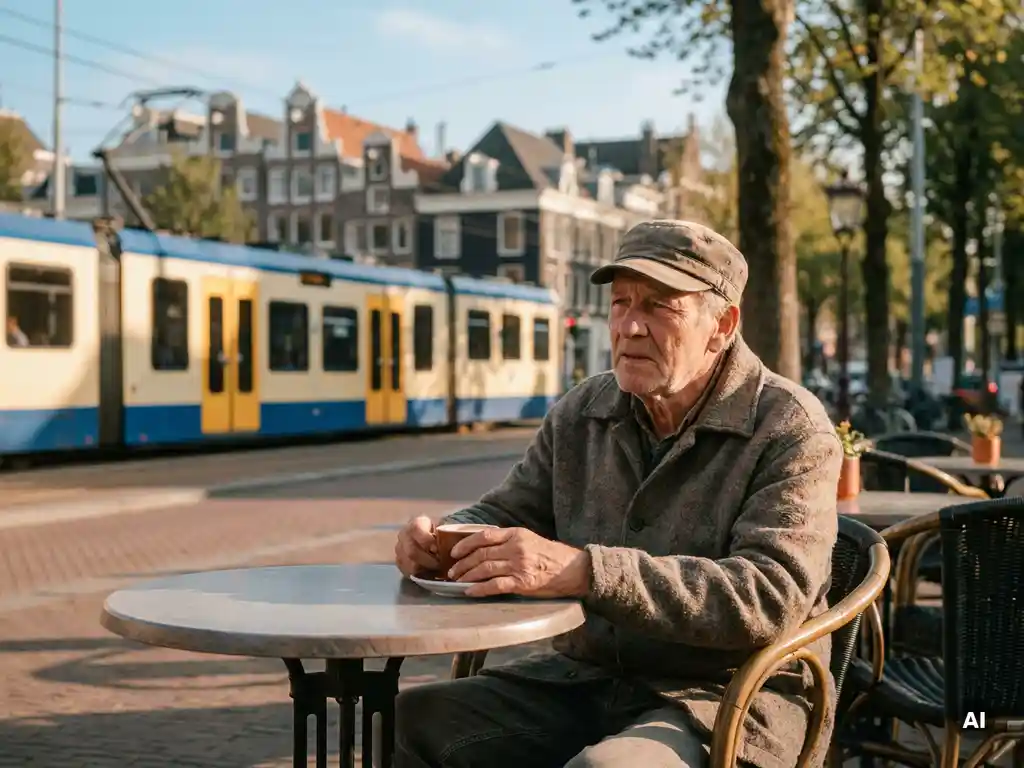
Most Amsterdam locals have a complicated relationship with Leidseplein. The honest answer is that the square has shifted significantly over the past decade or so, moving away from a lively local hub toward something that feels more like a tourist processing zone. That said, it has not lost all of its appeal for residents; it is more that the relationship has become selective and conditional.
Below, I unpack the specific ways Leidseplein has changed, why locals tend to sidestep it, and what would actually need to shift for it to feel like a neighbourhood square again.
Has Leidseplein changed for the worse in recent years?
Yes, most Amsterdam locals would say Leidseplein has changed for the worse, though the decline has been gradual rather than sudden. The square still has its physical bones, the trams, the terrace culture, the theatre facades, but the character has hollowed out. What was once a genuinely mixed square, where tourists and locals coexisted without one overwhelming the other, has tipped decisively toward mass tourism.
The shift is visible in the businesses that have survived and the ones that have not. Independent bars and venues that catered to a local crowd have been replaced by high-volume operations optimised for tourist turnover. Menus are shorter, prices are higher, and the atmosphere is louder in a way that feels transactional rather than convivial. The Leidseplein change Amsterdam locals notice most is not any single thing; it is the cumulative erosion of the feeling that the square belongs to the city rather than to its visitors.
It is also worth noting that this is not purely an Amsterdam problem. Many European city centres have experienced the same drift. But Leidseplein stings a little more precisely because it was once genuinely good, a place with real cultural weight, anchored by theatres, jazz clubs, and a tram intersection that made it feel like the city’s living room.
Why do Amsterdam locals tend to avoid Leidseplein now?
Amsterdam locals avoid Leidseplein primarily because the crowd dynamics have made casual enjoyment difficult. The square is frequently congested, particularly on weekends and during summer, and navigating it on foot or by bike requires patience that most residents would rather spend elsewhere. When you live in Amsterdam, you have plenty of other options, and almost all of them feel more like the city you actually inhabit.
There is also a cost factor. The terraces around Leidseplein are priced for visitors who are spending holiday money rather than residents managing a monthly budget. A round of drinks that might feel reasonable on a city break feels absurd when you live ten minutes away and know exactly what the same beer costs on a quieter street.
Beyond the practical, there is something more subtle at play. Many locals describe a feeling of being out of place, of being a guest in a space that no longer reads as theirs. That psychological distance is hard to quantify but very easy to feel, and it is one of the more damaging consequences of a square losing its local identity.
Are there still reasons locals visit Leidseplein?
Yes, locals do still visit Leidseplein, but usually with a specific purpose rather than for the pleasure of the square itself. The area’s cultural infrastructure remains genuinely valuable. The Stadsschouwburg (now ITA, the Internationaal Theater Amsterdam), the Melkweg, and Paradiso are all within easy walking distance, and these venues continue to draw a local audience for theatre, live music, and cultural events. For many residents, Leidseplein is a place you pass through on the way to something worthwhile rather than a destination in its own right.
There is also a weather-dependent version of local appreciation. On a warm spring evening, before the summer peak hits, the terraces can still be genuinely pleasant. The physical setting, the open square, the trams, the canal nearby, is objectively appealing, and when the crowd composition tilts even slightly back toward mixed, the square recovers some of its old energy. Locals have not given up on Leidseplein entirely; they have just learned to visit on their own terms.
What do locals think should change about Leidseplein?
Amsterdam locals generally want Leidseplein to reclaim a sense of civic identity, to feel like a square that serves the city rather than one that exists primarily to absorb tourist footfall. The specific changes people tend to advocate for cluster around a few consistent themes.
- Better business diversity: More independent operators and fewer chains optimised purely for volume. A mix that gives residents a reason to sit down rather than walk past.
- Crowd management: Smarter distribution of tourist pressure across the city, so that Leidseplein is not absorbing a disproportionate share of Amsterdam’s visitor traffic.
- Cultural anchoring: Stronger support for the theatres and music venues that give the square its legitimate reason to exist, rather than allowing them to be gradually surrounded by an ecosystem that has nothing to do with culture.
- A slower pace: Fewer venues competing to be the loudest, and more that reward people who want to stay for a second drink rather than be turned over for the next group.
None of this is radical. It is essentially a wish for Leidseplein to be allowed to be a neighbourhood square again, one that happens to welcome visitors rather than one that has been entirely reconfigured around them. Whether Amsterdam’s city government has the appetite for that kind of recalibration is a separate and genuinely open question.
How Klagen Niet Klagen sees Leidseplein
Leidseplein is exactly the kind of Amsterdam tension that Klagen Niet Klagen was built to write about honestly. Not to complain for the sake of it, and not to pretend everything is fine when it clearly is not, but to look at a place like this square and ask what it tells us about the city we actually live in.
- Long-form essays on Amsterdam neighbourhoods, squares, and the forces reshaping them
- Honest commentary written from inside the city’s creative and entrepreneurial scene
- A perspective shaped by over three decades of lived Amsterdam experience
- No tourism board influence, no advertorial pressure, just a genuine point of view
If you want more of this kind of writing, the blog archive is the place to start. And if you have thoughts on Leidseplein, or any other corner of Amsterdam that deserves a closer look, the contact page is always open.
One more thing: if you find yourself near Leidseplein and want to spend an evening that actually feels like Amsterdam, Boom Chicago is right there in the neighbourhood. It has been part of the square’s cultural fabric since 1993: live improvised comedy, sharp writing, and an audience that comes to laugh rather than to be processed. Check the shows and agenda and see what is on. It is the kind of night out that reminds you why Leidseplein still has something worth defending.
Frequently Asked Questions
Is Leidseplein worth visiting at all, or should tourists skip it entirely?
Leidseplein is still worth visiting, but with realistic expectations and a clear purpose. Rather than treating the square itself as the destination, use it as a gateway to its cultural venues — Paradiso, Melkweg, and ITA are all genuinely world-class. If you time your visit for a quieter weekday or an early spring evening, the physical setting alone can still deliver a convincing taste of Amsterdam’s terrace culture.
What are the best alternatives to Leidseplein if I want a more authentic Amsterdam experience?
Squares and streets like De Pijp’s Gerard Douplein, the Jordaan’s Lindengracht on market day, or the quieter canal-side terraces around Prinsengracht tend to offer the mixed local-visitor atmosphere that Leidseplein once had. These spots are rarely more than a 15-minute walk or tram ride away and feel significantly more like the city residents actually inhabit. For nightlife specifically, neighbourhoods like Oost and Noord have developed genuine local scenes that are well worth exploring.
Has the city of Amsterdam taken any official steps to address over-tourism in areas like Leidseplein?
Amsterdam’s city government has introduced several measures in recent years, including a ban on new tourist shops in the city centre, restrictions on short-stay rentals, and active campaigns to redirect visitor flows toward less-congested parts of the city. However, critics — including many locals — argue that these measures have been too cautious and too slow to meaningfully change the character of high-pressure squares like Leidseplein. The political will to prioritise residents over visitor revenue remains a contested and ongoing debate.