
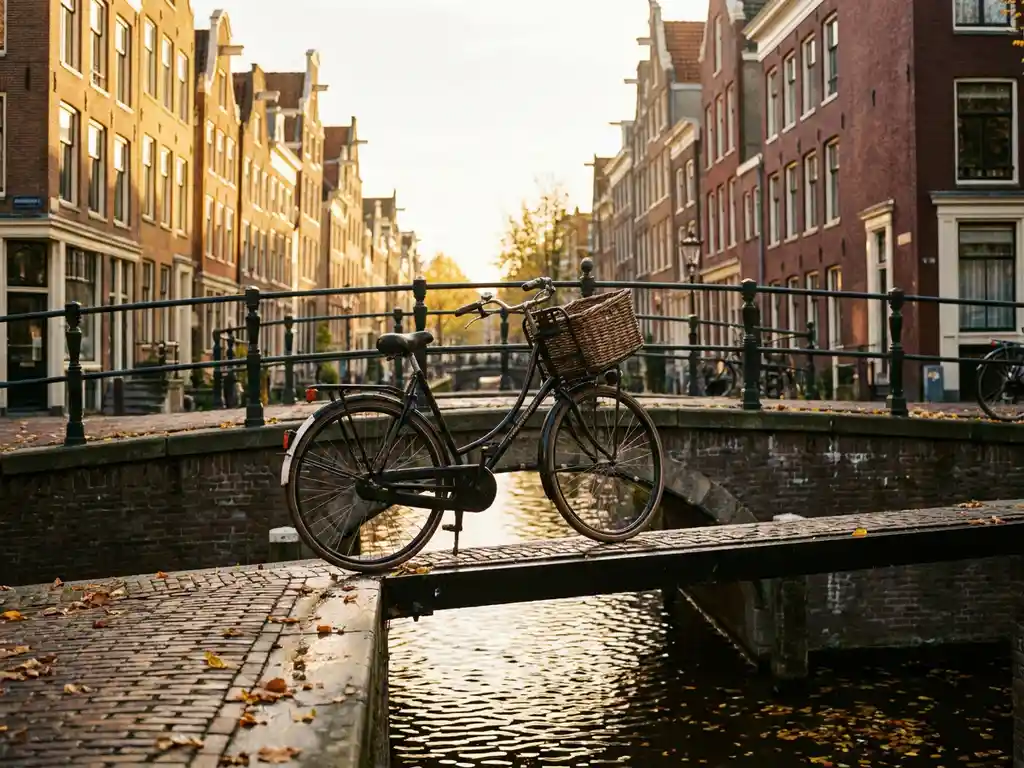
Which Amsterdam neighbourhoods are safest to cycle through as a beginner?
The Jordaan, the canal belt (Grachtengordel), and De Pijp are the safest and most rewarding neighbourhoods for beginner cyclists in Amsterdam. These areas have wide, well-marked cycle lanes, relatively low car traffic, and a pace of life that gives you time to look around without getting flattened by a delivery van.
The Jordaan in particular is forgiving because its narrower streets naturally slow everyone down. Cars are rare, trams are absent, and the locals cycling past you are mostly residents rather than commuters in a hurry. It is genuinely pleasant rather than merely survivable.
Avoid the main shopping streets like Leidsestraat, Kalverstraat, and the area immediately around Centraal Station when you are just starting out. These corridors are technically open to cyclists but are so densely packed with pedestrians, trams, delivery bikes, and confused tourists that even experienced riders treat them with caution. The canal belt streets running parallel to these busy axes, such as Keizersgracht and Prinsengracht, offer almost the same scenery with a fraction of the chaos.
What is the classic Amsterdam cycling route that locals actually use?
The classic local route follows the ring of the main canals: Prinsengracht, Keizersgracht, and Herengracht. Locals use these streets daily for commuting precisely because they are direct, scenic, and largely free of the tourist bottlenecks that clog the centre. A first-timer who sticks to Prinsengracht from north to south will see a genuinely lived-in Amsterdam rather than the theme-park version.
A practical loop that works well for beginners starts near the Westerkerk, heads south along Prinsengracht past the Leidseplein area, swings east through De Pijp, and then cuts back north through the Utrechtsestraat corridor toward Rembrandtplein. From there, a short westward ride through the quieter parts of the canal belt returns you to the starting point. The whole thing takes about an hour at a relaxed pace, and you will pass houseboats, brown cafes, local markets, and canal bridges that no guided tour will ever linger at long enough.
One insider tip: cycle the canals in the morning before 10am if you can. The light is extraordinary, the streets are quiet, and you will understand immediately why people who move to Amsterdam never quite manage to leave.
How do Amsterdam’s tram tracks actually cause bike accidents?
Amsterdam’s tram tracks cause bike accidents when a cyclist crosses them at too shallow an angle, allowing the front wheel to slip into the groove and get locked. The track groove is wide enough to swallow a standard bike tyre, and once the wheel drops in, the bike stops abruptly while the rider does not. This is one of the most common causes of falls in the city centre.
The fix is simple but requires conscious effort until it becomes instinct: always cross tram tracks at a 90-degree angle, or as close to perpendicular as the road layout allows. Crossing at a diagonal, especially when you are moving quickly or leaning slightly into a turn, is when the geometry works against you.
The most dangerous tram crossings for cyclists are on Leidsestraat, Raadhuisstraat, and the area around Centraal Station, where multiple tram lines converge and the tracks criss-cross in patterns that are genuinely confusing at speed. If you are on an unfamiliar route and suddenly see a web of metal lines ahead of you, slow down, pick your line, and cross each set of tracks deliberately rather than threading through them at pace. It feels overly cautious the first time. It feels completely reasonable the second time, after you have watched someone else go down.
Should you rent a bike or join a guided tour for your first Amsterdam ride?
Rent a bike independently if you are comfortable cycling in urban traffic and want genuine freedom. Join a guided tour if you have never cycled in a city before, are travelling with children, or want someone else to navigate while you absorb the scenery. Both options are valid, but they deliver fundamentally different experiences.
Renting independently gives you the authentic Amsterdam experience: you are just another person on a bike, moving at your own pace, stopping when something catches your eye, and figuring out the city on its own terms. The rental process is straightforward, most shops offer city maps with suggested routes, and the cost is modest. The main rental areas near Centraal Station are fine for convenience, though slightly overpriced compared to shops a few streets further into the city.
Guided cycling tours work best for people who want context delivered alongside the ride. A good guide will explain the canal system, point out architectural details you would otherwise cycle straight past, and handle all the navigation decisions so you can focus on looking around. The trade-off is that you move at the group’s pace, stop where the guide decides to stop, and spend more time listening than simply being in the city.
One honest note: if you are nervous about cycling in traffic, a single afternoon of guided riding will teach you the rhythms of Amsterdam cycling faster than any amount of reading. After that, you will feel confident enough to rent and explore on your own.
What are the unwritten rules of cycling in Amsterdam that nobody tells you?
The unwritten rules of cycling in Amsterdam come down to predictability, awareness, and not being the person who makes everyone else slow down. Locals do not necessarily cycle fast, but they cycle consistently, signal clearly, and expect the same from everyone around them. Unpredictability is the real danger, not speed.
Here are the rules that genuinely matter and that no rental shop leaflet will mention:
- Signal with your arm before every turn. This is not optional. Locals do it automatically, and failing to signal marks you immediately as someone who does not know what they are doing.
- Stay in the cycle lane. Do not drift into the pedestrian pavement, even briefly. Pedestrians and cyclists in Amsterdam have a tense relationship, and this is a major source of friction.
- Do not stop in the middle of the cycle lane. If you need to check your phone, consult a map, or wait for a friend, pull completely to the side first.
- Overtake on the left. This is the standard, and deviating from it causes confusion and near-misses.
- Ring your bell early and once. A single, well-timed ring is a polite heads-up. Repeated ringing is aggressive and will earn you a look that only Dutch people can fully deliver.
- Lock your bike properly, every time. Use the frame lock built into most rental bikes and add a second lock through the wheel and to a fixed object. Bike theft in Amsterdam is not a myth.
The broader unwritten rule is this: Amsterdam cycling culture rewards people who pay attention. Watch what the locals around you are doing, match their rhythm, and you will find the whole experience far more enjoyable than you expected.
How Klagen Niet Klagen helps you cycle Amsterdam like a local
A bike route map will tell you where to go. What it will not tell you is why the Jordaan feels different at 8am versus 2pm, what the tram track situation on Raadhuisstraat actually looks like from the saddle, or why locals quietly roll their eyes at certain tourist cycling routes. That kind of insight only comes from someone who has been cycling these streets for over thirty years.
- Honest, experience-based commentary on Amsterdam city life, written from inside the city rather than above it
- No tourism board influence, no sponsored content, no sanitised version of the city
- Long-form essays and opinion pieces that give you the cultural context behind what you are seeing
- Practical and cultural insight for expats, visitors, and anyone who wants to understand Amsterdam rather than just tick it off a list
If this kind of perspective interests you, the full blog archive has plenty more where this came from. And if you want to understand what makes Amsterdam genuinely tick, the Klagen Niet Klagen homepage is the place to start.
One more thing: if you are cycling through Amsterdam and want to end the day somewhere that captures exactly what makes this city worth living in, Boom Chicago has been doing that since 1993. Sharp comedy, genuine Amsterdam energy, and a room full of people who get the joke. Check the current shows and agenda and see what is on while you are here.
Frequently Asked Questions
What kind of bike should I rent for my first time cycling in Amsterdam?
For a first-timer, a standard Dutch city bike (omafiets) is the best choice — it sits you upright, gives you good visibility over traffic, and is exactly what locals ride. Avoid renting a racing bike or a bike with drop handlebars, as the riding position reduces your awareness of what is happening around you. Most rental shops near the centre carry city bikes by default, so you are unlikely to be offered anything unsuitable unless you specifically ask for it.
Is cycling in Amsterdam safe if I haven't cycled in a city before?
Yes, but it requires a short adjustment period. The biggest challenge is not the traffic itself but learning to read the flow — understanding when to yield, how to position yourself at junctions, and how to anticipate what other cyclists and trams are about to do. Starting on the quieter canal streets rather than the busy centre, and riding for 20 to 30 minutes before attempting anything more complex, will bring you up to speed faster than you expect.
What should I do if I get a flat tyre or my rental bike breaks down mid-ride?
Most rental shops provide a contact number for exactly this situation, so keep it saved on your phone before you set off. If you are stranded, Amsterdam’s fietsenstalling (bike parking and repair) spots are common throughout the city and staff are generally helpful even if you did not rent from them. In a pinch, the GVB public transport network covers most of the city, so you are never far from a tram or metro stop that can get you back to your starting point.